The Torah: The Heart of Judaism
The Torah is more than a book — it is the living constitution of Jewish life, studied and debated for over three millennia.
More Than a Book
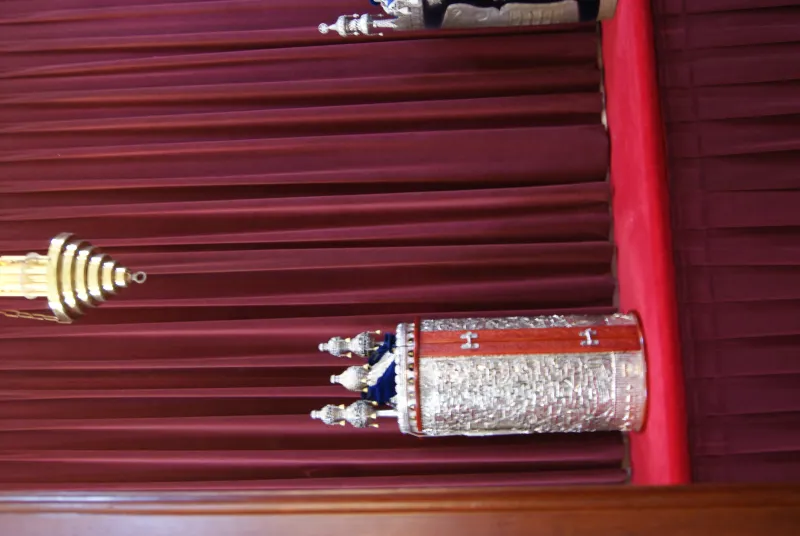
If you have ever watched a Torah scroll being carried through a synagogue, you have seen something that no description fully captures. The congregation rises. The scroll — heavy, ancient in form, dressed in velvet and crowned in silver — is lifted from the ark and cradled in someone’s arms. As it moves through the rows, people reach out instinctively, touching it with the fringes of their prayer shawls or the spines of their prayer books, then bringing their fingers to their lips. Children stretch on tiptoe. Elderly congregants lean forward from their seats. There is a tenderness in this gesture — a community reaching toward its most sacred object — that speaks louder than any theology.
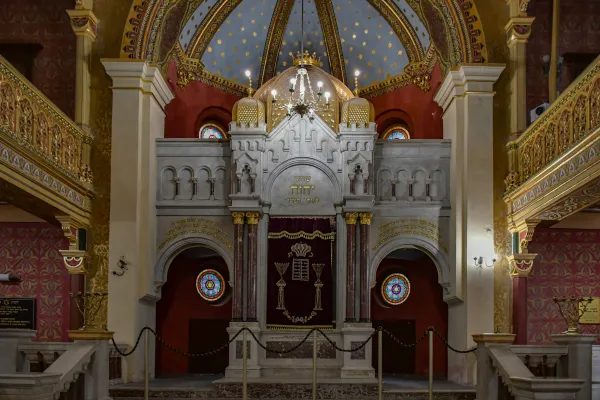
If you visit any synagogue in the world and look toward the front, you will see an ornate cabinet called the Aron Kodesh (Holy Ark). Inside rest one or more Torah scrolls — handwritten on parchment, mounted on wooden rollers, often adorned with silver crowns and embroidered coverings. When the Ark is opened and the Torah is carried through the congregation, people reach out to touch it with their prayer shawls or fingers, then kiss them.
This reverence tells you everything you need to know about the Torah’s place in Jewish life. It is not simply a holy text to be read. It is the foundational document of an entire civilization — a work that has been studied, debated, interpreted, and lived for more than three thousand years.
Quick Facts About the Torah
- Letters: Exactly 304,805 letters in every Torah scroll worldwide
- Words: 79,976 words in the Hebrew text
- Verses: 5,845 verses across all five books
- Commandments: 613 mitzvot (248 positive, 365 negative)
- Books: 5 books (Genesis, Exodus, Leviticus, Numbers, Deuteronomy)
- Weekly portions: 54 parashot read annually on Sabbath
- Creation time: 1 year of full-time work to handwrite a complete scroll
- Cost: $30,000-$100,000 for a new Torah scroll
- Age: Over 3,300 years since traditional composition at Mount Sinai
- Languages: Translated into 100+ languages, originally written in Hebrew
- Scribes: Must be specially trained (sofer) and follow 4,000 detailed rules
- Global reading: Same portion read simultaneously in Jewish communities worldwide each Sabbath
What Is the Torah?
The word Torah has several meanings depending on context:
The Narrow Definition: The Five Books of Moses
In its most specific sense, the Torah refers to the Chumash — the Five Books of Moses:
- Bereishit (Genesis): Creation, the patriarchs and matriarchs, the story of Joseph.
- Shemot (Exodus): Slavery in Egypt, the Exodus, the revelation at Sinai, the Tabernacle.
- Vayikra (Leviticus): Sacrificial laws, purity, holiness, and ethics.
- Bamidbar (Numbers): The wilderness journey, censuses, rebellions, and laws.
- Devarim (Deuteronomy): Moses’ farewell speeches, a review of the law, and his death.
Together, these five books contain 613 commandments (mitzvot) that traditional Judaism considers binding.
The Broader Definition
In a wider sense, “Torah” can refer to the entire body of Jewish teaching:
- Tanakh: The complete Hebrew Bible, which includes the Torah, the Prophets (Nevi’im), and the Writings (Ketuvim). Christians know a version of this as the “Old Testament.”
- Oral Torah: The vast body of interpretation and law passed down orally and eventually written in the Mishnah (around 200 CE) and the Talmud (completed around 500 CE).
- All of Jewish learning: In the broadest sense, “Torah” encompasses everything Jews have taught and studied — from ancient midrash to medieval philosophy to modern commentary.
The Torah Scroll
A Sefer Torah (Torah scroll) is one of the most sacred objects in Judaism. It is handwritten by a specially trained scribe (sofer) on parchment made from the skin of a kosher animal. The process of writing a Torah scroll:
- Takes approximately one year of full-time work
- Contains 304,805 letters, every one of which must be perfectly formed
- Is written with a quill pen and special ink
- Must follow exacting rules — a single error can render the entire scroll unfit for use
- Contains no vowels or punctuation marks
A completed Torah scroll can cost $30,000-$100,000 or more. Communities often celebrate the completion of a new scroll with a joyous procession called a Hachnasat Sefer Torah, with singing and dancing in the streets.
If a Torah scroll is damaged beyond repair, it is not thrown away. It is buried in a cemetery with the same respect given to a human being — a practice that reflects the Torah’s almost living status in Jewish tradition.
How the Torah Is Read
The Weekly Cycle
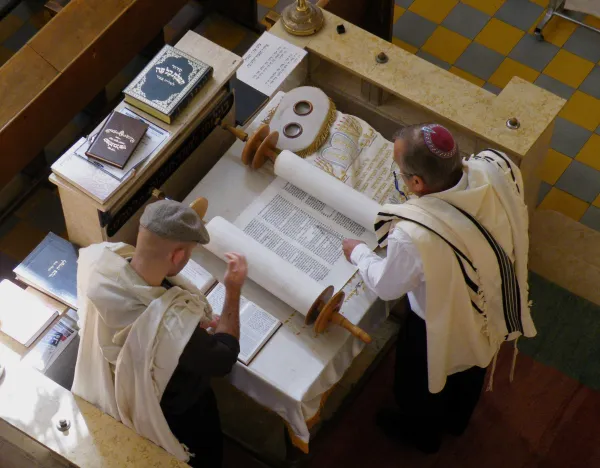
The Torah is divided into 54 portions (parashot), one for each week of the year. Each Shabbat morning, the week’s portion is chanted aloud from the scroll in the synagogue. The reader uses a silver pointer called a yad (literally “hand”) to follow the text, since touching the parchment directly is forbidden.
The reading follows a specific cantillation system (trope), a set of musical notations that guide the melody. The melodies differ among communities — Ashkenazi trope sounds quite different from Sephardi, Yemenite, or Iraqi melodies — but the text is identical everywhere.
On the holiday of Simchat Torah (“Rejoicing of the Torah”), the annual reading cycle ends and immediately begins again. Congregations celebrate by dancing with Torah scrolls in joyful processions called hakafot.
Torah Study
Reading the Torah aloud is only the beginning. The deeper Jewish practice is Torah study — the careful, critical, creative engagement with the text and its centuries of commentary.
A page of traditional Torah study might include:
- The biblical text itself
- Rashi (1040-1105), the most influential medieval commentator, whose clear explanations remain essential
- Ramban (Nachmanides, 1194-1270), who often offers mystical and philosophical interpretations
- Ibn Ezra (1089-1167), known for his grammatical and rational approach
- Dozens of other commentators spanning centuries and continents
The tradition encourages argument and disagreement. The Talmud famously preserves minority opinions alongside majority rulings, and the phrase “these and these are the words of the living God” expresses the belief that multiple valid interpretations can coexist.
Torah and Law
The Torah contains laws covering virtually every aspect of life:
- Ritual law: Shabbat, holidays, prayer, dietary rules (kashrut), purity.
- Civil law: Property, contracts, damages, courts, witnesses.
- Criminal law: Murder, theft, assault, punishment.
- Ethical law: Treatment of strangers, care for the poor, honesty in business.
- Agricultural law: Tithes, sabbatical years, gleaning for the needy.
Traditional Judaism understands these laws as divinely given and therefore eternal, though their application is constantly refined through rabbinic interpretation. Reform and Conservative Judaism approach the Torah’s laws with varying degrees of flexibility, seeing them as evolving expressions of Jewish values.
Multiple Jewish Perspectives on Torah
Different Jewish communities and movements understand the Torah in different ways:
- Orthodox Judaism maintains that the Torah was given by God to Moses at Sinai, word for word. The text is unchangeable, though its interpretation continues.
- Conservative Judaism generally accepts the divine origin of the Torah but allows for the role of human authorship and the evolution of Jewish law over time.
- Reform Judaism views the Torah as divinely inspired but humanly authored, emphasizing its ethical teachings while treating ritual law as optional.
- Sephardi and Mizrahi traditions tend to be more unified in their approach to Torah law, with a strong emphasis on custom (minhag) and the rulings of their own great scholars, like Rabbi Yosef Karo (author of the Shulchan Aruch).
- Ethiopian Jews (Beta Israel) historically based their practice on the written Torah and their own traditional texts, without the Talmudic tradition that shaped other communities.
Why the Torah Matters
The Torah has shaped not only Judaism but world civilization. Its ideas — monotheism, the weekly day of rest, the rule of law, the dignity of every human being created in God’s image, the obligation to care for the vulnerable — have rippled outward through Christianity, Islam, and secular Western thought.
There is something remarkable about watching a room full of people argue passionately about a text that is thousands of years old — not as an academic exercise, but because they believe it has something urgent to say about how to live right now. In a yeshiva study hall, two students lean over a page of Talmud, voices rising as they debate a fine point of law. In a Reform synagogue, a book group wrestles with the moral complexity of a patriarch’s choices. In a living room in Buenos Aires, a group gathers weekly to read the parashah in Spanish and Hebrew. The Torah is read in the same order, on the same schedule, in synagogues from Melbourne to Montreal — and yet every community finds something new in it each time.
For Jews, the Torah is not a relic of the past. It is a living text, studied and debated anew each week. The great medieval sage Maimonides taught that Torah study is the highest of all commandments, because it leads to all the others. And the tradition holds that the Torah is like water — essential, life-giving, and available to anyone willing to drink from its well.
Frequently Asked Questions
What is the Torah?
The Torah is the central sacred text of Judaism, consisting of the five books of Moses (Genesis, Exodus, Leviticus, Numbers, Deuteronomy). It contains the foundational narratives, laws, and ethics of Jewish life.
How many commandments are in the Torah?
The Torah contains 613 commandments (mitzvot) — 248 positive ('do') and 365 negative ('do not'). They cover all aspects of Jewish life from prayer and diet to justice and ethics.
Is the Torah the same as the Bible?
The Torah is the first five books of the Hebrew Bible (Tanakh). Christians call it the Pentateuch or Old Testament's first five books. The full Hebrew Bible also includes Prophets (Nevi'im) and Writings (Ketuvim).
Sources & Further Reading
Related Articles
The 613 Commandments: The Framework of Jewish Life
Judaism identifies 613 commandments in the Torah — 248 positive and 365 negative — covering everything from prayer and charity to agriculture and justice.
Bar and Bat Mitzvah: Coming of Age
At age 12 or 13, a Jewish child becomes responsible for the commandments — a milestone celebrated with joy and meaning.
Converting to Judaism: A Thoughtful Guide to Joining the Jewish People
Converting to Judaism is a serious, transformative journey involving study, mentorship, and ritual — welcomed by tradition yet approached with care across all denominations.
The Covenant: The Bond Between God and Israel
The covenant — brit in Hebrew — is the foundational relationship between God and the Jewish people. From Abraham's circumcision to the revelation at Sinai, explore what it means to live in covenant with the divine.
The Dead Sea Scrolls: Ancient Texts That Changed History
The story of the Dead Sea Scrolls — from their accidental discovery by a Bedouin shepherd in 1947 to what they reveal about ancient Judaism, biblical texts, and a mysterious sect at Qumran.
Orthodox, Conservative, and Reform: Understanding Jewish Denominations
Judaism is not monolithic — it encompasses diverse movements from Ultra-Orthodox to Reform, each with its own approach to tradition, law, and modern life.
The Exodus from Egypt: Slavery, Liberation, and the Birth of a Nation
The story of the Israelite exodus from Egypt — slavery under Pharaoh, Moses's call, the ten plagues, the parting of the Red Sea, forty years in the desert, and the revelation at Sinai.
Halakha: The Jewish Path of Law
Halakha — literally 'the way of walking' — is the comprehensive system of Jewish law that governs everything from prayer and diet to business ethics and family life.
Kabbalah: An Introduction to Jewish Mysticism
Beyond the law and the stories lies a hidden dimension of Judaism — Kabbalah, the mystical tradition that seeks to understand the nature of God, creation, and the human soul.
Maimonides' 13 Principles of Faith: Judaism's Closest Thing to a Creed
In the 12th century, Maimonides distilled Jewish belief into 13 principles — from God's existence and unity to the coming of the Messiah and resurrection. They became iconic, controversial, and the basis for two beloved prayers.
The Messiah in Judaism: Anointed King, Not Divine Savior
The Jewish Messiah is a human king from the line of David who will bring peace, rebuild the Temple, and gather the exiles — not a divine being who saves souls. The concept has inspired hope, spawned false claimants, and evolved across denominations.
Midrash: The Stories Behind the Torah
Why did Abraham smash his father's idols? Why did Moses stutter? The Torah does not say — but the Midrash does. Explore Judaism's ancient tradition of creative biblical interpretation.
Jewish Prayer: Connecting with the Divine
From the three daily prayer services to personal meditation, discover how Jewish prayer works and what it means.
Shavuot: The Festival of Weeks
Seven weeks after Passover, the Jewish world celebrates the giving of the Torah at Mount Sinai — with all-night study, dairy feasts, and the reading of the Book of Ruth.
The Shema: Judaism's Most Essential Prayer
Six Hebrew words — 'Hear, O Israel, the Lord our God, the Lord is One' — form the bedrock of Jewish faith, recited morning and evening, in joy and on the deathbed.
The Talmud: A Beginner's Guide to Jewish Oral Law
The Talmud is the vast ocean of Jewish thought — centuries of rabbinic debate on law, ethics, storytelling, and the meaning of life, all compiled into one extraordinary work.
The Tanakh: A Complete Guide to the Hebrew Bible
The Tanakh — Torah, Nevi'im, and Ketuvim — is the foundational scripture of Judaism, containing 24 books of law, prophecy, and wisdom. Learn how it was formed and how it differs from the Christian Old Testament.
The Ten Commandments: Foundation of Moral Law
Given at Mount Sinai and inscribed on two stone tablets, the Ten Commandments form the moral bedrock of Judaism — and have shaped ethical thinking across civilizations.
Torah Portions: The Weekly Reading Cycle
Every week, Jewish communities worldwide read the same Torah portion. Explore the 54 parashot, the system of aliyot, the Haftarah connection, and the joyous restart on Simchat Torah.
What Do Jews Believe? Core Beliefs, Values, and the Spirit of Debate
Jewish belief centers on one God, Torah, ethical action, and humanity's role in repairing the world — but within that framework, debate and diversity of opinion are not just tolerated but sacred.
What Is Judaism? A Living Introduction to the World's Oldest Monotheistic Faith
Judaism is the world's oldest monotheistic religion, built on covenant, Torah, ethical living, and an unbroken chain of tradition stretching back four thousand years.