The Talmud: A Beginner's Guide to Jewish Oral Law
The Talmud is the vast ocean of Jewish thought — centuries of rabbinic debate on law, ethics, storytelling, and the meaning of life, all compiled into one extraordinary work.
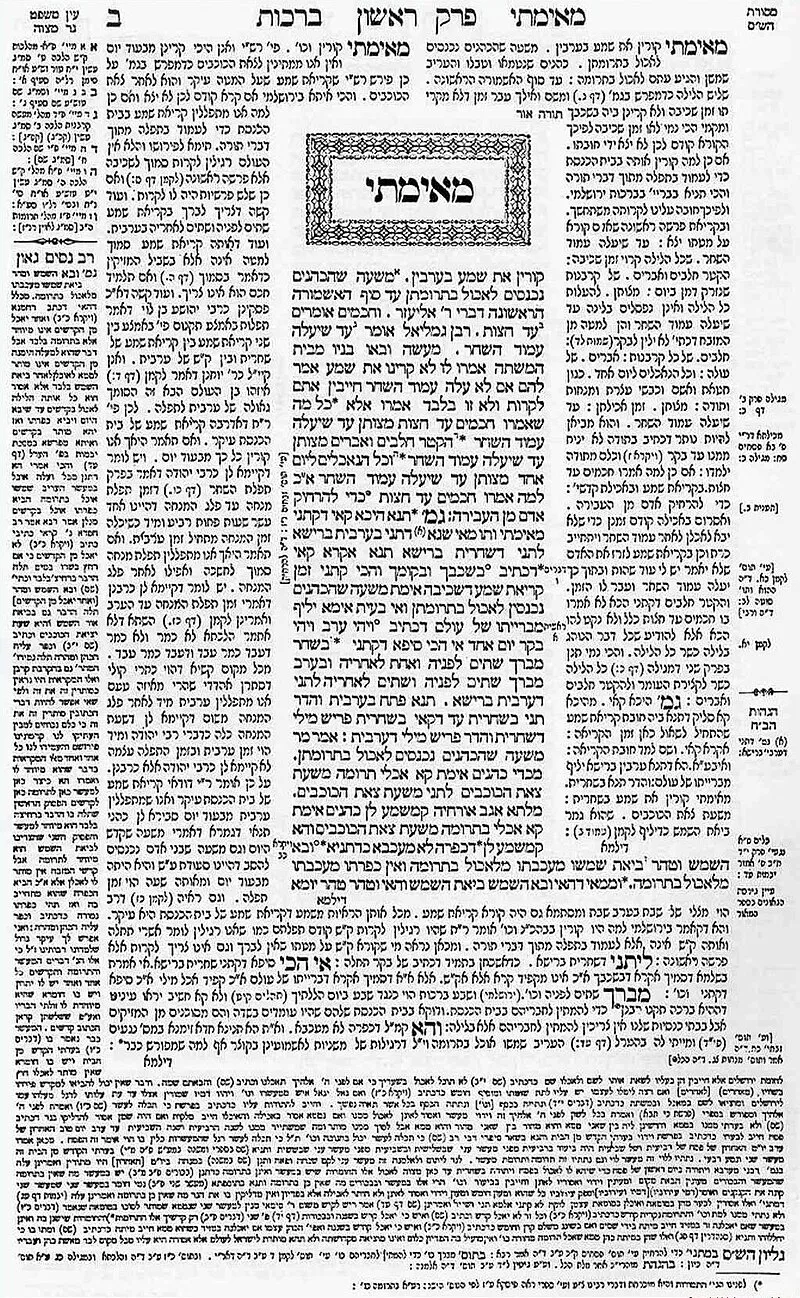
A Page Like No Other
Open a volume of the Talmud and you will encounter something you have never seen in any other book. In the center of the page sits a block of ancient text — the Mishnah, followed by the Gemara. Surrounding it on both sides, in smaller type, are the commentaries of Rashi (11th century) and his grandsons, the Tosafists (12th-13th centuries). Further out along the margins are cross-references, later commentaries, and textual notes. The page is a conversation frozen in time — or rather, a conversation that refuses to end. Voices from different centuries, different countries, and different schools of thought crowd together on a single leaf, arguing, clarifying, questioning, and building upon one another. There is nothing else quite like it in world literature.
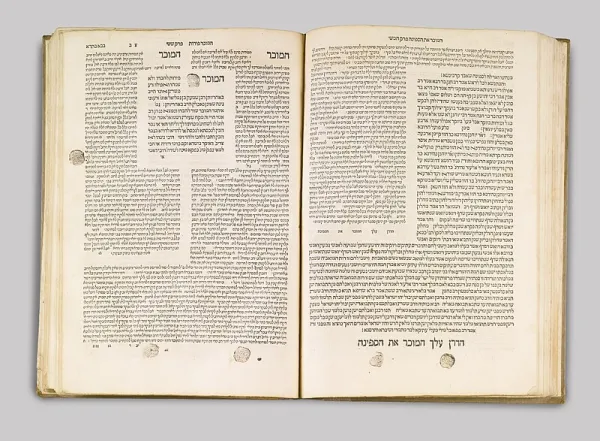
This distinctive layout, established by the printer Daniel Bomberg in Venice in the early 1520s, has remained essentially unchanged for five hundred years. Every printed edition of the Babylonian Talmud uses the same pagination — so when a scholar in Jerusalem references “Berakhot 2a,” a student in Brooklyn or Buenos Aires can open to exactly the same page.
What Is the Talmud?
To understand the Talmud, you need to understand how Jewish law works. Traditional Judaism recognizes two forms of Torah — the Written Torah (the Five Books of Moses) and the Oral Torah (the explanations and interpretations that accompanied it).
The Written Torah is often terse. It says, for example, to “bind them as a sign upon your hand” — but what, exactly, should be bound? What kind of sign? On which part of the hand? The Oral Torah fills in these details. For generations, these explanations were passed down by word of mouth from teacher to student.
The Mishnah is the first major written compilation of the Oral Law. Around 200 CE, Rabbi Judah HaNasi (Judah the Prince) organized centuries of oral tradition into a concise, systematic code. The Mishnah is written in clear, elegant Hebrew and covers nearly every aspect of Jewish life — from agricultural tithes to Shabbat observance to civil damages.
The Gemara is the vast rabbinic discussion that developed around the Mishnah over the next several centuries. If the Mishnah states a law, the Gemara asks: Where does this come from? What are its limits? What if two principles conflict? The Gemara records real debates among real scholars — complete with disagreements, tangents, stories, parables, medical advice, and even humor. Together, the Mishnah and the Gemara form the Talmud.
The Structure
The Mishnah is organized into six major divisions called Sedarim (orders), which are further divided into 63 tractates (masekhtot):
- Zeraim (Seeds): Agricultural laws, blessings, and prayer.
- Moed (Appointed Times): Shabbat, holidays, fasts, and the calendar.
- Nashim (Women): Marriage, divorce, vows, and family law.
- Nezikin (Damages): Civil and criminal law, courts, ethics (including Pirkei Avot, the Ethics of the Fathers).
- Kodashim (Holy Things): Temple sacrifices, ritual slaughter, and sacred items.
- Tohorot (Purities): Ritual purity and impurity.
Each tractate addresses a specific topic, though the Gemara’s discussions frequently wander far afield — a discussion about Shabbat candles might detour into astronomy, a debate about property law might pause for a parable about humility. These apparent digressions are part of the Talmud’s genius. Everything connects.
Two Talmuds: Babylonian and Jerusalem
There are actually two Talmuds. After the destruction of the Second Temple in 70 CE, major centers of Jewish scholarship developed in two places: the Land of Israel and Babylonia (modern-day Iraq).
The Jerusalem Talmud (Talmud Yerushalmi) was compiled around 350-400 CE by scholars in the academies of Tiberias, Caesarea, and Sepphoris. It is shorter, often more cryptic, and less polished — likely because its compilation was disrupted by Roman persecution.
The Babylonian Talmud (Talmud Bavli), completed around 500-600 CE, is roughly three times the length of the Jerusalem Talmud and far more thoroughly edited. The great academies of Sura and Pumbedita in Babylonia had centuries of relative stability in which to develop their discussions. When Jews speak of “the Talmud” without qualification, they almost always mean the Babylonian Talmud. It is the version studied in yeshivot worldwide and the basis for most Jewish legal rulings.
How the Talmud Argues
One of the most striking features of the Talmud is its embrace of disagreement. The Hebrew word machloket (dispute) is not a dirty word in Jewish scholarship — it is the engine of understanding. The Mishnah records the famous teaching: “A dispute for the sake of heaven will endure; one that is not for the sake of heaven will not endure. What is a dispute for the sake of heaven? The disputes of Hillel and Shammai.”
The Talmud regularly preserves minority opinions alongside majority rulings. Even when the law follows one rabbi, the losing opinion is recorded — because the reasoning matters, not just the conclusion. The tradition holds that “both these and these are the words of the living God,” a remarkable statement that multiple, contradictory interpretations can each contain truth.
This method — thesis, challenge, counter-argument, resolution, and sometimes deliberate irresolution — has shaped Jewish intellectual culture for millennia. It trains the mind to hold complexity, to argue honestly, and to respect the person across the table even when you think they are wrong.
Famous Talmudic Figures
The Talmud is populated by hundreds of named rabbis spanning several centuries. A few of the most important:
- Hillel and Shammai (1st century BCE): Two great sages whose schools debated nearly every area of Jewish law. Hillel is remembered for his patience and leniency; Shammai for his strictness and precision. The law usually follows Hillel.
- Rabbi Akiva (c. 50-135 CE): Perhaps the most beloved figure in the Talmud — a shepherd who began studying Torah at age 40 and became the greatest scholar of his generation. He was martyred by the Romans during the Bar Kokhba revolt, dying with the Shema on his lips.
- Rav and Shmuel (3rd century CE): The two towering figures of early Babylonian scholarship. Rav founded the academy at Sura; Shmuel led Nehardea. Their debates fill hundreds of pages.
- Rava and Abaye (4th century CE): Their intricate legal debates are considered the pinnacle of Talmudic reasoning. The law follows Rava in all but six cases.
Daf Yomi: A Page a Day
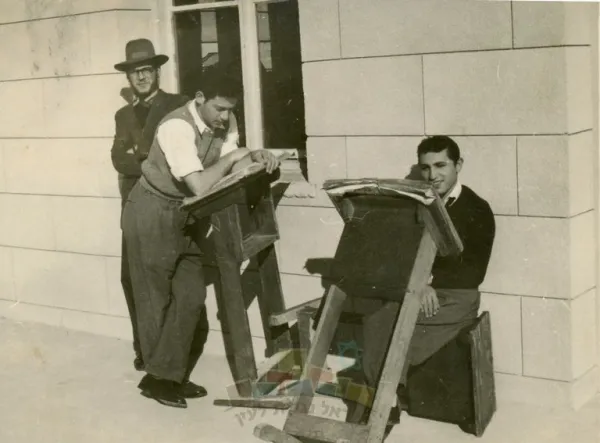
In 1923, Rabbi Meir Shapiro of Lublin proposed a revolutionary idea: what if every Jew in the world studied the same page of Talmud on the same day? He called it Daf Yomi — “a daily page.” At one double-sided page per day, the entire Babylonian Talmud takes approximately 7 years and 5 months to complete. The first cycle began on Rosh Hashanah 1923.
Today, Daf Yomi has grown into a global movement. Hundreds of thousands of Jews — on trains, in offices, in synagogues, and through podcasts and apps — study the same page each day. The completion of a cycle, called a Siyum HaShas, is celebrated with massive gatherings. The most recent Siyum in January 2020 filled MetLife Stadium in New Jersey with over 90,000 participants.
Daf Yomi has democratized Talmud study, making it accessible to people who might never have entered a traditional yeshiva. It has also created a shared vocabulary — on any given day, a Daf Yomi student in Melbourne can discuss the same passage with a fellow learner in Montreal.
Talmud Study Across Communities
Talmud study looks different depending on where and how you encounter it.
In Orthodox yeshivot, Talmud study is the central intellectual pursuit. Students spend hours each day studying in pairs — a method called chavruta (partnership) — reading the text aloud, debating its meaning, and testing each other’s reasoning. The great Lithuanian yeshiva tradition emphasizes analytical precision; Hasidic approaches often seek the spiritual dimension within the legal text.
Conservative Judaism has long embraced Talmud study as essential. The Jewish Theological Seminary trains its rabbis in rigorous Talmudic scholarship, and Conservative communities increasingly offer Talmud classes for laypeople. The Conservative movement’s legal body, the Committee on Jewish Law and Standards, explicitly engages with Talmudic sources in its rulings.
Reform Judaism traditionally placed less emphasis on Talmud, focusing instead on the prophetic tradition and ethical teachings. In recent decades, however, there has been a significant revival of Talmud study in Reform settings, with rabbis and educators recognizing its intellectual richness and relevance.
One of the most significant developments in modern Talmud study is the growing participation of women. Historically excluded from formal Talmud education in most communities, women now study Talmud at institutions like Drisha, the Matan Women’s Institute, and Yeshivat Maharat. In 2005, the completion of the first women’s [Daf Yomi cycle drew international attention. Programs like Hadran, founded by Rabbanit Michelle Cohen Farber, provide daily Talmud podcasts that have attracted a large female audience.
The Talmud is not an easy text. It demands patience, discipline, and a willingness to sit with confusion. But those who enter its world — whether through a daily page, a weekly class, or years of full-time study — often describe the experience in remarkably similar terms: it changes the way you think. It teaches you to question assumptions, to see multiple sides of every argument, and to find meaning in the details. As the tradition says: “Turn it over and turn it over, for everything is in it.”
Frequently Asked Questions
What is the difference between the Mishnah and the Talmud?
The Mishnah is the earlier work — a concise compilation of Jewish oral law organized by Rabbi Judah HaNasi around 200 CE. The Talmud includes the Mishnah plus the Gemara, centuries of rabbinic discussion and commentary on the Mishnah. There are two Talmuds: the Babylonian (more widely studied) and the Jerusalem Talmud.
How long would it take to read the entire Talmud?
The Babylonian Talmud contains 2,711 double-sided pages (daf). The Daf Yomi program, which reads one page per day, takes approximately 7.5 years to complete. Thousands of Jews worldwide follow this cycle, which was established in 1923.
Is the Talmud the same as the Torah?
No. The Torah is the Written Law — the five books of Moses. The Talmud is the Oral Law — rabbinic discussions interpreting and expanding the Torah's laws. Jews believe both were given at Sinai: the Torah in written form and the Oral Law as explanation passed down through generations.
Sources & Further Reading
Related Articles
The 613 Commandments: The Framework of Jewish Life
Judaism identifies 613 commandments in the Torah — 248 positive and 365 negative — covering everything from prayer and charity to agriculture and justice.
Jewish Views on the Afterlife: Olam Ha-Ba, Gan Eden, and the World to Come
Judaism has rich teachings about what happens after death — the World to Come, the Garden of Eden, purification in Gehinnom, and the resurrection of the dead — but it has always emphasized living well in this world over speculation about the next.
Orthodox, Conservative, and Reform: Understanding Jewish Denominations
Judaism is not monolithic — it encompasses diverse movements from Ultra-Orthodox to Reform, each with its own approach to tradition, law, and modern life.
Halakha: The Jewish Path of Law
Halakha — literally 'the way of walking' — is the comprehensive system of Jewish law that governs everything from prayer and diet to business ethics and family life.
Jewish Ethics: A Guide to Moral Living
From Hillel's golden rule to the Mussar movement, Jewish ethics offers a comprehensive framework for moral living — covering speech, the environment, labor rights, medical decisions, and the obligation to repair the world.
Midrash: The Stories Behind the Torah
Why did Abraham smash his father's idols? Why did Moses stutter? The Torah does not say — but the Midrash does. Explore Judaism's ancient tradition of creative biblical interpretation.
The Mishnah: How the Oral Law Was Written Down
Around 200 CE, Rabbi Judah HaNasi did something revolutionary: he wrote down the Oral Torah. The result — the Mishnah — became the foundation of the Talmud and all subsequent Jewish law.
Jewish Prayer: Connecting with the Divine
From the three daily prayer services to personal meditation, discover how Jewish prayer works and what it means.
The Torah: The Heart of Judaism
The Torah is more than a book — it is the living constitution of Jewish life, studied and debated for over three millennia.