The Exodus from Egypt: Slavery, Liberation, and the Birth of a Nation
The story of the Israelite exodus from Egypt — slavery under Pharaoh, Moses's call, the ten plagues, the parting of the Red Sea, forty years in the desert, and the revelation at Sinai.
The Story That Made a People
Every spring, Jewish families around the world sit down at a table set with strange foods — bitter herbs, unleavened bread, a roasted bone — and tell a story. Not just any story. The story. The one about how their ancestors were slaves in Egypt, and how they were set free. It is the oldest continuously observed ritual in Western civilization, and after thousands of years, the narrative still has the power to shake people awake.
The Exodus from Egypt is not simply a tale about the past. It is the founding myth of the Jewish people — the moment when a collection of enslaved families became a nation with a purpose. Whether you read it as literal history, as theological metaphor, or as something in between, its influence is immeasurable. The Exodus shaped Jewish identity, inspired liberation movements from the American civil rights struggle to anti-apartheid South Africa, and gave the world a radical idea: that freedom is not a privilege of the powerful but a divine right of every human being.
Slavery in Egypt
The story begins, as so many do, with a family. According to the Torah, Jacob (also called Israel) and his twelve sons settled in Egypt during a famine, welcomed by Joseph, who had risen to become Pharaoh’s vizier. For a time, the Israelites prospered. But then “a new king arose over Egypt who did not know Joseph” (Exodus 1:8), and everything changed.
The new Pharaoh, alarmed by the growing Israelite population, enslaved them. They were forced to build the store-cities of Pithom and Rameses, working under brutal conditions with brick and mortar. When enslavement alone did not slow their growth, Pharaoh ordered that every newborn Israelite boy be thrown into the Nile.
This is the world into which Moses was born — a world of cruelty and desperation. His mother, Yocheved, placed him in a waterproofed basket and set him adrift on the river. Pharaoh’s own daughter found the baby and raised him as an Egyptian prince.
Moses: Reluctant Prophet
Moses grew up in Pharaoh’s palace, but he never fully belonged. One day, watching an Egyptian taskmaster beat an Israelite slave, something broke inside him. He killed the taskmaster and fled to the desert of Midian, where he became a shepherd — about as far from palace life as a person could get.
It was there, at a burning bush that was not consumed by its flames, that God called to Moses. The mission: go back to Egypt and tell Pharaoh to let the Israelites go. Moses protested — he was not eloquent, he was nobody, Pharaoh would never listen. God was not persuaded by these objections. Moses went.
What followed was a confrontation between the greatest empire on earth and an eighty-year-old shepherd with a staff. Moses and his brother Aaron appeared before Pharaoh with a simple demand: “Let my people go, that they may serve Me in the wilderness” (Exodus 7:16). Pharaoh refused. And so began the ten plagues.
The Ten Plagues
The plagues escalated in severity, each one targeting an aspect of Egyptian life, power, or religion:
- Blood — the Nile turned to blood
- Frogs — swarms covered the land
- Lice — dust became gnats or lice
- Wild beasts — swarms of insects or animals
- Pestilence — livestock disease
- Boils — skin afflictions
- Hail — devastating fiery hailstorms
- Locusts — crops devoured
- Darkness — three days of impenetrable darkness
- Death of the firstborn — the final, most terrible plague
Each plague gave Pharaoh a chance to relent. Each time, he hardened his heart. The Torah’s language here is deliberately unsettling — sometimes Pharaoh hardens his own heart, sometimes God hardens it for him. Rabbis and philosophers have wrestled with this for millennia. Does God remove Pharaoh’s free will? Or does Pharaoh’s repeated stubbornness eventually calcify into something irreversible?
The tenth plague — the death of every firstborn Egyptian — broke Pharaoh at last. The Israelites, who had been instructed to mark their doorposts with lamb’s blood so that the angel of death would “pass over” their homes, were finally released. This is the origin of Passover, and its rituals still reenact that night of dread and deliverance.
Crossing the Red Sea
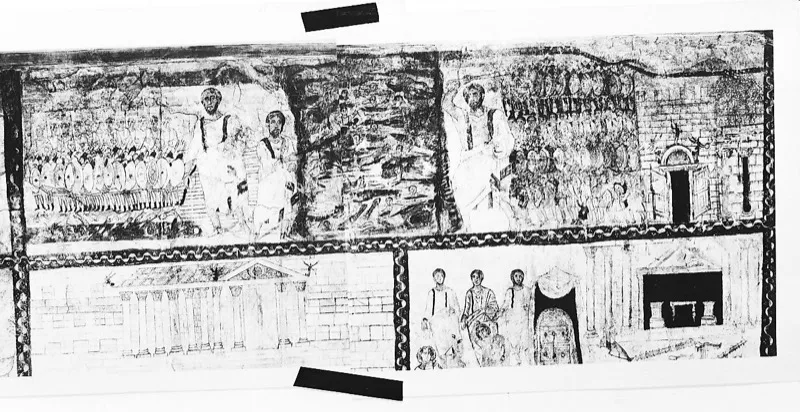
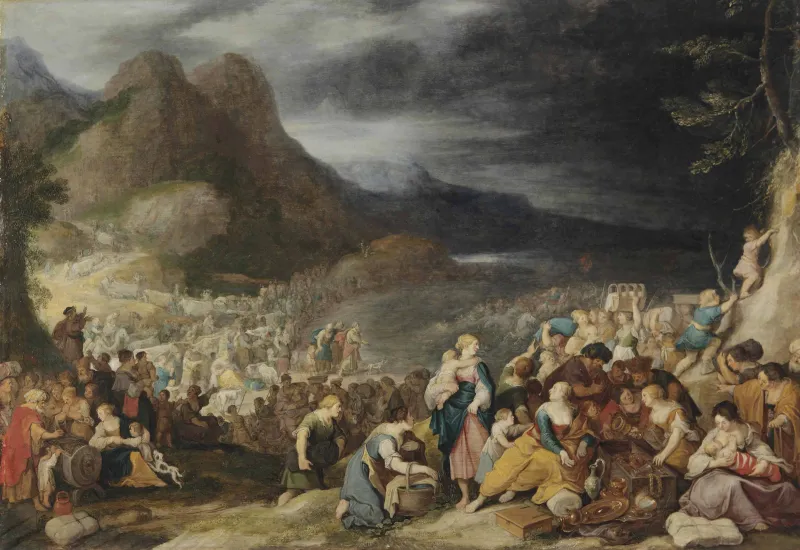
Freedom was not immediate. Pharaoh changed his mind — again — and sent his chariots thundering after the fleeing Israelites, who found themselves trapped between the army and the sea. In one of the most dramatic scenes in all of literature, God parted the waters. The Israelites walked through on dry ground, and when the Egyptians pursued, the sea closed over them.
The Song of the Sea (Exodus 15), sung by Moses and the Israelites on the far shore, is one of the oldest poems in the Hebrew Bible. Miriam, Moses’s sister, took up a tambourine and led the women in dance. It was a moment of ecstatic, almost incredulous joy — the slaves were free, and their oppressors were gone.
Forty Years in the Wilderness
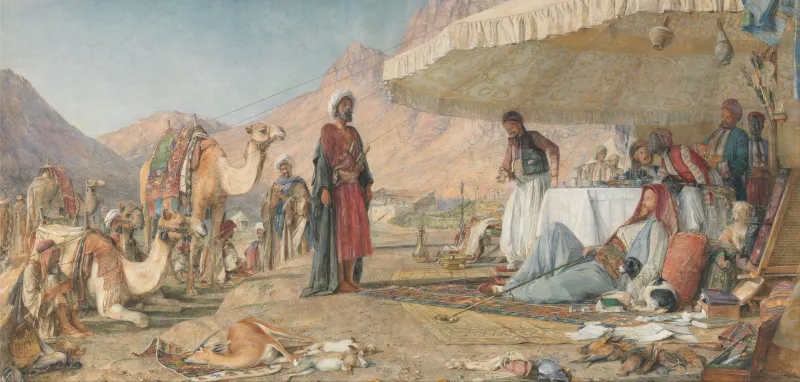
What happened next was less triumphant. The journey from Egypt to the Promised Land should have taken weeks. It took forty years. The Torah is bracingly honest about why: the Israelites were not ready. They complained about the food (God sent manna from heaven), complained about the water (Moses struck a rock), built a golden calf while Moses was receiving the Torah on Mount Sinai, and repeatedly questioned whether leaving Egypt had been a good idea.
These are not flattering stories. Jewish tradition has always been willing to present its heroes as flawed and its people as difficult. But the wilderness period also produced something extraordinary: the revelation at Sinai. Standing at the foot of the mountain, the entire nation heard God speak. The Ten Commandments were given, along with the rest of the Torah — 613 commandments that would govern every aspect of Israelite life.
The generation that left Egypt, with the exceptions of Joshua and Caleb, never entered the Promised Land. Even Moses was denied entry. He died on Mount Nebo, looking across the Jordan River at a land he would never touch. It is one of the most poignant scenes in the Bible — the liberator who gave everything, and who was not permitted to see the fulfillment of his mission.
The Historical Debate
Did the Exodus actually happen? This question has occupied archaeologists, historians, and biblical scholars for over a century, and there is no consensus.
Evidence that supports a historical core: The Merneptah Stele (c. 1208 BCE) — an Egyptian monument — mentions “Israel” as a people in Canaan, confirming that Israelites existed as a recognized group by the late 13th century BCE. Egyptian records document Semitic workers, and the geographic details in the Exodus narrative — including specific place names — reflect genuine knowledge of the Egyptian delta region.
Evidence that raises questions: No Egyptian record mentions the Israelites as slaves or their departure. The number of people described (two million) would leave massive archaeological traces, and none have been found in the Sinai Peninsula. Some scholars note that Canaan was under Egyptian control during the likely period of the Exodus, making an “escape to Canaan” paradoxical.
The middle ground: Many scholars today believe the Exodus narrative preserves a memory of real events — perhaps a smaller group of Semitic people who left Egypt and whose story became the national epic of a larger Israelite confederation. The story grew in the telling, as foundational stories always do.
What is beyond dispute is the story’s power. Whether or not two million people crossed the Red Sea, the Exodus gave the Jewish people — and ultimately the world — a narrative framework for understanding oppression, resistance, and liberation.
The Passover Connection
Every year at the Passover Seder, Jews relive the Exodus. They eat matzah (unleavened bread) because the Israelites fled so quickly their dough had no time to rise. They taste bitter herbs to remember slavery. They dip vegetables in salt water to recall tears. And they tell the story — the Haggadah instructs that “in every generation, a person is obligated to see themselves as though they personally came out of Egypt.”
This is not history as museum exhibit. It is history as lived experience. The Exodus is not something that happened to other people long ago. It is something that happens to you, tonight, at this table. That insistence on personal identification with the story is part of what has kept it alive for over three thousand years.
“We were slaves to Pharaoh in Egypt, and the Lord our God brought us out from there with a mighty hand and an outstretched arm.” — Deuteronomy 6:21
The Exodus is the story that made the Jewish people. It is the story they carry with them everywhere they go — into every exile, through every persecution, toward every promised land. It says: you were once slaves, and you were set free. Never forget what that means.
Frequently Asked Questions
Did the Exodus really happen?
This is one of the most debated questions in biblical scholarship. While no direct archaeological evidence has been found for a mass Israelite departure from Egypt, some scholars point to indirect evidence — Semitic workers in Egypt, the Merneptah Stele mentioning Israel, and plausible geographic details. Many historians believe the narrative may reflect a smaller historical migration embellished over centuries of oral tradition.
How many Israelites left Egypt?
The Torah states 600,000 men plus women and children, which would total roughly two million people. Most modern scholars consider this number symbolic or exaggerated. Some suggest a much smaller group — perhaps a few thousand — whose story became the foundational narrative of the entire Israelite nation.
Why is the Exodus so important to Judaism?
The Exodus is arguably the defining event of Jewish identity. It establishes God as a liberator, gives the Israelites their national story, and leads directly to the revelation at Sinai and the giving of the Torah. Jews retell the story every year at Passover, and references to the Exodus appear throughout Jewish prayer, ethics, and law.
Sources & Further Reading
Related Articles
Ancient Israel: From Abraham to the Kingdoms
The foundational story of the Jewish people — from the call of Abraham through the united monarchy of David and Solomon.
Passover (Pesach): The Festival of Freedom
The story of the Exodus comes alive each spring as Jewish families gather for the Seder — the most widely observed Jewish ritual.
The Torah: The Heart of Judaism
The Torah is more than a book — it is the living constitution of Jewish life, studied and debated for over three millennia.