The Ten Commandments: Foundation of Moral Law
Given at Mount Sinai and inscribed on two stone tablets, the Ten Commandments form the moral bedrock of Judaism — and have shaped ethical thinking across civilizations.

Thunder at the Mountain
Try to imagine it. You are standing at the base of a mountain in a wilderness you have crossed on foot. The ground trembles. Smoke rises from the peak like the smoke of a furnace. A sound — not quite a voice, not quite thunder — fills the air so completely that you feel it in your chest. According to the Torah, this is what the Israelites experienced at Mount Sinai, roughly three months after their liberation from Egypt. And what emerged from that trembling encounter became the most famous moral code in human history: the Ten Commandments.
In Hebrew, they are not called “commandments” at all. The phrase is Aseret HaDibrot — the “Ten Utterances” or “Ten Statements.” This distinction matters. Judaism has always understood these ten as something more than rules. They are declarations — God speaking directly to an entire people, establishing the terms of a relationship that would define Jewish life for the next three thousand years and beyond.
The Full Text
The Ten Commandments appear twice in the Torah: in Exodus 20:2-17 and again in Deuteronomy 5:6-21, with slight but significant variations. Here is the Jewish enumeration, following the traditional Hebrew division:
First Commandment: “I am the Lord your God, who brought you out of the land of Egypt, out of the house of bondage.”
Second Commandment: “You shall have no other gods before Me. You shall not make for yourself a carved image…”
Third Commandment: “You shall not take the name of the Lord your God in vain.”
Fourth Commandment: “Remember the Sabbath day, to keep it holy. Six days you shall labor and do all your work, but the seventh day is a Sabbath to the Lord your God.”
Fifth Commandment: “Honor your father and your mother, that your days may be long upon the land.”
Sixth Commandment: “You shall not murder.”
Seventh Commandment: “You shall not commit adultery.”
Eighth Commandment: “You shall not steal.”
Ninth Commandment: “You shall not bear false witness against your neighbor.”
Tenth Commandment: “You shall not covet your neighbor’s house. You shall not covet your neighbor’s wife, nor his manservant, nor his maidservant, nor his ox, nor his donkey, nor anything that is your neighbor’s.”
Two Tablets, Two Relationships
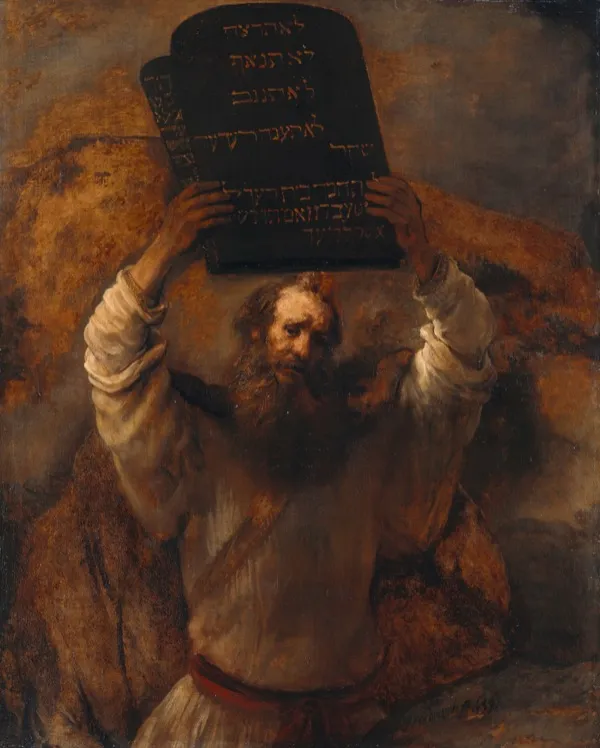
The tradition that the commandments were inscribed on two stone tablets is not merely a detail of packaging. The rabbis saw deep meaning in this division. The first tablet — commandments one through five — governs the relationship between human beings and God (bein adam la-Makom). The second tablet — commandments six through ten — governs relationships between people (bein adam la-chavero).
This symmetry is central to Jewish ethics. You cannot claim to love God while mistreating your neighbor. You cannot claim to be a good person while ignoring the divine. The two tablets stand side by side because morality, in the Jewish view, requires both vertical and horizontal integrity — reaching upward toward the transcendent and outward toward other human beings.
Notice, too, that the fifth commandment — honoring parents — sits on the first tablet, the one dedicated to the divine. The rabbis understood this as a statement: parents are partners with God in creation. To honor them is a form of honoring the Creator.
Jewish vs. Christian Numbering
One of the most frequently asked questions about the Ten Commandments concerns their numbering, which differs across religious traditions. In Judaism, “I am the Lord your God” stands alone as the first commandment — a declaration of identity before any demand is made. Most Protestant traditions, however, begin their count with “You shall have no other gods before Me,” treating the opening declaration as a preamble rather than a commandment.
Catholic and Lutheran traditions combine “no other gods” and “no graven images” into a single commandment and split the final prohibition against coveting into two. The result is that all traditions arrive at ten, but the internal architecture differs. These are not trivial distinctions. The Jewish insistence that “I am the Lord your God” is itself a commandment — the commandment to know and believe — reflects a theological priority: relationship comes before regulation.
The Sinai Revelation
The giving of the Ten Commandments at Sinai is the pivotal event in Jewish sacred history. The Torah describes the entire people of Israel — men, women, children, and even the unborn — standing at the foot of the mountain. This is unique in the ancient world: not a private revelation to a single prophet, but a public event witnessed by an entire nation.

The Talmud preserves striking midrashic details. The voice of God, the rabbis say, spoke simultaneously in all seventy languages of the world, because the Torah was intended for all humanity. The Israelites, overwhelmed by the experience, died and were revived with each utterance. Some traditions say the letters were carved through the stone tablets entirely, readable from both sides — a miracle of divine writing.
Whether one understands these accounts literally or metaphorically, the message is consistent: something extraordinary happened at Sinai. Judaism grounds its entire legal and moral system not in abstract philosophy but in a claimed encounter between God and a people.
The Shavuot Connection
The giving of the Torah at Sinai is commemorated annually on Shavuot, the Festival of Weeks, which falls seven weeks after Passover. On Shavuot, the Ten Commandments are read aloud in synagogue, and congregants traditionally stand — reenacting, in a sense, the posture of the Israelites at the foot of the mountain.
The custom of staying awake all night studying Torah on Shavuot (Tikkun Leil Shavuot) reflects a midrash that the Israelites overslept on the morning of the revelation and had to be awakened by Moses. Jews today stay up to demonstrate the eagerness their ancestors lacked — a beautiful act of repair across time.
Ten Among Six Hundred and Thirteen
It is important to understand that Judaism does not consider the Ten Commandments more binding or more sacred than the other 613 commandments in the Torah. This point may surprise those accustomed to thinking of the “Ten Commandments” as the summary of all Jewish law. In fact, the rabbis of the Talmud deliberately removed the daily recitation of the Ten Commandments from the synagogue liturgy precisely to counteract the claim — made by early Christians and sectarians — that only these ten were divinely given.
Rabbi Saadia Gaon (10th century) argued that all 613 commandments could be derived from the Ten Commandments, seeing them as categories rather than a complete list. Other scholars emphasized that the most foundational ethical principle — “Love your neighbor as yourself” (Leviticus 19:18) — does not appear among the ten at all. The Ten Commandments are the gateway, not the destination.
Living with the Ten
Walk into almost any synagogue in the world and you will see a representation of the two tablets — often above the ark that holds the Torah scrolls. They appear on synagogue facades, on Jewish organizational logos, on the covers of prayer books. The image is so ubiquitous that it has become a visual shorthand for Judaism itself, and for the idea that moral law has a source beyond human invention.
But the Ten Commandments are not meant to hang on a wall. They are meant to be lived. “Do not murder” sounds simple until you consider the Talmud’s teaching that embarrassing someone in public is a form of murder. “Do not steal” expands, in rabbinic interpretation, to include stealing someone’s peace of mind, their reputation, or their time. “Honor your father and mother” applies even when — especially when — it is difficult.
The thunder at Sinai has long since faded. But the words remain — ten utterances that continue to shape how billions of people think about right and wrong, obligation and freedom, the relationship between the human and the divine.
Frequently Asked Questions
What are the Ten Commandments in Judaism?
The Ten Commandments (Aseret HaDibrot, or 'Ten Utterances') are foundational moral and theological principles given by God to the Israelites at Mount Sinai. They include belief in one God, prohibitions against idolatry and murder, and commands to honor parents and observe Shabbat. Judaism considers them part of the broader 613 commandments.
How do Jewish and Christian numbering of the Ten Commandments differ?
Judaism counts 'I am the Lord your God' as the first commandment, while most Christian traditions begin with 'You shall have no other gods.' Judaism combines what some Christians split into two (coveting), and Catholicism and Lutheranism combine the prohibitions against idolatry and other gods into one. The total remains ten, but the internal divisions differ.
When are the Ten Commandments read in synagogue?
The Ten Commandments are read publicly during the Torah portions of Yitro (Exodus) and Va'etchanan (Deuteronomy), and again on Shavuot, which celebrates the giving of the Torah at Sinai. In many congregations, worshippers stand during the reading, though some rabbis have discouraged this to avoid implying these commandments are more important than the other 603.
Sources & Further Reading
Related Articles
The 613 Commandments: The Framework of Jewish Life
Judaism identifies 613 commandments in the Torah — 248 positive and 365 negative — covering everything from prayer and charity to agriculture and justice.
The Covenant: The Bond Between God and Israel
The covenant — brit in Hebrew — is the foundational relationship between God and the Jewish people. From Abraham's circumcision to the revelation at Sinai, explore what it means to live in covenant with the divine.
Shavuot: The Festival of Weeks
Seven weeks after Passover, the Jewish world celebrates the giving of the Torah at Mount Sinai — with all-night study, dairy feasts, and the reading of the Book of Ruth.
The Tanakh: A Complete Guide to the Hebrew Bible
The Tanakh — Torah, Nevi'im, and Ketuvim — is the foundational scripture of Judaism, containing 24 books of law, prophecy, and wisdom. Learn how it was formed and how it differs from the Christian Old Testament.
The Torah: The Heart of Judaism
The Torah is more than a book — it is the living constitution of Jewish life, studied and debated for over three millennia.