The Synagogue: House of Prayer, Study, and Assembly
More than just a place of worship — the synagogue is the heart of Jewish community life, combining prayer, learning, and social gathering under one roof.
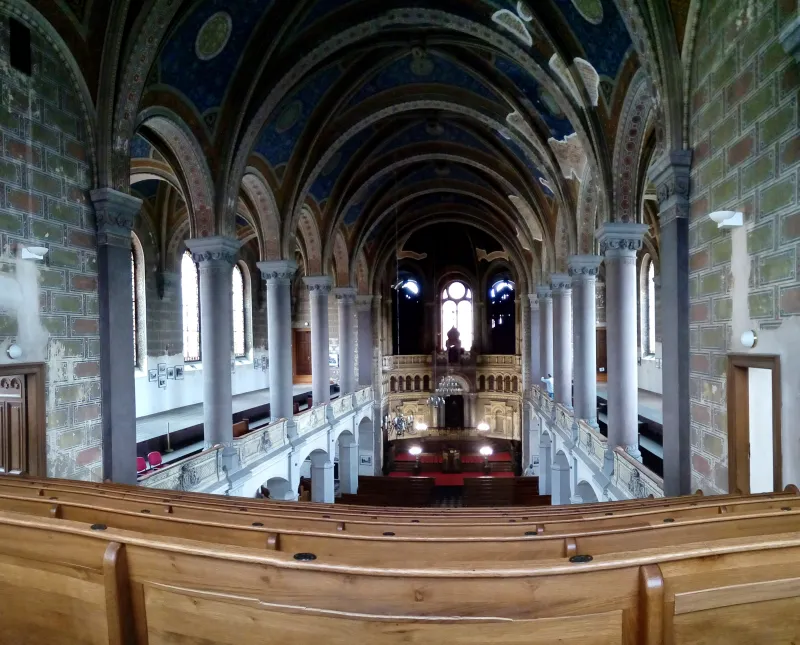
Three Functions Under One Roof
Walk into any synagogue — whether a grand sanctuary with soaring stained glass or a modest rented room with folding chairs — and you will notice certain things right away. At the front, a curtained cabinet that everyone faces during prayer: the ark, holding the Torah scrolls. Above it, a small light that never goes out: the ner tamid, the eternal flame. Somewhere in the room, a raised platform for reading. These elements appear in virtually every Jewish house of worship on earth, from a centuries-old stone building in Safed to a converted storefront in São Paulo. They are the landmarks of a shared sacred geography, and stepping into any synagogue that has them feels, in some quiet way, like coming home.
Quick Facts About Synagogues
- Hebrew names: Beit Knesset (House of Assembly), Beit Tefillah (House of Prayer), Beit Midrash (House of Study)
- Origin: Developed during Babylonian exile (586-538 BCE)
- Global count: 40,000+ synagogues worldwide
- Essential elements: Aron Kodesh (ark), ner tamid (eternal light), bimah (reading platform)
- Prayer quorum: Minyan of 10 adult Jews required for certain prayers
- Daily services: Shacharit (morning), Mincha (afternoon), Maariv (evening)
- Sacred direction: All face toward Jerusalem (mizrach)
- Torah reading: Regular cycle on Mondays, Thursdays, Shabbat, and holidays
- Community roles: Rabbi (teacher), cantor (chazzan), president, board members
- Architecture: Varies from Moorish to Gothic to modern styles
- Membership: Typically 200-400 families per Conservative/Reform congregation
- Historic synagogues: Oldest active - Santa María la Blanca (Toledo, 1180)
- Modern movements: Orthodox, Conservative, Reform, Reconstructionist variations
The synagogue is known by three Hebrew names, each reflecting a distinct purpose:
- Beit Tefillah (House of Prayer): The space where Jews gather for daily, Shabbat, and holiday services. Communal prayer has been the synagogue’s most visible function since the destruction of the Second Temple in 70 CE, when sacrifice gave way to worship through words.
- Beit Midrash (House of Study): Torah study is considered equal to — and by some accounts even greater than — prayer. Many synagogues house libraries, host classes, and serve as the setting for ongoing study partnerships (chevruta). In traditional communities, the study hall may be used even more than the sanctuary.
- Beit Knesset (House of Assembly): The synagogue is where the community gathers for celebrations, meetings, charity work, and mutual support. Historically, it functioned as courthouse, social hall, and community center all at once.
These three roles are not separate departments. They overlap and reinforce each other. A synagogue where people only pray but never study, or study but never gather as a community, is incomplete.
Inside the Synagogue: Key Architectural Features
While synagogues vary enormously in size and style — from ancient stone structures in the Galilee to grand European edifices to modest storefront shtiebels — certain elements appear in virtually every Jewish house of worship.
The Aron Kodesh (Holy Ark)
The Aron Kodesh is the most sacred object in the synagogue. This cabinet or alcove, usually set into the wall facing Jerusalem, houses the community’s Torah scrolls. The Ark is typically covered by an embroidered curtain called a parochet, recalling the curtain that separated the Holy of Holies in the ancient Temple. When the Ark is opened during services, the congregation rises in respect — a powerful moment of collective reverence.
The Bimah (Reading Platform)
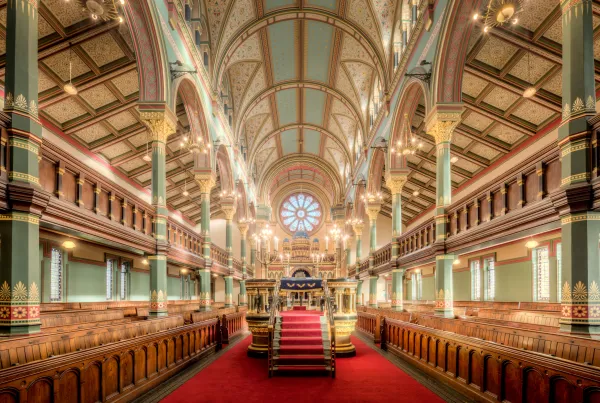
The bimah is the raised platform from which the Torah is read aloud and from which the service is often led. Its placement carries theological significance:
- In traditional Ashkenazi Orthodox and most Sephardi synagogues, the bimah stands in the center of the room, symbolizing that the Torah belongs to the entire community equally.
- In many Reform and some Conservative synagogues, the bimah is placed at the front, near the Ark, creating a more stage-like arrangement that focuses attention forward.
The Ner Tamid (Eternal Light)
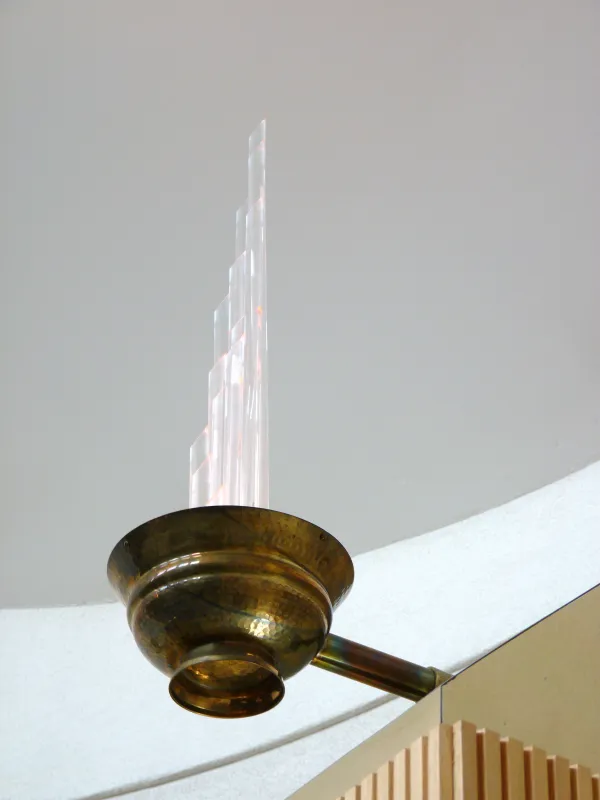
Above the Ark hangs the Ner Tamid, a lamp that burns continuously. It recalls the menorah that burned perpetually in the ancient Temple and symbolizes God’s unceasing presence. Whether the synagogue is full or empty, the Ner Tamid glows — a quiet, constant reminder of the sacred.
The Mechitzah (Partition)
In Orthodox synagogues, a mechitzah separates the men’s and women’s seating areas. The mechitzah can take many forms — a curtain, a latticed screen, a balcony, or a half-wall. Its purpose, according to traditional sources, is to prevent distraction during prayer and to maintain modesty. The mechitzah is one of the most visible differences between Orthodox and non-Orthodox worship spaces, and its presence (or absence) is often one of the first things a visitor notices.
Denominations: Different Approaches to the Same Space
Orthodox Synagogues
Orthodox synagogues maintain the most traditional practices. Services are conducted entirely in Hebrew (with some Aramaic). Men and women sit separately. The service follows a fixed liturgy (nusach) with little variation. Men wear a tallit and kippah; in many communities, married women cover their hair. The atmosphere is often informal — people may arrive at different times, pray at their own pace, and greet friends between sections of the service.
Conservative Synagogues
Conservative Judaism seeks a middle path. Services are primarily in Hebrew but often include English readings and explanations. Most Conservative synagogues have mixed seating. Women participate fully in services in the majority of Conservative congregations — reading Torah, leading prayers, and counting in the minyan. The liturgy closely follows the traditional structure but permits certain modifications.
Reform Synagogues
Reform synagogues (sometimes called “temples”) tend to feature shorter services with significant portions in the vernacular language. Instrumental music, including organ and guitar, may accompany worship. The emphasis is on accessibility, personal meaning, and ethical engagement. Reform congregations were the first to ordain women as rabbis and to welcome interfaith families.
Reconstructionist and Renewal
Reconstructionist synagogues emphasize Judaism as an evolving civilization and tend toward egalitarian, participatory services. Jewish Renewal congregations draw on Hasidic mysticism, meditation, and chanting to create deeply spiritual worship experiences.
Ashkenazi and Sephardi Styles
Beyond denominational differences, synagogue culture varies along ethnic and regional lines.
Ashkenazi synagogues — rooted in the traditions of Central and Eastern Europe — are characterized by the prominent role of the hazzan (cantor), elaborate choral music in some communities, and a generally more formal atmosphere in larger congregations. The architecture of historic Ashkenazi synagogues in Europe ranged from the fortified stone synagogues of Poland to the ornate, Moorish-inspired “cathedral synagogues” of 19th-century Germany and Hungary.
Sephardi synagogues — drawing from the traditions of Spain, North Africa, the Ottoman Empire, and the Middle East — tend to be more participatory. The congregation joins in responses, melodies are passed down through oral tradition, and the bimah is almost always in the center. Sephardi synagogues often feature beautiful tilework, arched windows, and design elements reflecting the Islamic and Mediterranean architectural environments in which they developed.
Yemenite, Ethiopian, Italian, and Indian Jewish communities each maintain their own distinct synagogue customs, melodies, and architectural traditions — a reminder that the synagogue is not a monolithic institution but a living, diverse expression of Jewish life across the globe.
A Living Institution
The synagogue has survived the destruction of both Temples, centuries of exile, persecution, and modernity’s challenges. It has adapted to every culture Jews have inhabited, from ancient Galilee to medieval Spain to the American suburbs. Whether a grand sanctuary seating thousands or a rented room where ten people gather to pray, the synagogue fulfills its essential purpose: bringing Jews together to pray, to learn, and to sustain one another as a community.
There is something moving about the sheer variety of spaces Jews have sanctified as synagogues — a coral stone building in Curaçao with sand on its floor, an ornate Moorish palace in Budapest, a tiny wooden shul in rural Vermont. The architecture differs, the melodies differ, the customs differ. But in each one, at some point in the service, the ark is opened, the congregation rises, and for a moment, every synagogue in the world is the same place.
Frequently Asked Questions
What is the difference between a synagogue, temple, and shul?
They all refer to a Jewish house of worship. 'Synagogue' is the most universal term. 'Temple' is commonly used by Reform congregations. 'Shul' is the Yiddish term used by Orthodox and traditional communities.
Can non-Jews visit a synagogue?
Yes, visitors are generally welcome. It is respectful to dress modestly, and men may be asked to wear a kippah (head covering). Contact the synagogue in advance if visiting during a service.
What is the Ark in a synagogue?
The Aron Kodesh (Holy Ark) is the ornamental cabinet at the front of the synagogue that houses the Torah scrolls. It faces Jerusalem and is the focal point of the sanctuary, often adorned with an embroidered curtain (parochet).
Sources & Further Reading
Related Articles
The Amidah: Judaism's Central Standing Prayer
The Amidah — nineteen blessings recited standing, facing Jerusalem, three times daily — is the backbone of every Jewish prayer service. Explore its structure, meaning, and the spiritual practice of standing before God.
The Cantor: The Voice of Jewish Prayer
The cantor — hazzan in Hebrew — is the voice that carries a congregation's prayers to heaven. From golden age legends like Yossele Rosenblatt to the modern debate over women cantors, explore this ancient and evolving role.
Orthodox, Conservative, and Reform: Understanding Jewish Denominations
Judaism is not monolithic — it encompasses diverse movements from Ultra-Orthodox to Reform, each with its own approach to tradition, law, and modern life.
The Menorah: Judaism's Oldest Symbol, from the Temple to the State of Israel
The seven-branched menorah is Judaism's most ancient symbol — described in Exodus, crafted for the Temple, carved on the Arch of Titus, and chosen as the emblem of the modern State of Israel. Its light has never gone out.
The Mezuzah: What's Inside, How to Hang It, and Why It Matters
A small scroll on the doorpost, containing the most important words in Judaism. The mezuzah marks every Jewish home as sacred space — and the rules for writing, placing, and caring for it are as precise as they are meaningful.
Jewish Prayer: Connecting with the Divine
From the three daily prayer services to personal meditation, discover how Jewish prayer works and what it means.
The Star of David: How a Simple Hexagram Became Judaism's Most Recognized Symbol
The Star of David is everywhere — on the Israeli flag, on synagogues, on jewelry. But it was not always a Jewish symbol. Its journey from decorative motif to the universal emblem of Judaism is a surprising story of history, identity, and reclamation.
The Torah: The Heart of Judaism
The Torah is more than a book — it is the living constitution of Jewish life, studied and debated for over three millennia.
Torah Portions: The Weekly Reading Cycle
Every week, Jewish communities worldwide read the same Torah portion. Explore the 54 parashot, the system of aliyot, the Haftarah connection, and the joyous restart on Simchat Torah.
What Is a Rabbi? Teacher, Leader, and Guide
The word 'rabbi' means 'my teacher' — but the role has evolved from ancient legal authority to modern spiritual leader, counselor, and community guide across every denomination.