The Amidah: Judaism's Central Standing Prayer
The Amidah — nineteen blessings recited standing, facing Jerusalem, three times daily — is the backbone of every Jewish prayer service. Explore its structure, meaning, and the spiritual practice of standing before God.
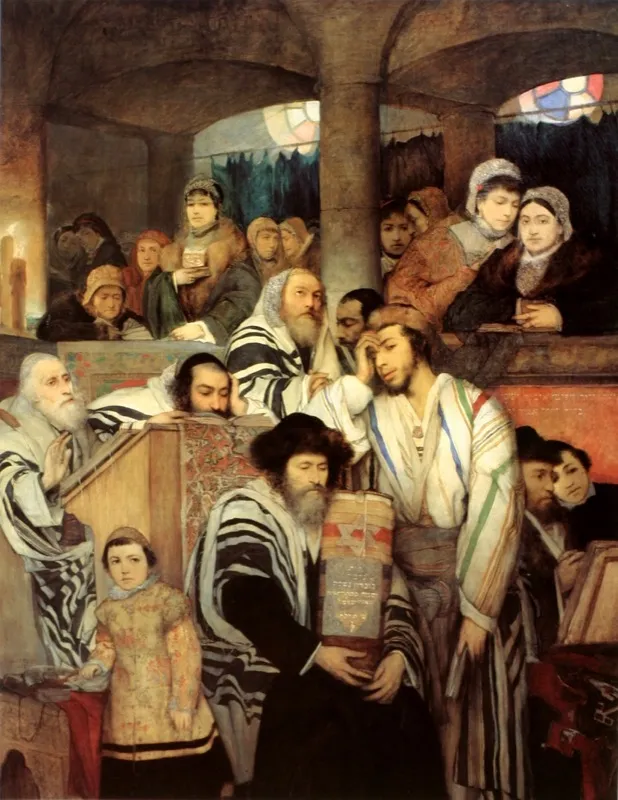
Standing Before the King
There is a moment in every Jewish prayer service when the room falls quiet. The congregation rises. Feet are placed together. And for the next several minutes, each person stands in whispered conversation with God — lips moving, body swaying gently, the words barely audible even to the person standing beside them.
This is the Amidah, and it is the heartbeat of Jewish prayer.
The word Amidah simply means “standing,” and that physical posture tells you everything about its theology. You stand before God the way you might stand before a sovereign — upright, attentive, present. The Talmud calls it tefillah, “the prayer,” as if all other prayers are merely warm-ups. Three times every day, in synagogues and living rooms and hospital corridors around the world, Jews rise for this encounter.
From Eighteen to Nineteen
The Amidah is also known as Shemoneh Esreh — literally, “eighteen” — because it originally contained eighteen blessings. Around 100 CE, Rabban Gamliel II at the academy in Yavneh added a nineteenth blessing, the Birkat HaMinim, directed against sectarians and informers who threatened the Jewish community during a period of intense persecution. The old name stuck, the way a building keeps its address even after renovations.
Those nineteen blessings are organized into a structure that rabbis compare to approaching a king: you begin with praise, then make your requests, and conclude with gratitude.
The Three Sections
Praise (Blessings 1-3)
The first three blessings establish who you are speaking to:
- Avot (Ancestors): Acknowledges God as the God of Abraham, Isaac, and Jacob — and in many liberal liturgies, Sarah, Rebecca, Rachel, and Leah. This blessing roots the prayer in relationship and history.
- Gevurot (God’s Power): Praises God’s might — sustaining the living, healing the sick, raising the dead. This blessing includes the phrase mashiv ha-ruach u-morid ha-geshem (“who causes the wind to blow and the rain to fall”), added during the winter months.
- Kedushah (Holiness): Declares God’s holiness. During the repetition, this blessing expands into the Kedusha, one of the most dramatic moments in the service, when the congregation joins the angels in calling out: Kadosh, kadosh, kadosh — “Holy, holy, holy is the Lord of Hosts.”
Petition (Blessings 4-16)
The middle section is where you bring your needs before God. These thirteen blessings cover the full range of human concern:
- Wisdom (Binah): “Grant us knowledge, understanding, and insight.”
- Repentance (Teshuvah): “Bring us back to Your Torah.”
- Forgiveness (Selichah): “Forgive us, for we have sinned.”
- Redemption (Geulah): “Behold our affliction and fight our struggles.”
- Healing (Refuah): “Heal us, O Lord, and we shall be healed.” This is where personal prayers for the sick are traditionally inserted.
- Prosperity (Birkat HaShanim): A prayer for agricultural abundance and economic well-being.
- Ingathering of Exiles (Kibbutz Galuyot): “Sound the great shofar for our freedom.”
- Justice (Hashavat HaMishpat): “Restore our judges as in former times.”
- Against Heretics (Birkat HaMinim): The controversial nineteenth blessing.
- The Righteous (Al HaTzaddikim): Support for the pious and converts.
- Jerusalem (Boneh Yerushalayim): “Return to Your city Jerusalem in mercy.”
- The Messiah (Malkhut Beit David): “May the branch of David speedily flourish.”
- Hearing Prayer (Shome’a Tefillah): “Hear our voice, have compassion upon us.”
These petitions reveal what the rabbis considered essential to human flourishing: not just physical health and material security, but wisdom, justice, community, and spiritual homecoming.
Thanksgiving (Blessings 17-19)
The final three blessings express gratitude and hope:
- Temple Service (Avodah): A prayer for the restoration of worship — interpreted literally by some, metaphorically by others.
- Thanksgiving (Hoda’ah): “We give thanks to You… for our lives entrusted to Your hand.” During the repetition, the congregation bows and recites Modim d’Rabbanan, their own parallel thanksgiving.
- Peace (Sim Shalom): “Grant peace, goodness, and blessing.” The entire Amidah concludes with a prayer for peace — a fitting final word.
How to Pray the Amidah
The physical choreography of the Amidah is precise and meaningful:
- Three steps forward before beginning — entering God’s presence, as if approaching a throne.
- Feet together throughout — imitating the angels, who according to Ezekiel’s vision have “straight feet” (Ezekiel 1:7).
- Whispered voice — following Hannah’s example. The Shulchan Aruch specifies that you should hear your own words but no one nearby should hear them.
- Bowing at specific points: the beginning and end of the first blessing, the beginning and end of Modim (thanksgiving).
- Three steps backward at the conclusion — taking leave of the divine presence, like a servant withdrawing from a king.
Weekday, Shabbat, and Holidays
The Amidah changes shape depending on the occasion:
On weekdays, all nineteen blessings are recited — the full range of human petition. But on Shabbat and holidays, the thirteen petitionary blessings are removed and replaced with a single middle blessing appropriate to the day. The reasoning is beautiful: on Shabbat, you should not burden yourself with worry. Rest means rest — even from asking.
This reduces the Shabbat Amidah to seven blessings. The holiday versions vary further, incorporating themes of the specific festival — freedom on Passover, revelation on Shavuot, God’s sovereignty on Rosh Hashanah.
On Rosh Hashanah and Yom Kippur, the Amidah takes on its most elaborate form, with extensive additions about God’s kingship, remembrance, and the shofar.
The Repetition and the Kedusha
In traditional services, the Amidah is recited twice: first silently by each individual (tefillah be-lachash), then repeated aloud by the shaliach tzibbur (prayer leader). This repetition serves those who might not be able to recite it themselves and creates a communal frame around what was a private experience.
The highlight of the repetition is the Kedusha — a responsive reading in which the congregation joins the prayer leader in declaring God’s holiness, echoing the angels’ words from Isaiah 6:3: “Holy, holy, holy is the Lord of Hosts; the whole earth is full of His glory.” In many congregations, worshippers rise on their toes with each repetition of kadosh, reaching upward as the angels do.
The Amidah Across Movements
Different Jewish communities approach the Amidah differently. Orthodox congregations recite it in full Hebrew, standing in silence, with the complete repetition. Conservative communities generally maintain the traditional structure, though some have modified specific blessings — for instance, adding the matriarchs alongside the patriarchs. Reform congregations often abbreviate the Amidah significantly and may recite portions in the vernacular. Reconstructionist and Renewal communities sometimes rewrite blessings to reflect contemporary theology.
These differences can be significant. The traditional blessing praising God who “revives the dead” (mechayeh ha-metim) is changed in many Reform prayer books to “who gives life to all” (mechayeh ha-kol), reflecting discomfort with literal resurrection theology. Such changes reveal how the Amidah is not a fossil but a living prayer, continually negotiated between tradition and conscience.
A Daily Discipline
Three times each day — morning, afternoon, and evening — the Amidah punctuates Jewish life. It is a rhythm as regular as breathing. And perhaps that is the deepest teaching of this prayer: that the sacred is not something you visit once a week but something you return to, again and again, standing up, stepping forward, whispering the words that millions have whispered before you.
The rabbis taught that when you pray the Amidah, you should feel as though you are standing before the divine presence itself. Not performing. Not reciting. But standing — fully present, fully human, fully alive — in the company of the Holy One.
Frequently Asked Questions
How many blessings are in the Amidah?
The weekday Amidah contains 19 blessings, though it is still sometimes called Shemoneh Esreh ('eighteen') because the 19th blessing was added later by Rabban Gamliel II around 100 CE. On Shabbat and holidays, the middle petitionary blessings are replaced, reducing the total to seven.
Why do Jews whisper the Amidah?
The Amidah is recited in a whisper — lips moving but voice barely audible — following the example of Hannah, who prayed silently in the Tabernacle at Shiloh (1 Samuel 1:13). The whisper reflects the intimacy of standing directly before God in personal conversation.
Which direction do Jews face during the Amidah?
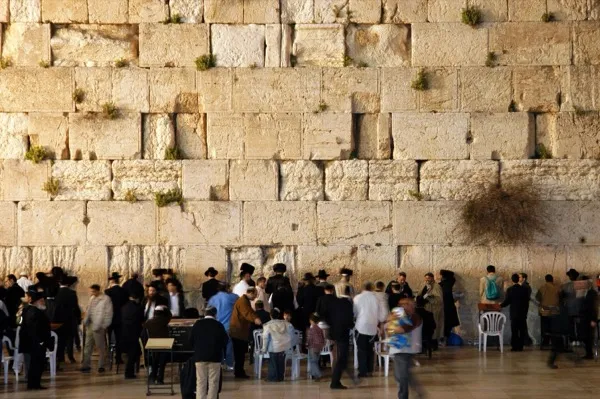
Jews face toward Jerusalem when reciting the Amidah. Those in Israel face toward the Temple Mount. This practice is rooted in King Solomon's prayer at the Temple dedication (1 Kings 8:48) and reflects the spiritual centrality of Jerusalem in Jewish worship.
Sources & Further Reading
Related Articles
Jewish Prayer: Connecting with the Divine
From the three daily prayer services to personal meditation, discover how Jewish prayer works and what it means.
The Shema: Judaism's Most Essential Prayer
Six Hebrew words — 'Hear, O Israel, the Lord our God, the Lord is One' — form the bedrock of Jewish faith, recited morning and evening, in joy and on the deathbed.
The Synagogue: House of Prayer, Study, and Assembly
More than just a place of worship — the synagogue is the heart of Jewish community life, combining prayer, learning, and social gathering under one roof.