The Holocaust: Remembering the Six Million
The systematic murder of six million Jews during World War II — the darkest chapter in human history and its lasting impact on Jewish identity.
The Darkness Descends
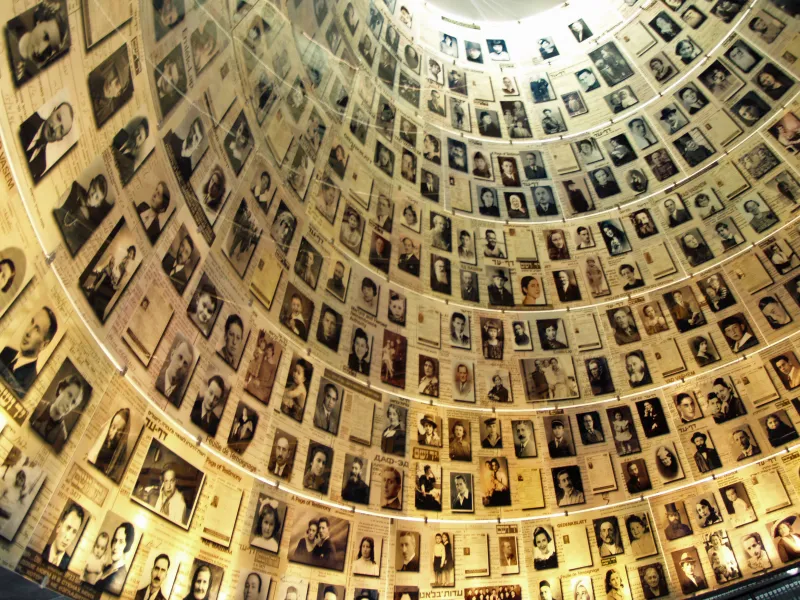
Walk through the Hall of Names at Yad Vashem in Jerusalem, and the silence presses in. The domed ceiling holds photographs — faces of the murdered, looking out from black-and-white portraits. Below, a pool of water reflects their images. Pages of testimony, each one recording a single name, fill shelves that reach toward the ceiling. There are millions of names. And there are still millions more for which no record survives — people whose faces, voices, and stories were erased so completely that not even a name remains. The weight of this place is physical. Visitors speak in whispers, if they speak at all.
The Holocaust — known in Hebrew as the Shoah (meaning “catastrophe”) — was the systematic, state-sponsored persecution and murder of six million Jews by the Nazi regime and its collaborators between 1933 and 1945. It stands as the most devastating tragedy in Jewish history and one of the darkest chapters in all of human civilization.
To understand how this horror was possible, we must look at the conditions that allowed it to take root.
The Rise of Nazism
After Germany’s defeat in World War I, the country was gripped by economic depression, political instability, and deep resentment over the terms of the Treaty of Versailles. Adolf Hitler and his National Socialist (Nazi) party exploited this turmoil, channeling public frustration into virulent antisemitism — the hatred of Jews.
Hitler’s ideology held that Jews were a racial threat to the so-called “Aryan” German nation. When the Nazis came to power in January 1933, they quickly enacted laws stripping Jews of their rights:
- The Nuremberg Laws (1935) revoked Jewish citizenship and forbade marriage between Jews and non-Jews.
- Jewish businesses were boycotted, vandalized, and eventually seized.
- On Kristallnacht (November 9-10, 1938), Nazi mobs destroyed thousands of synagogues, businesses, and homes across Germany and Austria — a terrifying preview of what was to come.
“First they came for the socialists, and I did not speak out — because I was not a socialist. Then they came for the trade unionists, and I did not speak out — because I was not a trade unionist. Then they came for the Jews, and I did not speak out — because I was not a Jew. Then they came for me — and there was no one left to speak for me.” — Pastor Martin Niemöller
Ghettos: Walls of Despair
As Nazi Germany conquered much of Europe during World War II, millions of Jews came under its control. Beginning in 1939, the Nazis forced Jews into overcrowded, walled-off sections of cities known as ghettos. The largest ghettos included:
- The Warsaw Ghetto (Poland) — over 400,000 Jews crammed into 1.3 square miles
- The Łódź Ghetto (Poland) — approximately 160,000 Jews
- The Theresienstadt Ghetto (Czechoslovakia) — used by the Nazis as a propaganda showcase
Inside the ghettos, Jews suffered from starvation, disease, forced labor, and random violence. Yet even under these unbearable conditions, communities organized schools, underground newspapers, religious services, and cultural events — acts of spiritual defiance against dehumanization.
The “Final Solution” and the Death Camps
In January 1942, senior Nazi officials met at the Wannsee Conference to coordinate what they called the “Final Solution to the Jewish Question” — the planned extermination of all European Jews. This industrial-scale genocide was carried out primarily through a network of extermination camps in occupied Poland:
- Auschwitz-Birkenau — the largest, where over 1.1 million people were murdered
- Treblinka — approximately 800,000 killed
- Sobibor, Belzec, Chelmno, and Majdanek — hundreds of thousands more
Victims arrived in overcrowded cattle cars. Upon arrival, most were sent immediately to gas chambers. Those selected for forced labor endured starvation, brutality, and medical experiments.
The Holocaust consumed Jewish communities of every background. The vast majority of victims were Ashkenazi Jews from Eastern and Central Europe, but Sephardic Jews in Greece, the Balkans, and North Africa, as well as Mizrahi Jews in parts of the Middle East, also suffered under Nazi and collaborationist regimes. The ancient Jewish community of Thessaloniki, a Sephardic center for centuries, was nearly annihilated.
Resistance and Courage
Despite overwhelming odds, Jews resisted in every way they could:
- The Warsaw Ghetto Uprising (April–May 1943) — Jewish fighters held off the German army for nearly a month, the largest act of Jewish armed resistance during the war.
- Partisan groups operated in the forests of Eastern Europe, sabotaging Nazi supply lines and sheltering refugees. Groups led by figures like the Bielski brothers saved over 1,200 Jews.
- Spiritual resistance took many forms: secret prayer services, hidden Torah scrolls, teaching children, keeping diaries. Figures like Emmanuel Ringelblum organized the secret Oyneg Shabes archive in the Warsaw Ghetto, preserving testimony for future generations.
- Righteous Among the Nations — non-Jews who risked their lives to save Jews, such as Raoul Wallenberg, Oskar Schindler, and the residents of Le Chambon-sur-Lignon in France.
Liberation and Aftermath
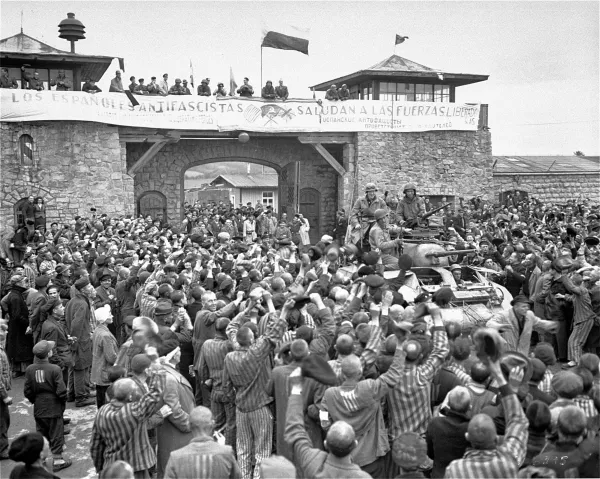
Between 1944 and 1945, Allied forces liberated the camps. What soldiers found defied comprehension — emaciated survivors, mass graves, and the machinery of industrialized murder. The world was confronted with the full horror of what had taken place.
Six million Jews had been murdered — approximately one-third of the world’s Jewish population. Entire communities, centuries of culture, scholarship, language, and tradition were wiped from the earth. Poland alone lost roughly 90% of its Jewish population.
The survivors — many of them orphaned, stateless, and traumatized — faced the enormous task of rebuilding their lives. Many emigrated to British Mandate Palestine, where the memory of the Shoah became a powerful force behind the establishment of the State of Israel in 1948.
Remembrance: Yom HaShoah
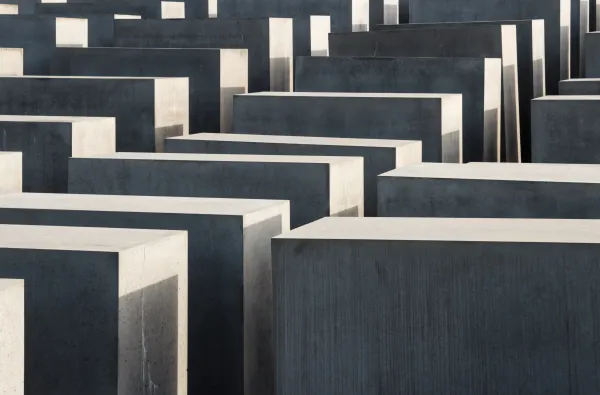
The Jewish people have made remembrance of the Holocaust a sacred obligation. Yom HaShoah (Holocaust Remembrance Day), observed each spring, is marked by:
- Sirens sounding across Israel, bringing the entire nation to a standstill
- Memorial ceremonies at Yad Vashem in Jerusalem and at Holocaust memorials worldwide
- Survivor testimony — the living voices that connect us to this history
- The lighting of six candles, one for each million who perished
Why Remembrance Matters
The Holocaust did not happen in a vacuum. It was the culmination of centuries of antisemitism, enabled by indifference and silence. Remembering the Shoah is not only an act of honoring the dead — it is a commitment to vigilance against hatred in all its forms.
“For the dead and the living, we must bear witness.” — Elie Wiesel, Holocaust survivor and Nobel laureate
In Israel on Yom HaShoah, a siren sounds across the entire country. Traffic stops on every highway. Pedestrians freeze on the sidewalk. For two full minutes, an entire nation stands still — in grocery stores, on construction sites, in schoolyards. The silence is not empty. It is full of the weight of six million absences, each one a life that was whole and particular and irreplaceable. When the siren ends and the world resumes, something lingers — a reminder that remembrance is not a passive act but a choice, renewed each year, to refuse forgetting.
As the generation of survivors passes, the responsibility of memory falls to all of us. To remember the six million is to affirm that every human life has infinite value — and that “never again” must be more than words.
Frequently Asked Questions
How many Jews were killed in the Holocaust?
Approximately six million Jews were systematically murdered during the Holocaust (1933-1945), representing about one-third of the world's Jewish population at the time.
What is Yom HaShoah?
Yom HaShoah (Holocaust Remembrance Day) is observed annually on the 27th of Nisan (April/May). In Israel, a siren sounds nationwide and people stand in silence. Communities worldwide hold memorial ceremonies.
What does 'Never Again' mean?
'Never Again' is the phrase that emerged after the Holocaust as a pledge that such genocide must never be repeated. It drives Holocaust education, memorial efforts, and vigilance against antisemitism and all forms of hatred.
Key Terms
Sources & Further Reading
Related Articles
Understanding Antisemitism: History, Forms, and the Fight Against Hatred
Antisemitism — hatred of Jews — is one of the oldest and most persistent forms of prejudice. From ancient expulsions to modern online hate, understanding its roots is the first step toward fighting it.
The Jewish Diaspora: 2,000 Years Across the Globe
How the destruction of the Second Temple scattered the Jewish people across continents, creating diverse communities united by faith.
A History of Antisemitism: From Ancient World to Modern Times
A comprehensive look at the history of antisemitism — from ancient Egyptian and Greek hostility through medieval blood libels, expulsions, the Dreyfus Affair, pogroms, the Holocaust, and modern manifestations.
Jewish Partisans in World War II: Fighting Back
The untold story of Jewish resistance during World War II — from forest partisans and the Bielski brothers to the Warsaw Ghetto Uprising, the Sobibor revolt, and Hannah Senesh's sacrifice.
The Birth of Modern Israel
From the rise of Zionism to the declaration of independence in 1948 — the story of how the Jewish homeland was reestablished.
Tisha B'Av: The Saddest Day in the Jewish Calendar
On the ninth of Av, Jews mourn the destruction of both Temples and centuries of tragedy — through fasting, lamentation, and the haunting words of the Book of Lamentations.
Yom HaShoah: Holocaust Remembrance Day
Each spring, a siren sounds across Israel and the nation stands still — remembering the six million. Yom HaShoah is a day of solemn witness, survivor testimony, and the sacred obligation to never forget.
Zionism: The Movement That Built a Nation
Zionism — the movement for Jewish self-determination in the ancestral homeland — transformed from a radical 19th-century idea into the founding ideology of the State of Israel.