Yom HaShoah: Holocaust Remembrance Day
Each spring, a siren sounds across Israel and the nation stands still — remembering the six million. Yom HaShoah is a day of solemn witness, survivor testimony, and the sacred obligation to never forget.
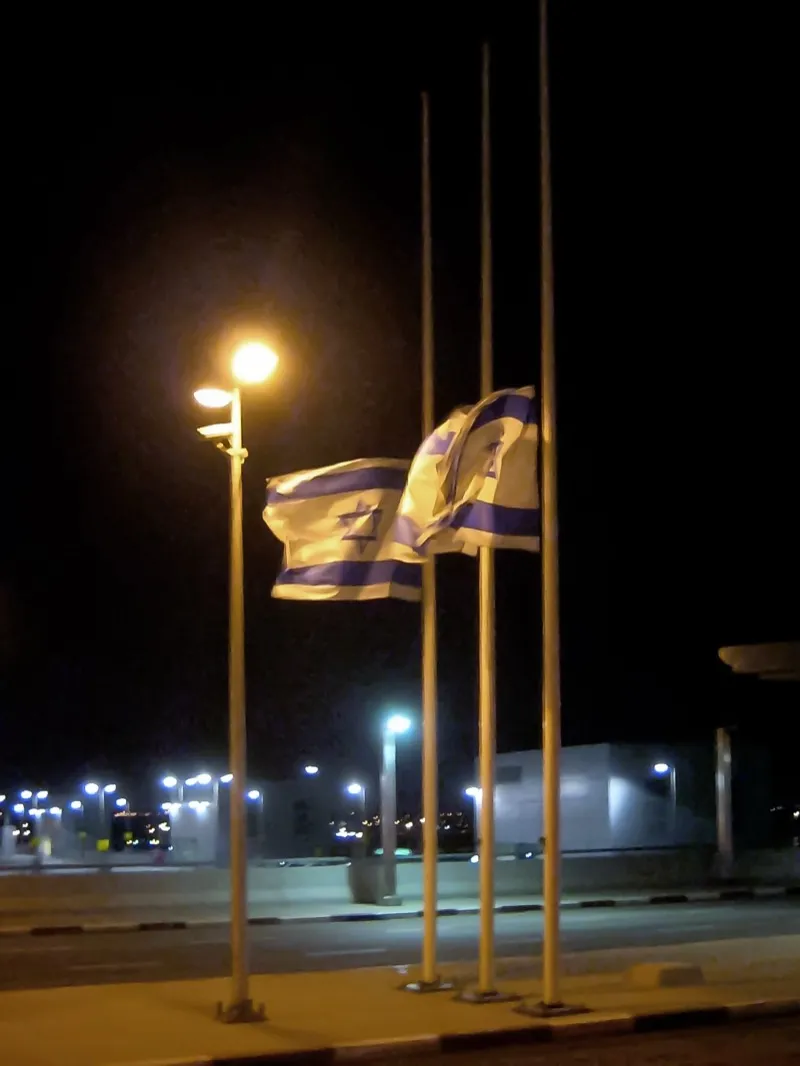
When a Nation Stands Still
Every year, at precisely 10:00 in the morning, something happens in Israel that visitors never forget.
A siren sounds — a single, unbroken wail that rises over every city, town, village, and kibbutz in the country. For exactly two minutes, the nation stops. Cars pull over on highways and drivers step out to stand beside their vehicles. Shoppers freeze in supermarket aisles. Construction workers set down their tools. Schoolchildren stand at their desks. On sidewalks, in parks, at bus stations — millions of people stand motionless, heads bowed, in absolute silence.
Then the siren fades, and life resumes. But something has been marked. Something has been honored. For those two minutes, the entire State of Israel has become a memorial.
This is Yom HaShoah — Yom HaZikaron laShoah ve-laGvurah, the Day of Remembrance for the Holocaust and Heroism. It falls on the 27th of Nisan, usually in April or May, and it is the day on which Israel and Jewish communities around the world pause to remember the six million Jews murdered by Nazi Germany and its collaborators during World War II.
A Date Chosen with Care
The establishment of Yom HaShoah was itself a matter of intense debate. When the Israeli Knesset legislated the day in 1951, choosing the date was profoundly contentious.
Some religious authorities argued that the already-existing fast of Tisha B’Av — the day that commemorates the destruction of both Temples and other Jewish catastrophes — should absorb the Holocaust into its liturgy. The Shoah, they argued, was the latest in a long chain of destructions, and should be mourned within the traditional framework.
Others, particularly Holocaust survivors and secular Israelis, felt strongly that the Shoah demanded its own day — that it was an event of such singular magnitude that folding it into an ancient fast would diminish rather than honor it. They initially proposed the anniversary of the Warsaw Ghetto Uprising (15 Nisan), a date that emphasized not only victimhood but also Jewish resistance and heroism. However, that date coincided with Passover, making it impractical.
The compromise was the 27th of Nisan — close enough to the Warsaw Ghetto Uprising to preserve the connection to resistance, yet falling after Passover so as not to conflict with the festival. The date was formally established in 1953 and has been observed ever since.
The Yad Vashem Ceremony
The official state ceremony takes place on the evening that begins Yom HaShoah at Yad Vashem, Israel’s national Holocaust memorial and museum, on the Mount of Remembrance in Jerusalem.
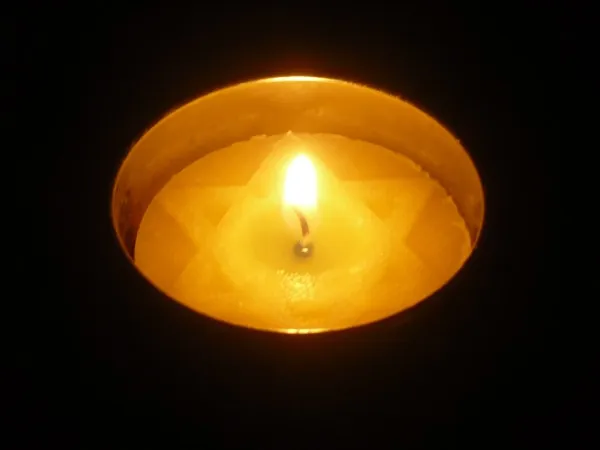 *A Yom HaShoah memorial candle. Photo by Valley2city, CC BY-SA 3.0, via Wikimedia Commons.*
The ceremony is solemn and carefully structured. The President or Prime Minister delivers an address. Prayers are recited. But the heart of the ceremony is the lighting of six torches — each one lit by a Holocaust survivor, representing one million of the six million murdered. As the survivors age and their numbers dwindle, this ritual has become increasingly poignant. Each year, fewer survivors are able to participate, and the urgency of preserving their testimony grows.
The six torches serve as a powerful symbol. They are not abstract. Each is lit by a real person — someone who was a child in a ghetto, who survived a death march, who emerged from hiding to find that their entire family had been annihilated. When they step forward, frail and elderly, and touch flame to torch, the ceremony moves from commemoration to witness. The audience is not merely remembering history; they are in the presence of someone who lived it.
Observance in Israel
Yom HaShoah in Israel is not a religious holiday in the traditional sense — there is no specific liturgy required by Jewish law. Instead, it is a national memorial day, and its observances are civic as well as spiritual.
On the evening Yom HaShoah begins, places of entertainment — cinemas, theaters, restaurants, bars — are closed by law. Israeli television and radio shift to memorial programming: documentaries, survivor interviews, readings of names. The flags on all public buildings are lowered to half-mast.
Schools devote the day to Holocaust education. Students hear from survivors (increasingly through recorded testimony), study the history, and participate in memorial ceremonies. Many schools organize their own candle-lighting rituals, and students often read aloud the names of victims.
The morning siren is the day’s most iconic moment, but the quiet hours that follow are equally meaningful. Throughout the day, Yad Vashem’s Hall of Names is open, and visitors come to look up relatives, to add pages of testimony for victims whose stories have not yet been recorded, and simply to stand in silence in the memorial’s cavernous spaces.
The March of the Living
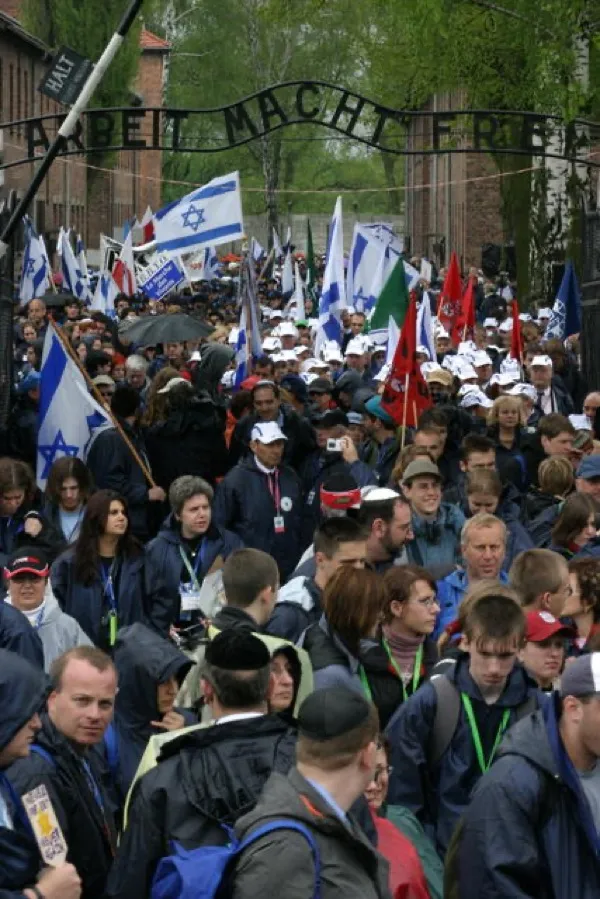 *The March of the Living at Auschwitz-Birkenau. Photo used under GFDL 1.2, via Wikimedia Commons.*
Since 1988, Yom HaShoah has also been marked by the March of the Living — an annual pilgrimage in which thousands of participants, predominantly Jewish teenagers from around the world, walk the three-kilometer path from Auschwitz to Birkenau in Poland.
The march is a deliberate inversion of the death marches that the Nazis forced upon concentration camp prisoners. Where those marches led to death, this one is a march of the living — a statement that the Jewish people survived, that they remember, and that they carry the memory forward.
For many young participants, the March of the Living is a transformative experience. They walk the same ground where over a million people — most of them Jews — were murdered. They see the barracks, the railroad tracks, the ruins of the gas chambers. And then, in many programs, they travel to Israel, where the juxtaposition of destruction and rebirth becomes viscerally real.
The March has grown to include delegations from dozens of countries and has expanded its mission to include education about genocide more broadly, drawing connections between the Holocaust and other atrocities.
”Never Again”
The phrase most associated with Yom HaShoah — and with Holocaust remembrance more broadly — is “Never Again.” First used in the immediate aftermath of the war, it has become a universal pledge against genocide and mass atrocity.
But the phrase carries different weight in different communities. For many Israelis, “Never Again” is inseparable from the existence of the state itself — the idea that Jewish sovereignty and military strength are the ultimate guarantees against a repetition of the Shoah. For others, “Never Again” is a universal moral imperative — a call to stand against genocide, persecution, and dehumanization wherever they occur, regardless of who the victims are.
This tension — between particular Jewish memory and universal moral responsibility — runs through all of Yom HaShoah’s observances. It is not a tension that needs to be resolved. Both dimensions are present, and both are necessary. Remembering the specific horror of the Holocaust as a Jewish catastrophe does not diminish the universal lessons; affirming the universal lessons does not erase the particular Jewish grief.
Observance in the Diaspora
Outside Israel, Yom HaShoah observances vary widely. Many synagogues hold special memorial services, often centered on candle-lighting, readings of names, and survivor testimony. Some communities organize public ceremonies with civic leaders, interfaith participation, and educational programming.
In the United States, the Days of Remembrance — a week of observance established by Congress in 1980 — is anchored by a ceremony in the U.S. Capitol and events at the United States Holocaust Memorial Museum in Washington, D.C. Communities across the country hold their own programs, often featuring local survivors.
A particularly moving custom that has spread widely is the reading of names. For hours on end, volunteers stand at a podium and read aloud the names of Holocaust victims — one by one, with their age and place of origin. It is slow, repetitive, and deliberately incomplete (the names of all six million could never be read in a single day). The power lies in the accumulation: each name is a person, not a statistic.
The Challenge of Memory
As the generation of survivors passes — the youngest are now in their late eighties and nineties — Yom HaShoah faces a profound challenge: how do you maintain living memory when the living witnesses are gone?
The answer, increasingly, lies in recorded testimony. Projects like the USC Shoah Foundation (founded by Steven Spielberg) have recorded over 55,000 survivor testimonies in dozens of languages. Yad Vashem’s archives hold millions of documents, photographs, and artifacts. These resources ensure that the facts of the Holocaust will be preserved.
But facts alone are not memory. Memory is personal, emotional, embodied — it is the tremor in a survivor’s voice, the tears in their eyes, the long pause before they can continue. The great work of Yom HaShoah going forward is to transmit not just information but obligation — the sacred duty to remember, to teach, to bear witness, and to act.
As Elie Wiesel, the Nobel laureate and survivor, wrote: “For the dead and the living, we must bear witness.”
On Yom HaShoah, a siren sounds, a nation stands still, and six torches are lit. It is not enough. It can never be enough. But it is a beginning — a commitment, renewed each year, that the six million will not be forgotten, and that their memory will shape the conscience of generations to come.
Frequently Asked Questions
When is Yom HaShoah?
Yom HaShoah falls on the 27th of Nisan, the Hebrew month that also contains Passover. It usually occurs in April or May. The date was chosen for its proximity to the anniversary of the Warsaw Ghetto Uprising (1943).
What happens during the siren on Yom HaShoah?
At 10:00 a.m. on Yom HaShoah, a two-minute siren sounds across all of Israel. Traffic stops on highways, pedestrians freeze in place, and the entire country stands in silent tribute to the six million Jews murdered in the Holocaust.
What is the March of the Living?
The March of the Living is an annual educational program in which thousands of people — primarily Jewish youth — walk the three-kilometer path from Auschwitz to Birkenau in Poland on Yom HaShoah, honoring the victims and affirming Jewish survival.
Test Your Knowledge
Think you know this topic? Try our quiz!
Take the Jewish Holidays: Advanced Quiz →Sources & Further Reading
Related Articles
The Holocaust: Remembering the Six Million
The systematic murder of six million Jews during World War II — the darkest chapter in human history and its lasting impact on Jewish identity.
The Birth of Modern Israel
From the rise of Zionism to the declaration of independence in 1948 — the story of how the Jewish homeland was reestablished.
Tisha B'Av: The Saddest Day in the Jewish Calendar
On the ninth of Av, Jews mourn the destruction of both Temples and centuries of tragedy — through fasting, lamentation, and the haunting words of the Book of Lamentations.