Zionism: The Movement That Built a Nation
Zionism — the movement for Jewish self-determination in the ancestral homeland — transformed from a radical 19th-century idea into the founding ideology of the State of Israel.
A Journalist’s Epiphany
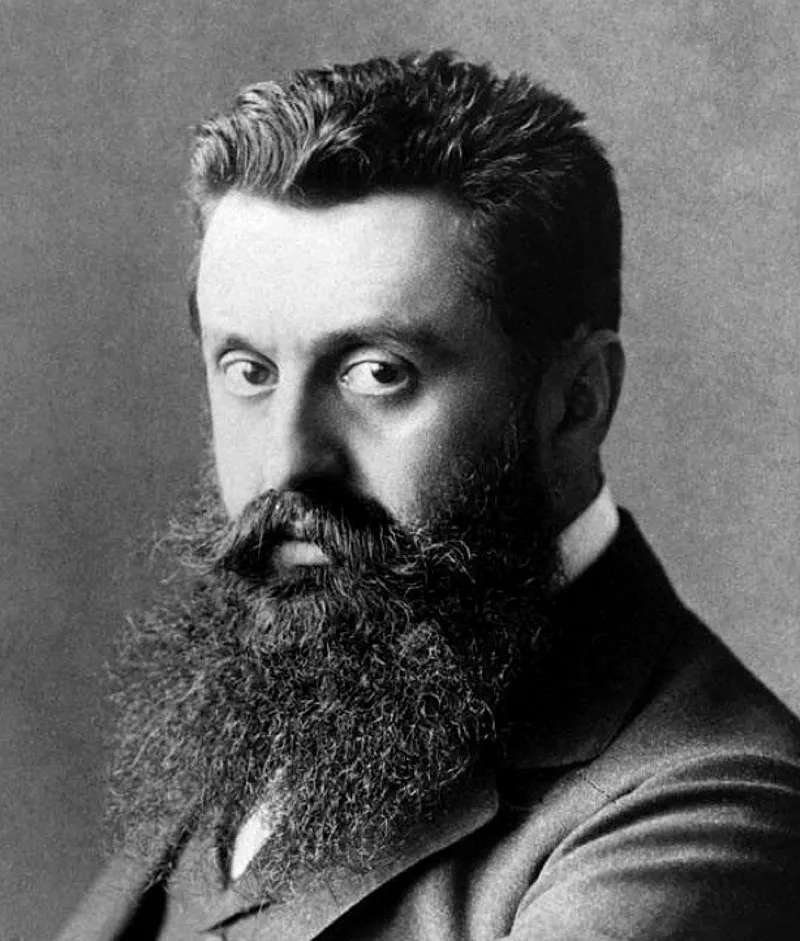
According to the widely told account, in January 1895 a Viennese journalist named Theodor Herzl stood in a Paris courtyard and watched a Jewish officer — Captain Alfred Dreyfus — be publicly stripped of his rank. The French army had convicted Dreyfus of treason on fabricated evidence. As the officer’s epaulets were torn from his shoulders and his sword was broken, the crowd outside the gates screamed: “A mort les Juifs!” — “Death to the Jews!”
Herzl had come to Paris as the correspondent for a prestigious Viennese newspaper. He was an assimilated, cosmopolitan Jew who had believed that European Enlightenment would eventually dissolve anti-Jewish prejudice. The Dreyfus Affair shattered that belief. If antisemitism could thrive in France — the birthplace of liberty, equality, and fraternity — then it could thrive anywhere. The Jewish people needed their own state.
Within two years, Herzl had written Der Judenstaat (“The Jewish State”), convened the First Zionist Congress in Basel, and launched the movement that would, half a century later, create the State of Israel.
Roots Before Herzl
Herzl did not invent the idea of Jewish return to the Land of Israel. Jews had prayed for it for two thousand years — every day in the Amidah prayer, every Passover with the declaration “Next year in Jerusalem,” every time they faced east to pray.
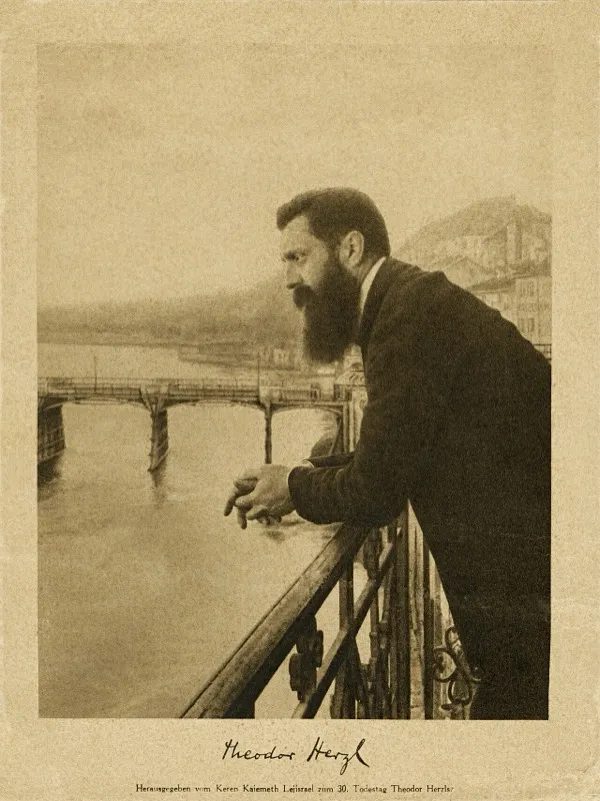
In the mid-nineteenth century, several movements anticipated Herzl. Rabbi Yehuda Alkalai and Rabbi Zvi Hirsch Kalischer argued that Jewish return to the Land of Israel was not just a messianic hope but a practical obligation. Moses Hess, a German-Jewish socialist, published Rome and Jerusalem (1862), calling for a Jewish state. The Hovevei Zion (“Lovers of Zion”) movement in Russia organized the first modern wave of Jewish immigration to Ottoman Palestine in the 1880s, establishing agricultural settlements.
But it was Herzl who transformed scattered longing into a political movement with institutions, diplomacy, and global reach.
The Basel Congress of 1897
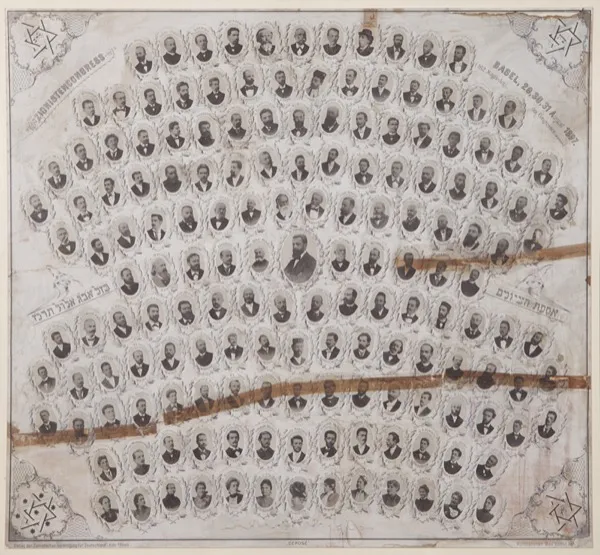
On August 29, 1897, 208 delegates from across Europe gathered in Basel, Switzerland, for the First Zionist Congress. Herzl presided. The delegates adopted the Basel Program, which declared: “Zionism seeks to establish a home for the Jewish people in Palestine secured under public law.”
Herzl famously wrote in his diary: “In Basel, I founded the Jewish state. If I said this out loud today, I would be answered by universal laughter. In five years perhaps, and certainly in fifty years, everyone will perceive it.” The State of Israel was proclaimed almost exactly fifty-one years later.
The Congress established the World Zionist Organization, began raising funds through the Jewish National Fund, and started the diplomatic campaign that would eventually yield the Balfour Declaration.
Types of Zionism
Zionism was never a monolith. From the beginning, fierce debates raged about what kind of Jewish homeland should be built.
Political Zionism
Herzl’s vision: a state established through international diplomacy and great-power support. Herzl himself was relatively indifferent to the specific location — he briefly considered Argentina and Uganda as alternatives to Palestine. His followers rejected these alternatives, insisting on the historic homeland.
Cultural Zionism
Ahad Ha’am (Asher Ginsberg) argued that a political state was not enough. The goal should be the revival of Hebrew culture — language, literature, philosophy — creating a “spiritual center” that would renew Jewish life worldwide. Ahad Ha’am’s vision profoundly shaped the cultural institutions of the eventual state.
Labor Zionism
The dominant ideology of the pre-state period. Labor Zionists — including figures like A.D. Gordon, David Ben-Gurion, and Golda Meir — believed in building the Jewish homeland through physical labor, collective agriculture, and socialist principles. They created the kibbutz movement, the Histadrut labor federation, and the political infrastructure that governed Israel for its first three decades.
Religious Zionism
Rabbi Abraham Isaac Kook articulated a theology that saw the return to the Land of Israel as the beginning of the messianic process. Religious Zionists embraced the state-building project as a religious commandment. After 1967, this movement became strongly associated with the settlement movement in the West Bank.
Revisionist Zionism
Vladimir Jabotinsky founded the Revisionist movement in the 1920s, advocating for Jewish sovereignty over both banks of the Jordan River and a more militant approach to achieving statehood. The Revisionist movement gave rise to the Irgun and Lehi paramilitary organizations and, later, to Israel’s Likud party.
The Balfour Declaration and the British Mandate
In November 1917, the British government issued the Balfour Declaration — a brief letter from Foreign Secretary Arthur Balfour to Lord Rothschild, stating: “His Majesty’s Government view with favour the establishment in Palestine of a national home for the Jewish people.” The declaration was carefully worded: it spoke of “a national home” rather than “a state,” and it included the caveat that nothing should prejudice the rights of existing non-Jewish communities.
After World War I, Britain received the League of Nations Mandate over Palestine and was tasked with implementing the Balfour Declaration. The Mandate period (1920-1948) was marked by successive waves of Jewish immigration (aliyah), the development of Jewish institutions, and escalating tensions between Jewish and Arab communities.
The UN Partition and Independence
After World War II and the Holocaust, international support for a Jewish state grew dramatically. In November 1947, the United Nations General Assembly voted to partition Palestine into a Jewish state and an Arab state, with Jerusalem under international administration. The Jewish leadership accepted the plan; the Arab leadership rejected it.
On May 14, 1948, David Ben-Gurion declared the establishment of the State of Israel. The new state was immediately recognized by the United States and the Soviet Union — and immediately attacked by five Arab armies. The war that followed, known in Israel as the War of Independence and by Palestinians as the Nakba (“catastrophe”), resulted in Israeli victory, the expansion of Israel’s borders beyond the partition plan, and the displacement of hundreds of thousands of Palestinians.
Post-1948: Evolution and Debate
After independence, Zionism evolved from a liberation movement into the governing ideology of a state — and, inevitably, into something more complicated. The ingathering of the diaspora brought Jews from over seventy countries, creating a society of extraordinary diversity and sometimes painful internal tensions.
The 1967 Six-Day War, in which Israel captured the West Bank, Gaza Strip, Sinai Peninsula, and Golan Heights, transformed the Zionist debate. For Religious Zionists, the conquest of biblical Judea and Samaria was messianic fulfillment. For others, the occupation of millions of Palestinians posed a fundamental challenge to Zionism’s democratic aspirations.
Anti-Zionism and Antisemitism
The question of whether anti-Zionism constitutes antisemitism is one of the most charged debates in contemporary Jewish and political life.
Those who equate the two argue that denying Jews the right to self-determination — while supporting that right for other peoples — is inherently discriminatory. The IHRA (International Holocaust Remembrance Alliance) working definition of antisemitism includes “denying the Jewish people their right to self-determination” as a potential example.
Those who distinguish the two argue that opposing a specific political ideology or state policies is not the same as hating a people. Some ultra-Orthodox Jews (particularly Satmar Hasidim and Neturei Karta) oppose Zionism on religious grounds, believing that a Jewish state should only be established by the Messiah. Some left-wing Jews advocate for alternative political arrangements — binational states, confederation — without any anti-Jewish animus.
The debate is real, the stakes are high, and honest people disagree. What is clear is that antisemitism often disguises itself as anti-Zionism, and that vigilance is required to distinguish legitimate political critique from hatred.
Zionism Today
Zionism in the twenty-first century looks nothing like the movement Herzl founded. Israel exists. The question is no longer whether there should be a Jewish state, but what kind of state it should be. The debates within Zionism — about democracy, religion, borders, and identity — are as fierce as the debates between Zionists and their critics.
For millions of Jews worldwide, Israel remains central to their identity — a source of pride, anxiety, and endless argument. For millions of others, the consequences of Zionism’s success remain unresolved. The story is far from over.
Frequently Asked Questions
What is the difference between Zionism and Judaism?
Judaism is a religion and civilization spanning thousands of years. Zionism is a modern political movement, founded in the late 19th century, advocating for Jewish self-determination in the Land of Israel. Not all Jews are Zionists, and not all Zionists are Jewish. Some ultra-Orthodox Jews oppose Zionism on religious grounds, while many secular and religious Jews support it.
What are the different types of Zionism?
The major types include Political Zionism (Herzl — establishing a state through diplomacy), Cultural Zionism (Ahad Ha'am — reviving Hebrew culture), Labor Zionism (building a socialist society through kibbutzim), Religious Zionism (integrating Jewish law with statehood), and Revisionist Zionism (Jabotinsky — asserting Jewish sovereignty over all of historic Israel). Each emphasized different aspects of the national project.
Is anti-Zionism the same as antisemitism?
This is one of the most debated questions in contemporary Jewish life. Some argue that opposing the existence of the only Jewish state is inherently antisemitic because it denies Jews the right to self-determination. Others, including some Jews, distinguish between criticizing Israeli policies and opposing the state's existence. The line between legitimate criticism and antisemitism remains contested and context-dependent.
Sources & Further Reading
Related Articles
The Jewish Diaspora: 2,000 Years Across the Globe
How the destruction of the Second Temple scattered the Jewish people across continents, creating diverse communities united by faith.
The Holocaust: Remembering the Six Million
The systematic murder of six million Jews during World War II — the darkest chapter in human history and its lasting impact on Jewish identity.
The Birth of Modern Israel
From the rise of Zionism to the declaration of independence in 1948 — the story of how the Jewish homeland was reestablished.