Ancient Israel: From Abraham to the Kingdoms
The foundational story of the Jewish people — from the call of Abraham through the united monarchy of David and Solomon.
The Beginning of a People
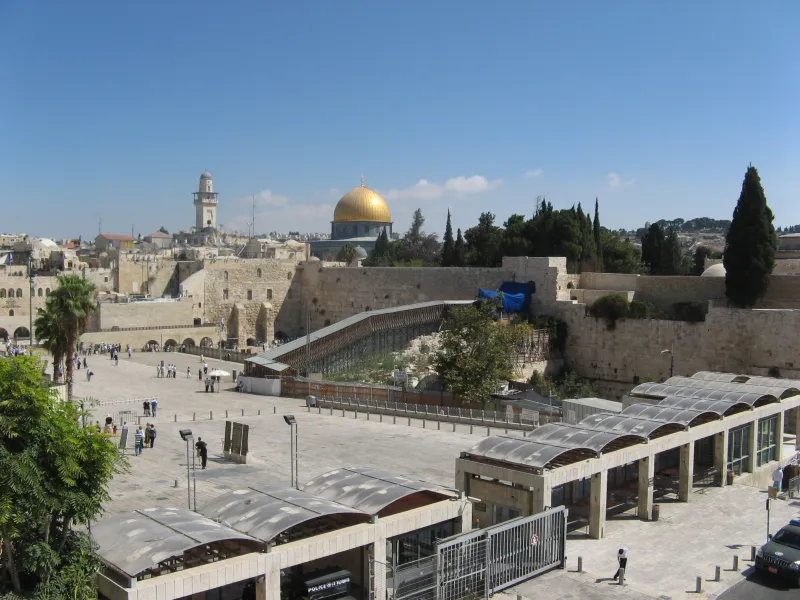
Stand at the Western Wall in Jerusalem and press your hands against the stones. They are cool to the touch, worn smooth by centuries of contact with human palms. These massive blocks were laid more than two thousand years ago, and they are all that remains above ground of the Temple complex where ancient Israelites once gathered to worship. Visitors tuck folded prayers into the cracks between the stones. Around you, people pray in a dozen languages. The wall does not answer, but it holds — steady, silent, immovable. Touch these stones and you are touching the physical edge of the story that follows.
The story of the Jewish people begins not with a nation or a kingdom, but with a single act of faith. According to the Torah, a man named Abraham — living in the ancient city of Ur in Mesopotamia (modern-day Iraq) — heard the voice of God calling him to leave his homeland and journey to a land that would be shown to him. That land was Canaan, the region we know today as Israel and Palestine.
Abraham’s willingness to follow this call, roughly four thousand years ago, marks the beginning of the covenant between God and the Jewish people. This covenant — a mutual promise — would shape the identity, laws, and destiny of an entire civilization.
The Patriarchs and Matriarchs
Jewish tradition honors three patriarchs — Abraham, his son Isaac, and Isaac’s son Jacob — as well as four matriarchs: Sarah, Rebecca, Rachel, and Leah. Together, these figures form the foundation of Jewish ancestry.
Jacob, later renamed Israel (“one who wrestles with God”), had twelve sons. Each son became the head of a tribe, and together they formed the Twelve Tribes of Israel — the core structure of the ancient Israelite nation.
Key moments in the patriarchal era:
- The Binding of Isaac (Akedah): Abraham’s willingness to sacrifice his son Isaac at God’s command is one of the most powerful and debated stories in all of religious literature.
- Jacob’s Ladder: Jacob dreams of a ladder reaching to heaven with angels ascending and descending — a vision of the connection between the earthly and divine.
- Joseph in Egypt: Jacob’s son Joseph is sold into slavery by his jealous brothers, only to rise to become the second most powerful person in Egypt. This sets the stage for the Israelites’ eventual journey into and out of Egypt.
Slavery and the Exodus
The Israelites settled in Egypt during a famine, but over the centuries, their growing numbers alarmed the Egyptian rulers. The Pharaoh enslaved them, and for generations they endured brutal forced labor.
According to the biblical account, God chose Moses — a Hebrew raised in the Egyptian royal court — to lead the Israelites to freedom. After the famous Ten Plagues devastated Egypt, Pharaoh finally relented. The Israelites crossed the Red Sea (or “Sea of Reeds”) and began their journey through the Sinai Desert.
The Exodus story is so central to Jewish identity that it is retold every year during the Passover Seder. It is not merely ancient history — it is a living narrative that reminds every generation of the value of freedom.
At Mount Sinai, Moses received the Torah — including the Ten Commandments — establishing the religious and legal foundation of Jewish life. The Sinai revelation is considered the defining moment when the Israelites became a people bound by law and covenant.
Entering the Promised Land
After forty years of wandering in the desert, the Israelites entered Canaan under the leadership of Joshua. The period that followed — the era of the Judges — was marked by tribal governance, with charismatic leaders like Deborah, Gideon, and Samson rising to defend the Israelites against neighboring enemies.
This was not yet a unified nation. Each tribe controlled its own territory, and there was no central government. The Book of Judges describes this era with the refrain: “In those days there was no king in Israel; everyone did what was right in their own eyes.”
The United Monarchy: Saul, David, and Solomon
The people eventually demanded a king, and around 1020 BCE, Saul was anointed as the first king of Israel. Saul’s reign was troubled, and he was eventually succeeded by David, a shepherd from Bethlehem who famously defeated the Philistine giant Goliath.
David is one of the most important figures in all of Jewish history:
- He united the twelve tribes into a single kingdom.
- He conquered Jerusalem and made it his capital — establishing it as the eternal spiritual center of the Jewish people.
- He is credited with composing many of the Psalms, the poetic prayers still recited in synagogues worldwide.
- Jewish tradition holds that the Messiah will one day come from the line of David.
David’s son Solomon took the kingdom to its peak of wealth and influence. Solomon’s greatest achievement was the construction of the First Temple in Jerusalem — a magnificent structure that served as the central place of worship for all Israelites. The Temple housed the Ark of the Covenant, believed to contain the original tablets of the Ten Commandments.
The Temple’s Significance
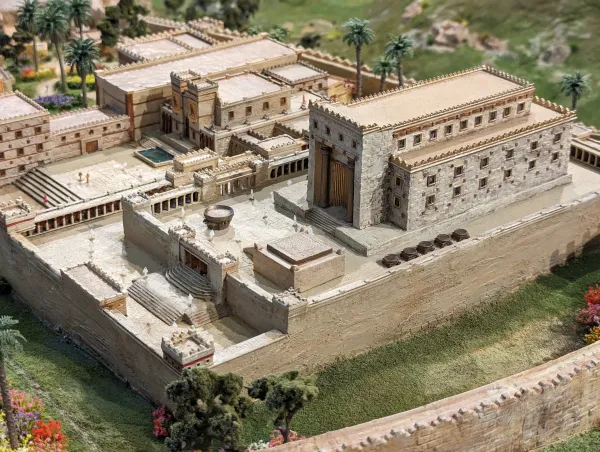
The First Temple was not just a building; it was the spiritual heart of the nation. Sacrifices, prayers, and pilgrimages centered on this single holy site. The concept of a central sanctuary transformed Israelite worship and identity.
The Divided Kingdom
After Solomon’s death around 930 BCE, the kingdom split in two:
- The Northern Kingdom (Israel): Ten tribes, with its capital eventually at Samaria.
- The Southern Kingdom (Judah): The tribes of Judah and Benjamin, with Jerusalem as its capital.
The two kingdoms often fought each other and faced threats from powerful empires. In 722 BCE, the Assyrian Empire conquered the Northern Kingdom, scattering its inhabitants. These became the famous “Ten Lost Tribes,” whose fate remains a subject of legend and speculation to this day.
The Southern Kingdom of Judah survived for another century and a half, until 586 BCE, when Nebuchadnezzar of Babylon destroyed Jerusalem and the First Temple. The people were exiled to Babylon — an event known as the Babylonian Exile.
Why This Period Matters
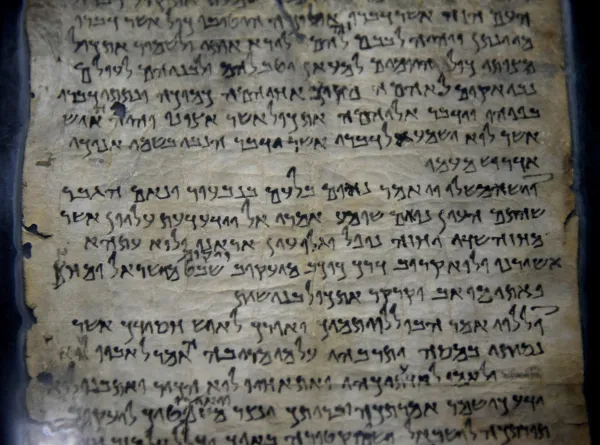
The stories of ancient Israel are not simply tales of the distant past. They established the fundamental ideas that define Judaism:
- Monotheism: The belief in one God, revolutionary in the ancient world.
- Covenant: The idea that the relationship between God and humanity involves mutual obligation.
- Law and ethics: The Torah’s legal codes shaped not only Judaism but influenced Christianity, Islam, and Western civilization.
- Memory as duty: The commandment to remember — the Exodus, the covenant, the Temple — makes historical consciousness a religious obligation.
There is something extraordinary about the fact that a people scattered across the globe for two millennia never stopped telling these stories. The Exodus was recounted at Seder tables in Baghdad and Brooklyn alike. The Psalms of David were chanted in synagogues from Marrakech to Melbourne. The names of Abraham, Sarah, Isaac, and Rebecca were whispered over newborns in every century and on every continent. These are not just stories about the past — they are the living connective tissue of a civilization that has refused to forget where it came from.
Whether understood as literal history, sacred narrative, or a blend of both, the story of ancient Israel remains the bedrock upon which all of Jewish civilization is built. Every prayer, every holiday, and every Jewish community in the world today traces its roots back to these foundational chapters.
Frequently Asked Questions
What is the significance of Ancient Israel?
Ancient Israel represents a pivotal chapter in Jewish history that shaped the trajectory of Jewish communities, culture, and identity for generations that followed.
When did Ancient Israel take place?
The events surrounding Ancient Israel unfolded during a specific period of Jewish history, with consequences that continue to influence Jewish life and memory today.
How is Ancient Israel remembered today?
Ancient Israel is commemorated through education, memorial observances, and scholarly study. Museums, archives, and community institutions preserve its memory for future generations.
Sources & Further Reading
Related Articles
King David and King Solomon: Israel's Golden Age
The story of David the shepherd who became king, established Jerusalem as the capital, and his son Solomon who built the First Temple — the golden age of ancient Israel.
The Dead Sea Scrolls: Ancient Texts That Changed History
The story of the Dead Sea Scrolls — from their accidental discovery by a Bedouin shepherd in 1947 to what they reveal about ancient Judaism, biblical texts, and a mysterious sect at Qumran.
The Jewish Diaspora: 2,000 Years Across the Globe
How the destruction of the Second Temple scattered the Jewish people across continents, creating diverse communities united by faith.
The Exodus from Egypt: Slavery, Liberation, and the Birth of a Nation
The story of the Israelite exodus from Egypt — slavery under Pharaoh, Moses's call, the ten plagues, the parting of the Red Sea, forty years in the desert, and the revelation at Sinai.
Jerusalem: 3,000 Years of Faith, Conflict, and Hope
For three millennia, Jerusalem has been the spiritual heart of the Jewish people — and a city sacred to three faiths. Its story is one of devotion, destruction, and enduring hope.
The Maccabees and the Hasmonean Era
The dramatic story of the Maccabean revolt against Greek oppression — from Mattathias's defiance to Judah Maccabee's victories, the Temple rededication, and the rise and fall of the Hasmonean dynasty.
The Menorah: Judaism's Oldest Symbol, from the Temple to the State of Israel
The seven-branched menorah is Judaism's most ancient symbol — described in Exodus, crafted for the Temple, carved on the Arch of Titus, and chosen as the emblem of the modern State of Israel. Its light has never gone out.
Tisha B'Av: The Saddest Day in the Jewish Calendar
On the ninth of Av, Jews mourn the destruction of both Temples and centuries of tragedy — through fasting, lamentation, and the haunting words of the Book of Lamentations.
The Western Wall (Kotel): Judaism's Holiest Place of Prayer
The Western Wall — the last remnant of the ancient Temple Mount — is where Jews have prayed, wept, and celebrated for centuries. It is a place of profound spiritual power.