The Western Wall (Kotel): Judaism's Holiest Place of Prayer
The Western Wall — the last remnant of the ancient Temple Mount — is where Jews have prayed, wept, and celebrated for centuries. It is a place of profound spiritual power.
Where Stones Hold Memory
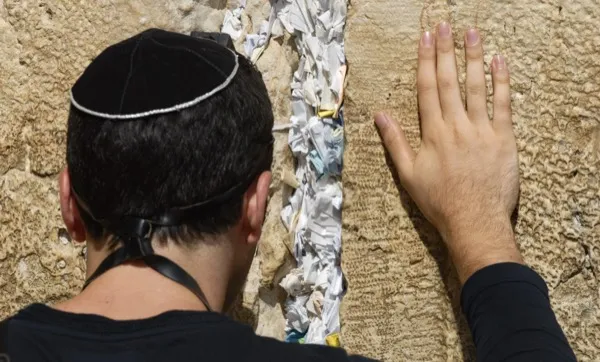
Press your palm against the Western Wall and you are touching stones that Herod’s workers quarried and placed more than two thousand years ago. Some of them weigh hundreds of tons. Their surfaces are smooth in places where millions of hands have rested, rough where time has etched the limestone. In the cracks between them, folded slips of paper are wedged so tightly they seem to grow from the stone itself — prayers written in dozens of languages, carried from every corner of the earth, and left here in the conviction that this place is closer to God than any other.
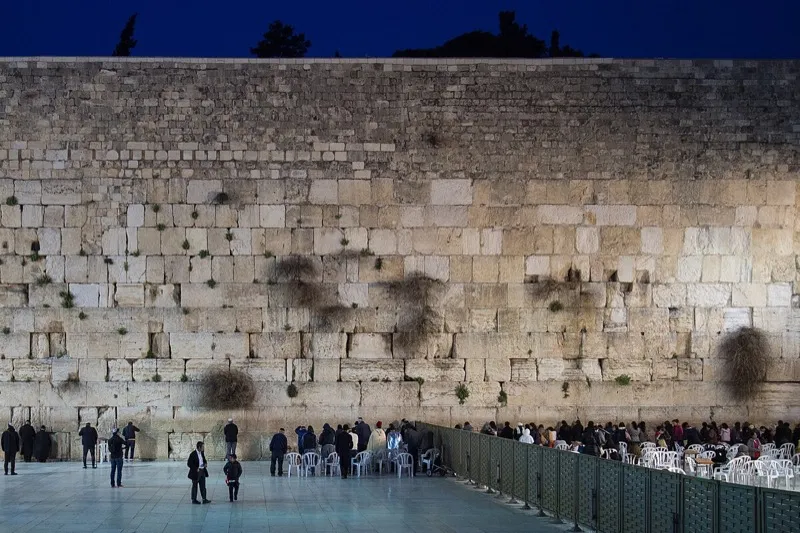
The Western Wall — known in Hebrew as the Kotel (הכותל) — is the last visible remnant of the retaining wall that surrounded the Second Temple Mount. It is not a wall of the Temple itself, but a wall of the massive platform that Herod the Great built to support and expand the Temple complex. And yet, for the Jewish people, it is the holiest accessible place on earth — a site of prayer, pilgrimage, celebration, and mourning that has endured conquest, neglect, and transformation.
The Herodian Stones
When King Herod renovated and expanded the Second Temple beginning around 19 BCE, he doubled the size of the Temple Mount platform by constructing enormous retaining walls and filling the spaces between them. The lower courses of the Western Wall consist of massive Herodian ashlars — precisely cut limestone blocks, some exceeding 12 meters in length and weighing over 500 tons. The largest single stone, visible in the Western Wall Tunnel, is one of the heaviest objects ever lifted by human beings without modern machinery.
Above the Herodian layers, smaller stones from later periods — Roman, Umayyad, Ottoman — tell the story of the Wall’s long life. The Wall stands approximately 19 meters above the prayer plaza, with another 17 meters hidden below ground level, reaching down to the original bedrock.
After the Romans destroyed the Temple in 70 CE, the retaining walls survived because they were not part of the Temple building itself. Over the centuries, the Western Wall became the focus of Jewish mourning for the lost Temple — which is why European visitors once called it the “Wailing Wall,” a name most Jews consider misleading. Jews do not come here merely to wail. They come to pray, to connect, and to hope.
The Prayer Plaza
For most of the Ottoman period, Jews prayed in a narrow alley barely four meters wide in front of the Wall. In 1967, after Israel captured the Old City in the Six-Day War, the Moroccan Quarter adjacent to the Wall was cleared to create the large prayer plaza that exists today.
The plaza functions as an open-air synagogue, divided into two sections: a men’s section on the left (as you face the Wall) and a women’s section on the right, separated by a mechitza (divider). The men’s section is roughly twice the size of the women’s — a disparity that has generated significant controversy.
The Wall is accessible 24 hours a day, every day of the year, including Shabbat and holidays. There is no admission charge. Visitors of all faiths are welcome, though modest dress is expected (head coverings for men are available at the entrance).
Notes in the Cracks
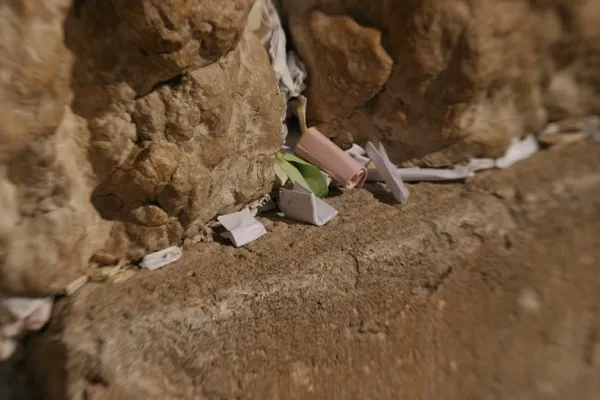
The tradition of placing written prayers (known as kvitlach) in the Wall’s crevices dates back centuries. Today, an estimated one million notes are placed each year. They range from carefully composed petitions to simple scrawled hopes: health for a loved one, peace, forgiveness, a child, a job, a miracle.
The notes are collected twice a year — before Passover and before Rosh Hashanah — and buried on the Mount of Olives, in accordance with the Jewish practice of giving worn sacred texts a respectful burial (genizah).
In the age of email and fax, some organizations offer to print and place notes on behalf of people who cannot travel to Jerusalem. The Wall receives prayers from around the world — a reminder that for millions of Jews, the Kotel is not merely a historical site but a living spiritual address.
Bar and Bat Mitzvah at the Wall
Every Monday and Thursday morning — the traditional days for Torah reading — families gather at the Western Wall to celebrate Bar and Bat Mitzvah ceremonies. These are some of the most joyful scenes at the Wall: a thirteen-year-old chanting from the Torah for the first time, family members tossing candy, women ululating from the other side of the mechitza, the shofar sounding.
For families from the diaspora, holding a Bar or Bat Mitzvah at the Kotel carries special meaning — it connects the young person to the deepest layers of Jewish history at the very site where their ancestors once brought offerings to the Temple.
The Egalitarian Prayer Controversy
The separation of men and women at the Wall — following Orthodox practice — has been a source of ongoing tension. The Women of the Wall organization, founded in 1988, has fought for decades for the right of women to pray at the main plaza wearing tallitot (prayer shawls) and reading from the Torah — practices that Orthodox authorities at the site have opposed, sometimes forcefully.
In 2016, the Israeli government approved a plan to create an expanded egalitarian prayer space at Robinson’s Arch, a section of the Western Wall south of the main plaza. The space would be managed jointly by Orthodox, Conservative, and Reform representatives. However, the plan was frozen in 2017 under pressure from ultra-Orthodox political parties, and its status remains unresolved.
This controversy reflects a broader tension within Judaism: Who gets to define how Jews pray at their holiest site? Orthodox leaders argue that the Wall should follow traditional halakhic practice. Progressive and Conservative Jews counter that the Wall belongs to all Jews and should accommodate all legitimate forms of Jewish worship. The debate is deeply felt on all sides and remains one of the most contentious religious issues in Israeli society.
The Western Wall Tunnels
Beneath the streets of the Muslim Quarter runs a remarkable underground passage: the Western Wall Tunnel, excavated over decades beginning in the 1960s. The tunnel follows the full 488-meter length of the Western Wall, most of which is hidden behind buildings and below street level.
Walking through the tunnel is like descending through time. You pass Herodian streets, Hasmonean-era waterways, and a point opposite the Holy of Holies — the spot closest to where the innermost chamber of the Temple once stood. Many visitors find this section the most emotionally powerful part of the entire experience, and it is common to see people praying with intensity at this point underground.
The Emotional Impact of a First Visit
Ask anyone who has visited the Western Wall for the first time and you will hear the same thing: I didn’t expect to feel so much. People who describe themselves as secular, who came as tourists with no particular religious expectation, find themselves moved to tears. Something about the stones, the weight of history, the sight of others pouring out their hearts — it bypasses intellectual defenses and reaches somewhere deeper.
This is not unique to Jews. Christians, Muslims, and people of no faith at all describe the same unexpected emotional response. The Wall seems to function as a kind of spiritual amplifier — a place where whatever you carry inside you rises to the surface.
Perhaps it is because the Wall has absorbed so much — so many centuries of prayer, so much grief, so much stubborn hope. Perhaps it is simply the power of a place that has meant so much to so many for so long. Whatever the explanation, the experience is remarkably consistent: you go expecting stones, and you find something alive.
For the Jewish people, the Western Wall is not a ruin. It is a promise — that what was lost can be remembered, that what was broken can be honored, and that the connection between a people and their holiest place can survive anything the world inflicts. The Wall still stands. And so do they.
Frequently Asked Questions
Why do people put notes in the Western Wall?
The tradition of placing written prayers in the crevices of the Western Wall dates back at least several hundred years. It is believed that prayers offered at the Wall are especially close to God's presence. Twice a year, the notes are respectfully collected and buried on the Mount of Olives, as is customary for sacred texts.
Can non-Jews visit the Western Wall?
Yes, the Western Wall is open to visitors of all faiths and backgrounds, free of charge, every day of the year including Shabbat and holidays. Visitors are asked to dress modestly (covering shoulders and knees) and to respect the sanctity of the site.
Why are there separate men's and women's sections at the Western Wall?
The Western Wall plaza follows Orthodox Jewish tradition, which separates men and women during prayer (mechitza). The men's section is larger than the women's. An egalitarian prayer space at Robinson's Arch, south of the main plaza, was approved in 2016 but its implementation remains disputed.
Sources & Further Reading
Related Articles
Ancient Israel: From Abraham to the Kingdoms
The foundational story of the Jewish people — from the call of Abraham through the united monarchy of David and Solomon.
Jerusalem: 3,000 Years of Faith, Conflict, and Hope
For three millennia, Jerusalem has been the spiritual heart of the Jewish people — and a city sacred to three faiths. Its story is one of devotion, destruction, and enduring hope.
Jewish Prayer: Connecting with the Divine
From the three daily prayer services to personal meditation, discover how Jewish prayer works and what it means.