Sufganiyot Recipe: Israeli Jelly Donuts for Hanukkah
Light, pillowy, and bursting with jelly — master these Israeli Hanukkah doughnuts with step-by-step frying tips and modern filling variations from dulce de leche to halva cream.

December in Tel Aviv
Walk through any Israeli city during Hanukkah and you will see them in every bakery window: golden rounds dusted with snow-white powdered sugar, their jelly filling threatening to escape from the sides. Sufganiyot — the plural of sufganiyah — are Israel’s definitive Hanukkah food. While American Jews tend to associate the holiday with latkes, in Israel the doughnut reigns supreme.
And these are not ordinary doughnuts. Israeli sufganiyot have evolved into an art form. Bakeries compete fiercely each Hanukkah season, offering fillings that range from classic strawberry jam to dulce de leche, halva cream, pistachio custard, and Nutella. Some are injected with two or three fillings. Some are topped with elaborate decorations. It is a national obsession, and roughly 18 million sufganiyot are consumed in Israel during the eight days of Hanukkah.
You can make them at home. The dough is forgiving, the frying is straightforward once you get the temperature right, and the filling possibilities are limited only by your imagination.
The Recipe
Yield: About 24 doughnuts Prep time: 30 minutes Rise time: 2 hours Fry time: About 30 minutes total
Ingredients
- 4 cups all-purpose flour
- ⅓ cup sugar
- 2¼ teaspoons instant yeast (1 packet)
- ½ teaspoon salt
- ½ teaspoon ground nutmeg
- ¾ cup whole milk, warm
- 3 large egg yolks
- ¼ cup (½ stick) unsalted butter, softened
- 1 teaspoon vanilla extract
- Vegetable or canola oil for frying (about 2 quarts)
- Powdered sugar for dusting
- Jam or filling of your choice
Instructions
1. Make the dough. In a stand mixer with the dough hook, combine the flour, sugar, yeast, salt, and nutmeg. Add the warm milk, egg yolks, and vanilla. Mix on low until combined, then increase to medium and knead for 5 minutes. Add the softened butter a tablespoon at a time, kneading until each addition is absorbed. Continue kneading for another 5–7 minutes until the dough is smooth, elastic, and pulls away from the bowl sides.
2. First rise. Transfer to a greased bowl, cover with plastic wrap, and let rise in a warm spot for 1½ hours until doubled.
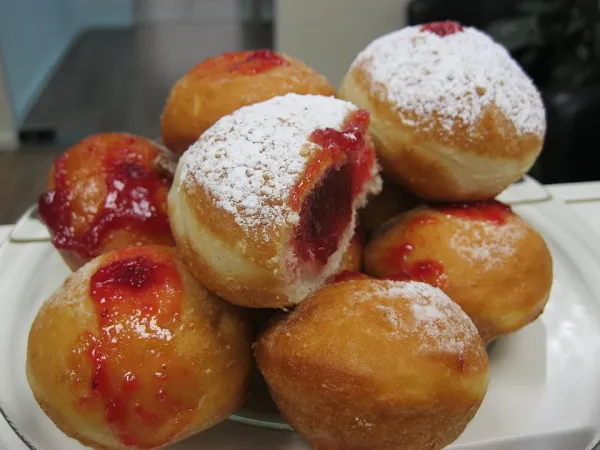
3. Shape. Turn the dough out onto a lightly floured surface. Roll to about ½ inch thick. Using a 3-inch round cutter (or a glass), cut out circles. Gather scraps, re-roll once, and cut more. Place the rounds on parchment-lined baking sheets, spaced 2 inches apart.
4. Second rise. Cover loosely and let rise for 30 minutes until puffy.
5. Fry. Fill a heavy-bottomed pot or Dutch oven with 3 inches of oil. Heat to 350°F (175°C) — use a thermometer. Carefully lower 3–4 doughnuts at a time into the oil. Fry for 2–3 minutes per side until deep golden brown. The doughnuts should have a pale white stripe around the middle where they sat at the oil line.
6. Drain. Remove with a slotted spoon and place on a wire rack set over a baking sheet. Do not use paper towels — they make the bottoms soggy.
7. Fill. Once cool enough to handle, use a small knife to poke a hole in the side of each doughnut. Fill a piping bag (or zip-lock bag with a corner cut) with your chosen filling. Insert the tip into the hole and squeeze gently until you feel the doughnut grow slightly heavier — about 1–2 tablespoons of filling.
8. Finish. Dust generously with powdered sugar. Serve the same day — sufganiyot do not improve with age.
Modern Filling Variations
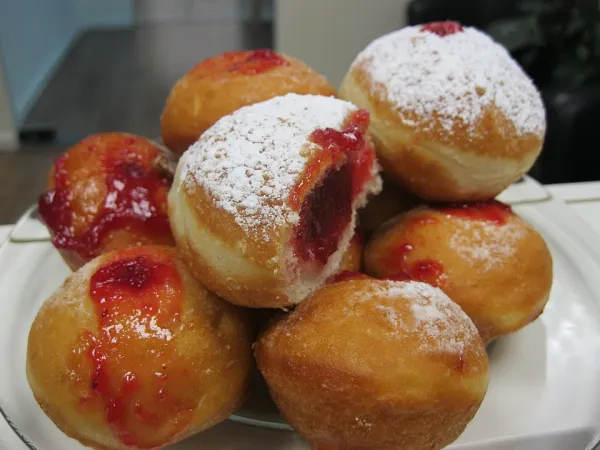
Dulce de leche: Pipe in store-bought or homemade dulce de leche. The caramel richness against the light dough is extraordinary.
Halva cream: Blend 1 cup whipped cream with ½ cup crumbled halva and 2 tablespoons tahini. Pipe into the doughnuts and top with crushed halva.
Bavarian cream: Make a vanilla pastry cream, fold in whipped cream for lightness, and pipe generously.
Nutella: The easiest variation — just pipe in Nutella straight from the jar. No one will complain.
Lemon curd: Bright, tart, and a perfect contrast to the rich, fried dough. Make your own or use store-bought.
Frying Tips
Temperature is everything. Too cool (below 340°F) and the doughnuts absorb oil and become greasy. Too hot (above 370°F) and the outside burns before the inside cooks. Keep that thermometer in the oil and adjust the heat constantly.
Do not crowd the pot. Three to four doughnuts at a time. Each one drops the oil temperature, so fewer is better.
The white stripe. A well-fried sufganiyah has a pale stripe around the equator. This is normal and correct — it is where the dough sat at the surface of the oil.
Sufganiyot are the taste of Hanukkah — fried in oil, sweet as the miracle they celebrate, and best when shared with people who do not mind powdered sugar on their clothes.
Frequently Asked Questions
Why do Jews eat sufganiyot on Hanukkah?
Like latkes, sufganiyot are fried in oil, commemorating the miracle of the oil in the Temple. When the Maccabees rededicated the Temple, a small jar of oil that should have lasted one day burned for eight nights. Eating foods fried in oil — whether potato pancakes or doughnuts — celebrates this miracle.
What is the difference between sufganiyot and regular donuts?
Sufganiyot are specifically round doughnuts without a hole, made from a rich yeasted dough, deep-fried, filled with jelly or cream, and dusted with powdered sugar. Unlike American doughnuts, they are not glazed. The dough is typically richer in eggs and butter, producing a lighter, more brioche-like texture.
Can you bake sufganiyot instead of frying?
You can bake them at 375°F for 12-15 minutes, but they will not taste the same. The whole point of sufganiyot is the oil — both for flavor and for the Hanukkah symbolism. Baked versions are softer and more bread-like. If you do bake them, brush with melted butter immediately after removing from the oven to add richness.
Sources & Further Reading
- My Jewish Learning — Sufganiyot History ↗
- The Nosher — Sufganiyot Recipes ↗
- Janna Gur, The Book of New Israeli Food
Related Articles
Hanukkah: The Festival of Lights
Eight nights of candles, latkes, and dreidels — the story and customs of the beloved winter holiday.
Jewish Holiday Foods: What We Eat and Why
Every Jewish holiday has its signature foods — and each dish tells a story of history, symbolism, and tradition.
Classic Latkes Recipe: Crispy Hanukkah Potato Pancakes
Crispy on the outside, tender inside — master the art of perfect latkes with this traditional recipe, served with applesauce and sour cream for the ultimate Hanukkah treat.