Sephardic Cuisine: The Mediterranean Flavors of Jewish Cooking
Spiced, vibrant, and sun-drenched — Sephardic cuisine draws from the kitchens of Spain, Turkey, Morocco, and the Middle East, creating a Jewish food tradition that rivals any in the world.
Walking Through the Market
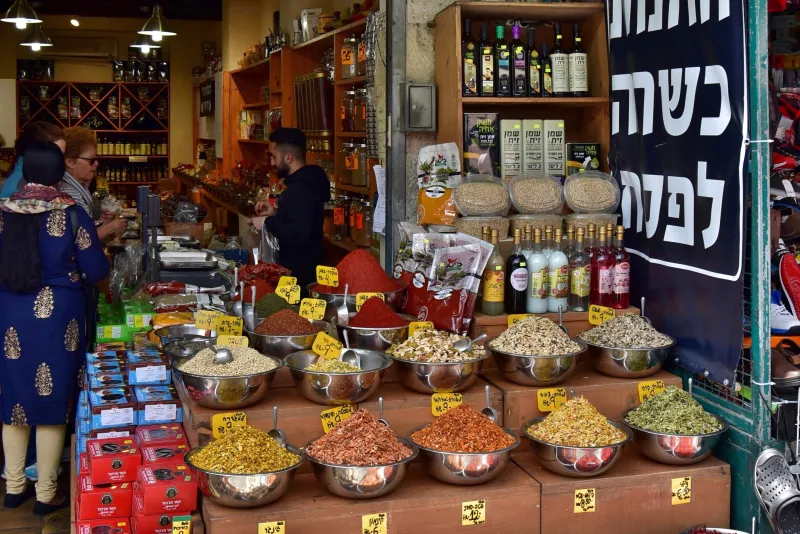
There is a moment, early on a Friday morning in Jerusalem’s Mahane Yehuda market, when the air becomes almost too rich to breathe. The spice stalls are open — pyramids of turmeric and cumin and paprika glowing under bare bulbs, barrels of dried rose petals and sumac and za’atar lined up in rows. A few stalls down, a man is pulling bourekas from the oven — golden, flaky, the cheese inside still bubbling — and stacking them on a tray that will be empty within the hour. Somewhere around the corner, someone is frying falafel, and the sizzle competes with a radio playing Mizrahi pop at a volume that suggests the cook is not taking requests.
This is the world of Sephardic cuisine — sun-drenched, spice-laden, abundant, and alive. It is a culinary tradition that spans continents and centuries, from the medieval kitchens of Moorish Spain to the street food stalls of modern Tel Aviv. And for much of the 20th century, it was overshadowed in the Western imagination by Ashkenazi food — the gefilte fish, the bagels, the deli sandwiches that defined “Jewish food” in America. But Sephardic cuisine has always been there, and in recent decades, the world has finally begun to pay attention.
What Is Sephardic Cuisine?
The term Sephardic comes from Sepharad, the Hebrew word for Spain. Strictly speaking, Sephardic Jews are descendants of the Jewish communities expelled from Spain and Portugal in 1492. But in common usage — especially in Israel — “Sephardic” has become an umbrella term for Jewish communities from the Mediterranean basin, the Middle East, and North Africa, including groups more precisely called Mizrahi (Eastern) Jews.
Sephardic cuisine, then, is really a family of cuisines — connected by shared ingredients, techniques, and Jewish dietary laws (kashrut), but shaped by the specific countries and cultures where these communities lived for centuries. What unites them is a sensibility: bold spices, fresh herbs, olive oil instead of butter or schmaltz, rice and legumes alongside wheat, and a love of color on the plate.
It is a cuisine built for warmth, both of climate and of temperament. Where Ashkenazi cooking often prioritized preservation and caloric density (logical in the cold winters of Eastern Europe), Sephardic cooking celebrates freshness, brightness, and the abundance of the Mediterranean growing season.
The Regions
Ottoman and Turkish Jewish Cuisine
After the 1492 expulsion, the Ottoman Empire welcomed Sephardic refugees, and Turkish Jewish cuisine became one of the richest branches of the tradition. Key dishes include:
- Bourekas — flaky phyllo or puff pastry filled with cheese, spinach, potato, or meat. Bourekas are perhaps the most iconic Sephardic food in Israel, sold in bakeries and bus stations across the country.
- Stuffed vegetables (dolma and sarma) — grape leaves, peppers, tomatoes, and zucchini filled with rice, meat, and spices.
- Boyos — savory pastries made with cheese and sometimes eggplant.
- Raki and meze — a tradition of small dishes served before meals, influenced by the broader Ottoman dining culture.
Moroccan Jewish Cuisine
Moroccan Jews developed one of the most sophisticated Jewish culinary traditions in the world, blending Berber, Arab, and Andalusian influences:
- Couscous — the Friday staple, served with a rich stew of meat, vegetables, and chickpeas. Moroccan Jewish couscous is often sweeter than its Muslim counterpart, sometimes incorporating dried fruits and cinnamon.
- Dafina — the Moroccan Jewish Shabbat stew, equivalent to Ashkenazi cholent. Slow-cooked overnight, it includes meat, potatoes, chickpeas, eggs (which turn brown from hours of cooking), and wheat berries. Each family has its own recipe, guarded jealously.
- Pastilla — a layered pastry traditionally filled with pigeon or chicken, almonds, and dusted with powdered sugar and cinnamon. The sweet-savory combination is quintessentially Moroccan.
- Preserved lemons and olives — essential pantry items that give Moroccan Jewish cooking its distinctive tang.
Iraqi Jewish Cuisine
Iraqi Jews — one of the oldest Jewish communities in the world, tracing their roots to the Babylonian exile — developed a cuisine of remarkable depth:
- Kubbeh — semolina-shelled dumplings filled with spiced ground meat, served in soups ranging from beet-red to tomato-based. Kubbeh soup has become one of Israel’s most popular comfort foods.
- T’beet — a whole chicken stuffed with rice and spices, slow-cooked overnight for Shabbat. It is the Iraqi Jewish equivalent of cholent.
- Amba — a pickled mango condiment that Iraqi Jews brought to Israel, where it became a beloved topping for falafel and shawarma.
- Sambousek — filled pastry pockets, either fried or baked, served as appetizers.
Yemenite Jewish Cuisine
Yemenite Jews, isolated for centuries in the Arabian Peninsula, developed a cuisine that is entirely their own — rustic, intensely spiced, and built around bread:
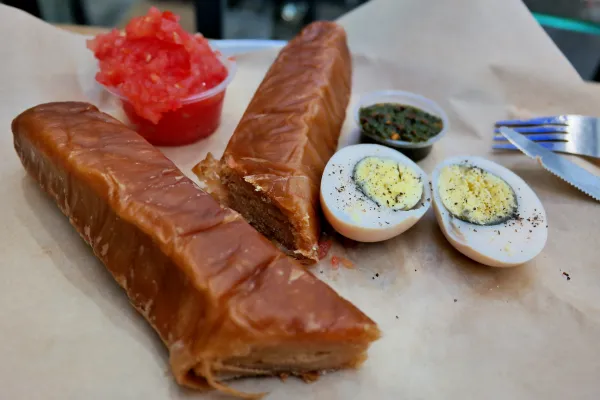
- Jachnun — a rich, buttery, slow-baked pastry that cooks overnight and is served for Shabbat morning with grated tomato and hard-boiled eggs. Its sweetness comes not from sugar but from the long, slow caramelization of the dough.
- Kubaneh — a pull-apart Shabbat bread, baked overnight in a sealed pot, producing an impossibly tender, almost steamed texture.
- Malawach — flaky, pan-fried flatbread, often served with the same tomato-and-egg accompaniment as jachnun.
- Skhug (zhug) — a fiery green (or red) chili paste that has become ubiquitous in Israeli cuisine. It is Yemenite in origin and indispensable in practice.
Indian Jewish Cuisine
India’s Jewish communities — the Bene Israel of Maharashtra, the Cochin Jews of Kerala, and the Baghdadi Jews of Kolkata — created kosher adaptations of Indian cooking:
- Coconut-based fish curries for Shabbat
- Malida — a sweet, spiced rice dish prepared for celebrations
- Aloo makala — fried potato slices served at festivals
Key Dishes
Shakshuka
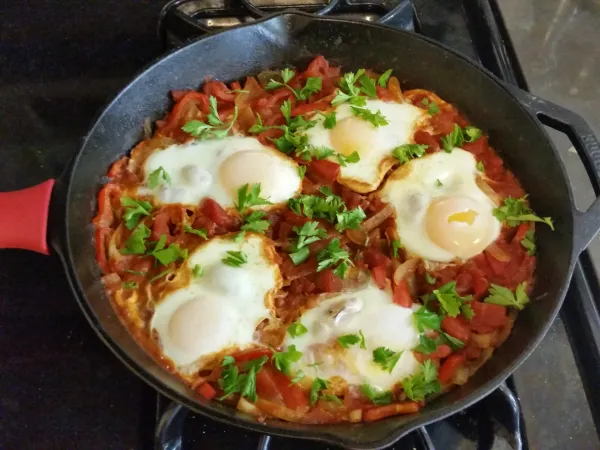
Eggs poached in a spiced tomato and pepper sauce, served in the pan with crusty bread for dipping. Shakshuka likely originated in Tunisia or Libya and arrived in Israel with North African immigrants. Today it is arguably Israel’s national breakfast dish, served in every cafe from Eilat to Metula. The basic version is tomatoes, peppers, onions, cumin, and paprika, but variations abound — green shakshuka with spinach and herbs, shakshuka with feta cheese, shakshuka with merguez sausage.
Bourekas
Flaky pastries filled with cheese, potato, spinach, or meat. In Israel, bourekas culture is a world unto itself — different shapes traditionally indicate different fillings (triangles for cheese, rectangles for potato, spirals for spinach). A proper bourekas breakfast includes a hard-boiled egg, a fresh tomato-cucumber salad, and a cup of Turkish coffee.
Couscous
Tiny granules of semolina, steamed and served with stew. Couscous is Friday food in North African Jewish homes — Moroccan, Tunisian, Algerian, and Libyan families each have their own version. The traditional preparation involves steaming the couscous multiple times in a couscoussier, building up layers of flavor and fluffiness.
Dafina/Hamin
The Sephardic answer to cholent — a slow-cooked Shabbat stew that simmers overnight because cooking is forbidden on the day of rest. Every community has its version: Moroccan dafina with wheat berries and dates, Iraqi t’beet with whole stuffed chicken, Yemenite hamin with hawaij spice blend.
Spices and Ingredients
What sets Sephardic cuisine apart is its pantry. Where an Ashkenazi kitchen might rely on salt, pepper, garlic, and dill, a Sephardic kitchen is an aromatic universe:
- Cumin — earthy, warm, and present in almost everything
- Turmeric — for color and an earthy undertone
- Saffron — the luxury spice, used in rice dishes and stews
- Cinnamon — not just for sweets but for meat dishes, stews, and rice
- Cardamom — essential in Iraqi and Yemenite cooking, especially in coffee
- Hawaij — a Yemenite spice blend (cumin, turmeric, black pepper, cardamom) used in both coffee and soup
- Rose water and orange blossom water — for desserts and pastries
- Sumac — tart, lemony, and sprinkled on salads and grilled meats
- Za’atar — the ubiquitous herb-and-sesame blend, mixed with olive oil and spread on flatbread
The cooking fats tell their own story. Olive oil dominates where Ashkenazi cooking uses schmaltz (chicken fat) or butter. Fresh herbs — parsley, cilantro, mint, dill — are used abundantly, not as garnish but as primary ingredients.
Shabbat and Holiday Specialties
Sephardic Shabbat food follows the same logic as Ashkenazi Shabbat food — cook before sundown on Friday, eat through Saturday without cooking — but the flavors are entirely different.
Friday night typically features fish as a first course (often whole fish baked with lemon, herbs, and tomatoes), followed by a meat main course with rice. In many Sephardic homes, Friday night dinner is the more elaborate meal, while Saturday lunch centers on the overnight stew.
Shabbat morning in a Yemenite home means jachnun or kubaneh with grated tomato and hard-boiled eggs. In a Moroccan home, it might mean dafina pulled from the oven, the eggs turned mahogany, the meat falling apart.
For the holidays, Sephardic traditions diverge beautifully from Ashkenazi ones:
- Rosh Hashanah: An elaborate simanim ceremony with symbolic foods — dates, pomegranates, leeks, black-eyed peas, squash, and a fish head — each accompanied by a pun-based prayer for the new year.
- Passover: Rice and legumes (kitniyot) are permitted, opening up a world of dishes unavailable to Ashkenazi Jews during the holiday. Sephardic Passover tables feature rice pilafs, stuffed vegetables, and legume-based dishes.
- Purim: Moroccan Jews celebrate with elaborate feasts and special cookies; Turkish and Greek Jews make folares (pastries with eggs baked inside).
Sephardic vs. Ashkenazi: Two Worlds, One Table
The differences between Sephardic and Ashkenazi cuisine tell the story of Jewish adaptation. The same people, following the same Torah, observing the same Shabbat, developed radically different food traditions based on where they lived:
| Ashkenazi | Sephardic | |
|---|---|---|
| Region | Eastern Europe | Mediterranean, Middle East, North Africa |
| Primary fat | Schmaltz, butter | Olive oil |
| Grain | Wheat, rye | Rice, couscous, wheat |
| Spice profile | Mild — salt, pepper, dill, garlic | Bold — cumin, saffron, cinnamon, turmeric |
| Shabbat stew | Cholent | Dafina, hamin, t’beet |
| Shabbat bread | Braided challah | Kubaneh, jachnun, various round breads |
| Passover kitniyot | Prohibited | Permitted |
Neither tradition is “more authentic” than the other. Both are ancient, both are deeply rooted in Jewish law and practice, and both represent the remarkable capacity of Jewish culture to absorb and transform the flavors of its surroundings while maintaining its own identity.
Where to Find It Today
For decades, Sephardic cuisine was underrepresented in cookbooks and restaurants outside Israel. That has changed dramatically. Cookbook authors like Claudia Roden, Yotam Ottolenghi, Joan Nathan, and Adeena Sussman have brought Sephardic and Middle Eastern Jewish flavors to a global audience. Restaurants specializing in Sephardic and Mizrahi food have opened in New York, London, Paris, and cities around the world.
In Israel, where more than half the Jewish population has Sephardic or Mizrahi roots, these foods were never obscure — they are the backbone of everyday eating. Shakshuka in every cafe. Bourekas at every bus station. Kubbeh soup in every Ladino-and-Arabic-speaking grandmother’s kitchen. The market stalls of Mahane Yehuda and Carmel Market overflow with the spices, herbs, and fresh produce that make this cuisine possible.
The story of Sephardic cuisine is ultimately a story about memory and survival. Jewish communities expelled from Spain carried their recipes across the Mediterranean. Families who left Iraq, Yemen, Morocco, and India for Israel brought their spice blends and cooking pots. The food endured because it was too good to forget — and because, in every kitchen where a grandmother taught a grandchild to roll kubbeh or fold bourekas, the tradition was renewed.
It is a cuisine that deserves to be known not as the “other” Jewish food but as one of the great culinary traditions of the Mediterranean world — which is exactly what it is.
Frequently Asked Questions
What is the difference between Ashkenazi and Sephardic food?
Ashkenazi cuisine comes from Eastern Europe — think gefilte fish, brisket, kugel, and cholent. Sephardic cuisine comes from the Mediterranean, Middle East, and North Africa — featuring rice, lamb, fresh herbs, spices like cumin and saffron, olive oil, and dishes like bourekas, shakshuka, and couscous.
Can Sephardic Jews eat rice on Passover?
Traditionally, Ashkenazi Jews avoid kitniyot (legumes and rice) during Passover, while Sephardic Jews permit them. In 2015, the Conservative movement's Committee on Jewish Law officially permitted kitniyot for all Jews during Passover, though many Ashkenazi families maintain the custom.
What are popular Sephardic Shabbat dishes?
Sephardic Shabbat favorites include: dafina or hamin (slow-cooked stew, equivalent to Ashkenazi cholent), jachnun (Yemenite pastry), kubaneh (Yemenite bread), bourekas (filled pastries), and various stuffed vegetables. Fish dishes with lemon and herbs are common for Friday night.
Sources & Further Reading
- My Jewish Learning — Sephardic Food ↗
- Claudia Roden's The Book of Jewish Food
- Jewish Food Society ↗
Related Articles
Jewish Holiday Foods: What We Eat and Why
Every Jewish holiday has its signature foods — and each dish tells a story of history, symbolism, and tradition.
Kashrut: The Jewish Dietary Laws
More than just 'no pork' — kashrut is a comprehensive system that transforms eating into a sacred act.
Shabbat Foods: A Culinary Journey Through the Day of Rest
From Friday night chicken soup to Saturday afternoon cholent — discover the beloved dishes that make Shabbat the most delicious day of the week.