50 Jewish Foods Explained: The Ultimate A-to-Z Guide
From babka to za'atar, the definitive guide to Jewish foods — what they are, where they come from, and why they matter. Fifty dishes, one delicious tradition.
A Culinary Dictionary
Jewish food is not one cuisine — it is dozens, shaped by every country and culture where Jews have lived for three thousand years. From the schmaltz-laden kitchens of Eastern Europe to the spice markets of Morocco, from the bakeries of Baghdad to the food trucks of Tel Aviv, Jewish cooking tells the story of a people on the move.
Here are fifty essential Jewish foods, from A to Z. Consider this your eating syllabus.
A-B
Babka — A rich, twisted yeast cake swirled with chocolate or cinnamon, originally from Eastern Europe. The subject of a famous Seinfeld episode and a genuine New York obsession.
Bagel — A boiled-then-baked ring of bread dough with a chewy interior and crisp crust. Born in Poland, perfected in New York. Do not toast a good bagel. Just don’t.
Bimuelos — Fried dough puffs served by Sephardic Jews on Hanukkah, drizzled with honey or syrup. The Sephardic answer to the Ashkenazi sufganiyah.
Blintz — A thin crepe filled with sweetened cheese (or fruit), folded into a pocket, and pan-fried until golden. Traditionally eaten on Shavuot, when dairy foods are customary.
Borscht — A beet soup served hot or cold, often with a dollop of sour cream. A staple of Ashkenazi summer cooking and Catskills resort dining.
Bourekas — Flaky pastry pockets filled with cheese, spinach, potato, or meat. Ottoman Sephardic in origin, now Israel’s most popular snack food. Shape indicates filling: triangles for cheese, rectangles for potato.
Brisket — Slow-braised beef brisket, the centerpiece of Ashkenazi holiday meals. Every Jewish family claims their grandmother’s recipe is the best. They are all correct.
C-D
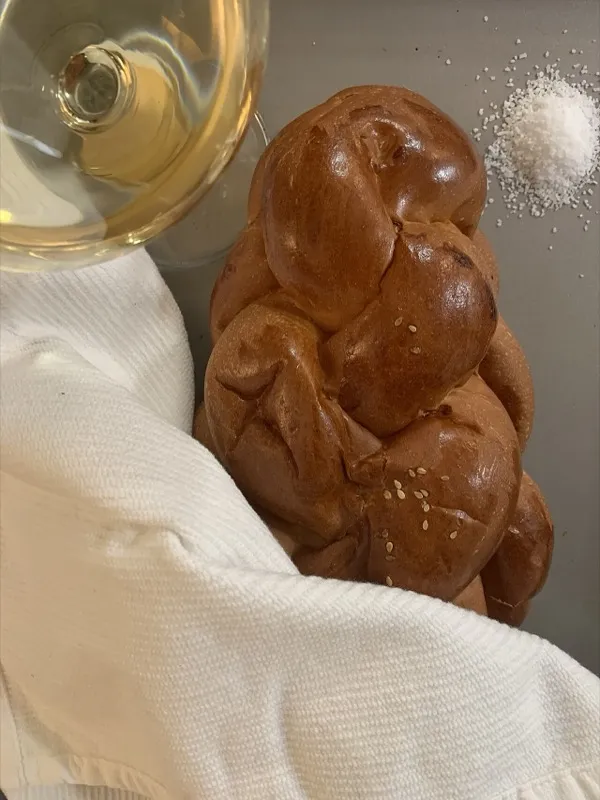
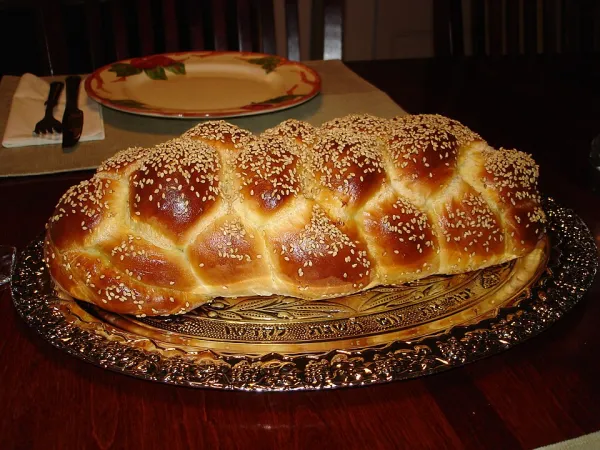
Challah — Braided egg bread for Shabbat and holidays. The braids represent unity; the two loaves recall the double portion of manna in the wilderness. Round challahs appear for Rosh Hashanah, symbolizing the cycle of the year.
Charoset — A sweet paste of fruit, nuts, wine, and spices eaten at the Passover seder. Represents the mortar used by Israelite slaves in Egypt. Sephardic versions use dates; Ashkenazi versions use apples and walnuts.
Cholent — The original slow-cooked stew, simmered from Friday afternoon through Saturday lunch because cooking on Shabbat is prohibited. Ashkenazi versions feature beef, potatoes, beans, and barley. Sephardic equivalents include dafina (Moroccan) and t’beet (Iraqi).
Couscous — Tiny steamed semolina granules served with meat and vegetable stew. The Friday night staple of North African Jews, particularly Moroccan and Tunisian communities.
Dafina — The Moroccan Jewish Shabbat stew: meat, potatoes, chickpeas, eggs (which turn brown overnight), and wheat berries. Every family’s recipe is sacred.
F-G
Falafel — Deep-fried chickpea balls served in pita with salad and tahini. Not originally Jewish, but adopted with such enthusiasm in Israel that it has become a national symbol.
Gefilte fish — Ground freshwater fish (usually carp, whitefish, and pike) mixed with egg, matzo meal, and onion, shaped into ovals, and poached. The quintessential Ashkenazi appetizer, beloved by some, tolerated by many, dreaded by a few.
Gribenes — Crispy fried chicken skin with onions, rendered while making schmaltz. The Jewish equivalent of pork rinds — crunchy, salty, and absolutely terrible for you in the best possible way.
H-K
Hamantaschen — Triangular filled cookies eaten on Purim, representing the three-cornered hat of the villain Haman. Classic fillings: poppy seed (mohn), prune (lekvar), and apricot. Modern fillings: chocolate, halva, Nutella, and basically anything.
Hummus — Creamed chickpeas with tahini, lemon, and garlic. The subject of intense Israeli-Arab competition over who makes it best. Everyone is wrong. Your grandmother makes it best.
Jachnun — A rich, buttery Yemenite Jewish pastry rolled and slow-baked overnight, served Saturday morning with grated tomato and hard-boiled eggs. One of Israel’s great Shabbat foods.
Kasha varnishkes — Buckwheat groats mixed with bow-tie pasta and fried onions. Pure Ashkenazi comfort food, not glamorous, not trying to be.
Kishke — Stuffed beef intestine (or, more commonly today, a synthetic casing) filled with a mixture of flour, fat, and seasoning, then slow-cooked inside the cholent. Not for the faint of heart.
Knish — A baked or fried dough pocket filled with mashed potato, kasha, or meat. A Lower East Side icon. If you eat one from a street cart, you become a New Yorker.
Kreplach — Small dumplings filled with ground meat or potato, served in chicken soup. Essentially Jewish wontons. Eaten on Purim, the eve of Yom Kippur, and Hoshana Rabba.
Kubbeh — Semolina-shelled dumplings filled with spiced meat, served in beet, lemon, or tomato soup. Iraqi Jewish in origin, now one of Israel’s most popular comfort foods.
Kugel — A baked casserole made from noodles (lokshen kugel) or potatoes. Sweet versions feature raisins and cinnamon; savory versions are peppery and crispy-edged. Wars have been fought over sweet vs. savory. The savory people are right.
L-M
Latkes — Fried potato pancakes eaten on Hanukkah to commemorate the miracle of the oil. Served with applesauce, sour cream, or both simultaneously if you are a person of courage.
Lox — Salt-cured salmon, thinly sliced, served on a bagel with cream cheese, capers, red onion, and tomato. Technically, “lox” is salt-cured; “nova” is cold-smoked. In practice, nobody cares about the distinction except food writers.
Ma’amoul — Semolina cookies filled with dates, walnuts, or pistachios, pressed into decorative molds. A Sephardic and Middle Eastern tradition, often served at holidays.
Matzah — Unleavened flatbread eaten during Passover, made from flour and water and baked in under 18 minutes to prevent rising. The “bread of affliction” that sustained the Israelites during the Exodus.
Matzo ball soup — Chicken soup with dumplings made from matzo meal, eggs, and fat. The great debate: fluffy (like clouds) or dense (like cannonballs). Both sides claim medical evidence for their position.
P-R
P’tcha — Jellied calves’ feet (aspic). The single most polarizing food in all of Jewish cuisine. If you didn’t grow up with it, you probably won’t start now. If you did grow up with it, you either love it with your entire being or have blocked the memory.
Pita — Flatbread with a pocket, used to scoop hummus, wrap falafel, or eat with almost anything. In Israel, pita is less a food and more a delivery system.
Rugelach — Crescent-shaped rolled pastries made from cream cheese dough and filled with chocolate, cinnamon, jam, or nuts. Dangerously good. You cannot eat one.
S
Sabich — An Iraqi Jewish sandwich: fried eggplant, hard-boiled egg, hummus, tahini, amba (pickled mango), and salad stuffed into pita. Israel’s best-kept street food secret.
Schmaltz — Rendered chicken fat, used as a cooking medium in traditional Ashkenazi cuisine before vegetable oils became common. Responsible for the flavor of everything your great-grandmother cooked and possibly for the state of her arteries.
Shakshuka — Eggs poached in a spiced tomato sauce, served in the pan with crusty bread for dipping. North African in origin, now Israel’s unofficial national breakfast.
Sufganiyot — Jelly-filled doughnuts eaten on Hanukkah (fried in oil to commemorate the miracle). Israeli bakeries compete annually to create the most outrageous fillings: halva cream, dulce de leche, crème brûlée.
T-Z
Tahini — Ground sesame paste, used as a sauce, dip, and ingredient across Middle Eastern Jewish cuisine. The foundation of hummus, a topping for falafel, and in Israel, drizzled on practically everything including ice cream.
Tzimmes — A sweet stew of carrots, sweet potatoes, dried fruits, and sometimes meat, served at Rosh Hashanah. The word has entered Yiddish as slang for “making a big fuss” — which is exactly what tzimmes requires.
Za’atar — A spice blend of dried thyme, oregano, sumac, and sesame seeds. Sprinkled on bread with olive oil, mixed into labaneh (strained yogurt), or used as a seasoning for everything. Essential to Israeli and Sephardic cooking.
Zhug — A fiery Yemenite hot sauce made from fresh chili peppers, garlic, coriander, and cardamom. The condiment that turns any meal into an adventure. Available in green (herby, intense) and red (smoky, slightly milder) varieties.
The Common Thread
Fifty foods from a dozen countries, and what connects them? Jewish dietary laws (kashrut) provide the framework — no mixing of meat and dairy, no pork, no shellfish. But beyond the rules, there is something else: the table as the center of Jewish life. These foods are not just nourishment. They are memory, community, identity, and love, shaped into something you can taste.
Every Jewish food carries a story. Now you know fifty of them. The best way to learn more is to eat.
Frequently Asked Questions
What is the most famous Jewish food?
Challah (braided bread for Shabbat), bagels, and matzo ball soup are probably the most widely recognized Jewish foods globally. However, in Israel, hummus and falafel — adopted from broader Middle Eastern cuisine — may be even more ubiquitous. The answer depends largely on whether you're asking Ashkenazi or Sephardic Jews, and whether you're in New York or Tel Aviv.
Are all Jewish foods kosher?
Not necessarily. 'Jewish food' refers to dishes traditionally prepared and eaten by Jewish communities, while 'kosher' refers to food that meets the dietary laws of halakha (Jewish law). Most traditional Jewish dishes were designed to be kosher, but modern recipes may not follow all kosher rules. A dish can be culturally Jewish without being kosher, and a dish can be kosher without being traditionally Jewish.
What is the difference between Ashkenazi and Sephardic food?
Ashkenazi food comes from Eastern European Jewish traditions — think hearty, slow-cooked dishes for cold climates: gefilte fish, brisket, kugel, cholent, latkes, and matzo ball soup. Sephardic food comes from Mediterranean, Middle Eastern, and North African traditions — featuring olive oil, fresh herbs, rice, spices, and dishes like bourekas, shakshuka, couscous, and stuffed vegetables. Israeli cuisine blends both traditions along with modern innovations.
Sources & Further Reading
- Joan Nathan, Jewish Cooking in America
- Claudia Roden, The Book of Jewish Food
- Jewish Food Society ↗
Related Articles
Ashkenazi Cuisine: The Soul Food of Eastern European Jewry
Gefilte fish, brisket, kugel, cholent, matzo ball soup, and rugelach — Ashkenazi cuisine turned poverty into creativity and created some of the most iconic comfort foods in the world.
Israeli Street Food Guide: Falafel, Hummus, Shakshuka, and Beyond
A guide to the vibrant world of Israeli street food — falafel, hummus, shawarma, sabich, shakshuka, jachnun, burekas, fresh salads, and the shuk culture that ties it all together.
Sephardic Cuisine: The Mediterranean Flavors of Jewish Cooking
Spiced, vibrant, and sun-drenched — Sephardic cuisine draws from the kitchens of Spain, Turkey, Morocco, and the Middle East, creating a Jewish food tradition that rivals any in the world.