Israeli Street Food Guide: Falafel, Hummus, Shakshuka, and Beyond
A guide to the vibrant world of Israeli street food — falafel, hummus, shawarma, sabich, shakshuka, jachnun, burekas, fresh salads, and the shuk culture that ties it all together.
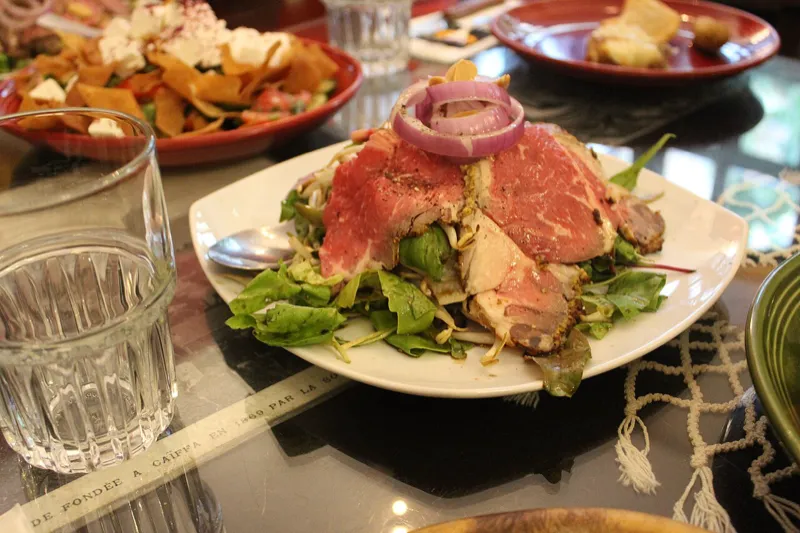
A Country That Eats
Israel is a small country with a very large appetite. Walk through any Israeli city and you will encounter food — everywhere, all the time, in quantities that seem to exceed what a nation of nine million people could possibly consume. Falafel stands on every corner. Hummus restaurants that spark fierce loyalty. Bakeries selling burekas at 6 a.m. Shawarma rotating on spits behind glass. Fresh-squeezed juice from fruits you may not recognize. And everywhere, always, an Israeli salad — diced so finely it looks like confetti.
Israeli cuisine is not one thing. It is a collision of dozens of food traditions — Ashkenazi, Sephardic, Yemenite, Ethiopian, Moroccan, Iraqi, Persian, Palestinian, Turkish, and more — smashed together in a tiny geographic space and transformed into something new. It is the food of immigrants who brought their grandmothers’ recipes and discovered that the ingredients were different, the climate was different, and the person at the next table was eating something completely unfamiliar that smelled incredible.
The result is one of the most exciting food cultures in the world. Here is your guide to the essentials.
Falafel
If Israel has a national food, it is falafel — crispy, golden balls of ground chickpeas (or fava beans, in the Egyptian tradition), seasoned with herbs, deep-fried, and stuffed into pita bread with an unreasonable number of toppings.
A proper Israeli falafel pita includes:
- 4-6 falafel balls (freshly fried, never sitting under a heat lamp)
- Tahini sauce (drizzled liberally)
- Israeli salad (tomato-cucumber-onion-parsley, diced fine)
- Pickled vegetables (turnips, cabbage, cucumbers)
- Amba (pickled mango sauce — the underrated star)
- French fries (optional but common — stuffed right into the pita)
- Hot sauce (s’chug — a Yemenite green or red chili paste)
The cultural politics of falafel are real. Palestinians and other Arab communities have eaten falafel for centuries, and the Israeli adoption of it as a national symbol has generated legitimate debates about cultural appropriation. The honest answer is that falafel, like hummus, exists in a shared culinary space that predates modern borders. Fighting over who “owns” it misses the point. Eating it is the point.
Hummus
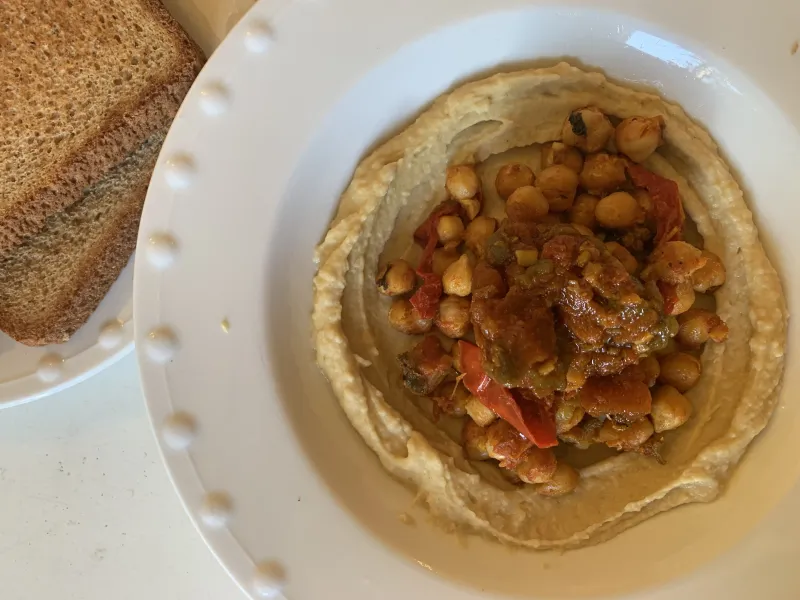
Israelis take hummus seriously — dangerously seriously. Arguments about the best hummus restaurant can end friendships. The basics: hummus is a puree of cooked chickpeas, tahini, lemon juice, garlic, and salt. Good hummus is silky, creamy, slightly warm, and served with a pool of olive oil, whole chickpeas, and fresh pita for scooping.
Hummus restaurants (hummusiyas) are a category unto themselves. They typically open early, serve hummus and nothing else (maybe falafel on the side), and close when the hummus runs out — which in popular spots can be before noon.
Toppings and variations include:
- Masabacha (or msabbaha) — hummus with whole warm chickpeas in tahini
- Hummus with ful — topped with stewed fava beans
- Hummus with meat — ground lamb or beef with pine nuts
- Hummus with mushrooms — a modern addition
The cardinal rule: never eat hummus cold from a plastic container if you can possibly eat it fresh.
Shawarma
Layers of seasoned meat — turkey, chicken, or lamb — stacked on a vertical spit and slow-roasted, then shaved off into pita or laffa (large flatbread) with tahini, pickles, and salads. Israeli shawarma has its own character: the seasoning tends to emphasize baharat (a warm spice blend), and the accompaniments lean heavy on pickled mango (amba) and fresh vegetables.
The best shawarma comes from places where the meat has been rotating long enough to develop a caramelized crust on the outside while staying juicy within. Lunchtime is prime shawarma hour.
Sabich
Sabich is an Iraqi-Jewish street food that deserves to be famous worldwide. It originated as a Shabbat breakfast among Iraqi Jews who settled in Israel, and it has become a beloved street food particularly in Tel Aviv and Ramat Gan.
A sabich pita contains:
- Fried eggplant slices (the star of the show)
- Hard-boiled egg
- Tahini
- Amba (pickled mango sauce)
- Israeli salad
- Pickled vegetables
- S’chug (hot sauce)
The combination of creamy eggplant, the richness of egg, the tang of amba, and the nuttiness of tahini is extraordinary. Many Israelis consider sabich superior to falafel — a heretical opinion that starts arguments at family dinners.
Shakshuka
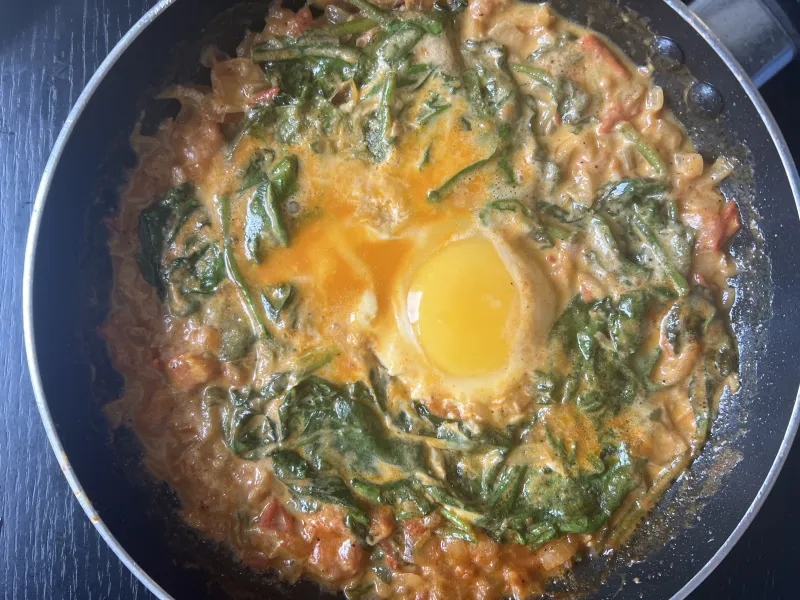
Shakshuka — eggs poached in a spiced tomato-pepper sauce — is the Israeli breakfast that conquered the world. The name comes from the Arabic/Berber for “mixture,” and the dish likely originated in North Africa before being brought to Israel by Tunisian and Libyan immigrants.
The basic version is tomatoes, peppers, onion, garlic, cumin, and paprika simmered into a thick sauce, with eggs cracked directly into the pan and cooked until the whites set but the yolks remain runny. It is served in the pan with crusty bread for mopping up every last trace of sauce.
Variations have proliferated:
- Green shakshuka — with spinach, Swiss chard, or herbs replacing tomatoes
- Shakshuka with feta — crumbled over the top
- Shakshuka with merguez — spicy sausage added to the sauce
- Shakshuka with eggplant — roasted eggplant folded in
Jachnun and Malawach
These Yemenite Jewish specialties have become Saturday morning staples across Israel.
Jachnun is a slow-baked pastry — dough rolled thin, brushed with butter or margarine, and baked overnight at low temperature. By morning, it has turned golden-brown and slightly sweet, with a flaky, pull-apart texture. It is served with grated tomato dip and hard-boiled eggs (which cook alongside it overnight and turn brown).
Malawach is a flaky, layered flatbread — pan-fried until crispy and golden. Think of it as a Yemenite Jewish croissant, except flat and better. Served with the same grated tomato dip and s’chug.
Both dishes are typically served on Shabbat morning because they require no active cooking on the day of rest — they are prepared before Shabbat and cook themselves overnight.
Burekas
Burekas — flaky pastry pockets filled with cheese, potato, spinach, or mushrooms — are the ultimate Israeli snack food. They came from the Sephardic and Turkish Jewish traditions and have become universal. Every bakery sells them. Every gas station sells them. They are eaten for breakfast, lunch, snacks, and occasionally dinner when nobody feels like cooking.
The shapes traditionally indicate the filling: triangles for cheese, rectangles for potato, spirals for spinach — though this system is not always observed.
The Shuk Experience
No guide to Israeli food is complete without the shuk — the open-air market that is the beating heart of Israeli food culture. The most famous is Machane Yehuda in Jerusalem — a riot of color, noise, and smells that overwhelms every sense simultaneously.
Stalls sell mountains of fresh produce, bins of spices, barrels of olives, towers of halva, bags of dried fruits and nuts, fresh-baked bread, and pastries in every conceivable form. Vendors shout their prices. Cats weave between legs. Someone is always squeezing pomegranate juice. The experience is chaotic, beautiful, and essential.
In recent years, Machane Yehuda has also become a nightlife destination, with bars and restaurants opening in and around the market stalls. The shuk by day and the shuk by night are two different worlds, both worth experiencing.
Israeli Salad
This deserves its own section because it appears at virtually every Israeli meal. Israeli salad is simply diced tomatoes, cucumbers, onion, and parsley dressed with olive oil, lemon juice, and salt. The key is the dice — everything should be cut small, uniform, and fresh.
Israelis eat this salad at breakfast, lunch, and dinner. It appears inside pita sandwiches, alongside hummus, next to grilled meat, and on its own. It is the constant in an otherwise wildly variable cuisine.
A Food Culture Like No Other
Israeli street food is not just food — it is identity, argument, nostalgia, and innovation all piled into a pita. It draws from Arab, Sephardic, Ashkenazi, Yemenite, Ethiopian, and countless other traditions, and it refuses to be any one of them. It is kosher and not kosher. It is ancient and brand new. It is a plate of hummus that tastes like it has been made the same way for a thousand years, and a shakshuka variation that was invented last Tuesday.
The best advice for anyone encountering Israeli food for the first time: try everything. Say yes to the amba. Accept the s’chug challenge. Let the sabich change your life. And never, under any circumstances, tell an Israeli that the hummus down the street is better than the one they just served you.
Frequently Asked Questions
Is Israeli food kosher?
Not necessarily. While many Israeli restaurants hold kosher certification (especially in Jerusalem), many do not — particularly in Tel Aviv and other secular areas. Israeli street food is often naturally kosher (falafel, hummus, and most salads contain no meat or dairy issues), but shawarma and other meat dishes may or may not be prepared under kosher supervision. The diversity of Israeli dining reflects the country's range of religious observance.
Is falafel Israeli or Arab?
This is one of the most heated food debates in the Middle East. Falafel has deep roots in Egyptian, Palestinian, and broader Arab cuisine, where it has been eaten for centuries. Israelis adopted it as a national food in the mid-20th century. Both cultures have legitimate claims. Many food scholars argue that fighting over falafel's 'ownership' misses the point — like all great foods, it belongs to everyone who makes and eats it.
What is a shuk?
A shuk (also spelled 'souk') is an open-air market — the heartbeat of Israeli food culture. The most famous is Machane Yehuda ('the Shuk') in Jerusalem, a chaotic, colorful, noisy market selling everything from fresh produce and spices to pastries and freshly squeezed pomegranate juice. The Carmel Market in Tel Aviv is another landmark. At night, many shuks transform into restaurant and bar districts.
Key Terms
Sources & Further Reading
- My Jewish Learning — Israeli Cuisine ↗
- Joan Nathan's The Foods of Israel Today
- Yotam Ottolenghi, Jerusalem: A Cookbook
- Gil Marks, Encyclopedia of Jewish Food
Related Articles
Jewish Holiday Foods: What We Eat and Why
Every Jewish holiday has its signature foods — and each dish tells a story of history, symbolism, and tradition.
Kashrut: The Jewish Dietary Laws
More than just 'no pork' — kashrut is a comprehensive system that transforms eating into a sacred act.
Sephardic Cuisine: The Mediterranean Flavors of Jewish Cooking
Spiced, vibrant, and sun-drenched — Sephardic cuisine draws from the kitchens of Spain, Turkey, Morocco, and the Middle East, creating a Jewish food tradition that rivals any in the world.