Tu BiShvat: The New Year of the Trees
On the 15th of Shevat, Jews celebrate the birthday of the trees — a minor ancient date that has blossomed into a holiday of ecological awareness, mystical seders, and tree planting.
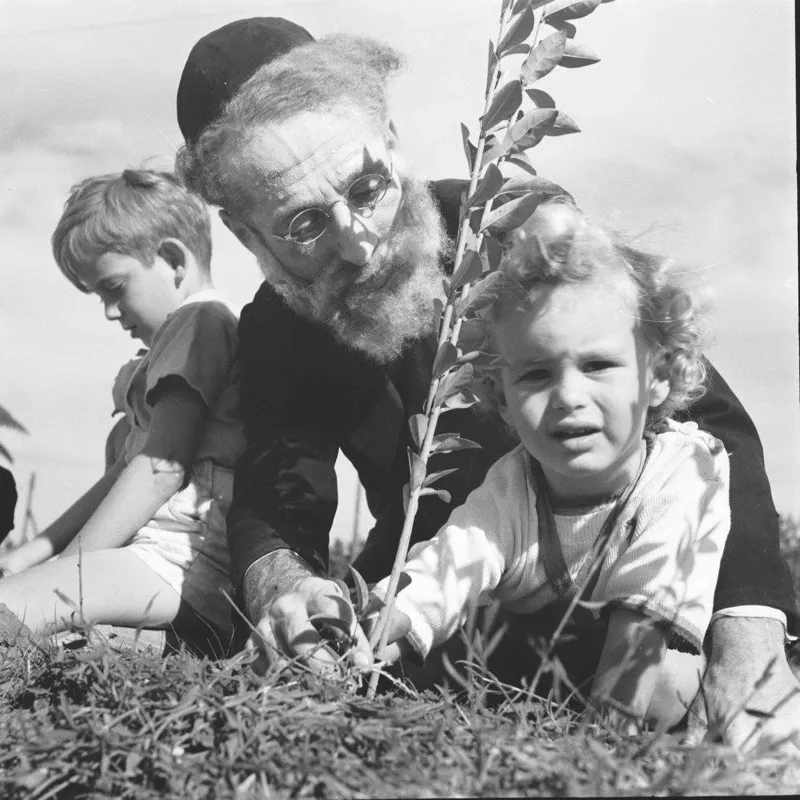
A Birthday for Trees
In the middle of winter — when in much of the Northern Hemisphere the ground is frozen and the branches are bare — the Jewish calendar declares a birthday. Not for a person, not for a nation, but for the trees. On the 15th of Shevat (usually falling in January or February), Jews around the world celebrate Tu BiShvat, the New Year of the Trees.
It is, at first glance, an unlikely holiday. Its origins are technical, rooted in ancient agricultural law. But over two thousand years, Tu BiShvat has grown — like the trees it honors — from a modest legal date into something far more expansive: a day of mystical ritual, ecological consciousness, and deep connection to the land.
In Israel, the almond trees are already blooming on Tu BiShvat, their pale pink and white blossoms the first sign that winter is loosening its grip. It is a reminder that renewal happens even when everything still looks dormant.
From Tax Day to Holy Day
The origins of Tu BiShvat are refreshingly practical. The Torah commands that the fruit of newly planted trees may not be eaten for the first three years (orlah), and that a tithe (tenth) of the fruit harvest must be given. But how do you determine a tree’s “birthday” for these calculations? The rabbis of the Mishnah (around 200 CE) debated this question and settled on the 15th of Shevat as the official cutoff date — the “New Year” for trees.
The choice was agricultural, not arbitrary. In the Land of Israel, the 15th of Shevat typically marks the point when most of the winter rain has fallen and the sap begins to rise in the trees. It is the moment the natural cycle turns toward growth.
For many centuries, that was essentially all Tu BiShvat was — a date on the calendar, a line in the Talmud. There were no special prayers, no synagogue rituals, no particular customs. Jews in Babylonia, North Africa, and Europe noted the day but did little to mark it. The holiday lay dormant, waiting — much like the trees in winter — for the right conditions to bloom.
The Kabbalistic Seder
Those conditions arrived in the 16th century, in the mystical city of Safed (Tzfat) in the Galilee, where a community of Kabbalists was reimagining Jewish spiritual life. These mystics — followers of Rabbi Isaac Luria (the Ari) and his student Rabbi Chaim Vital — saw in Tu BiShvat an opportunity to create a new ritual that would connect the physical and spiritual worlds.
The result was the Tu BiShvat seder — a structured meal modeled loosely on the Passover seder, but centered on fruits, nuts, and wine rather than matzah and bitter herbs.
 *Dried fruits prepared for a Tu BiShvat seder. Photo by Maor X, CC BY-SA 4.0, via Wikimedia Commons.*
The seder involves drinking four cups of wine, progressing from pure white to deep red, symbolizing the transition from winter to spring and from the physical world to the spiritual. The fruits and nuts are eaten in a specific order corresponding to the four mystical worlds of Kabbalah:
Assiyah (Action) — Fruits with tough outer shells and edible interiors: walnuts, almonds, pomegranates, pistachios. The hard shell represents the barriers of the physical world, protecting the sweetness within.
Yetzirah (Formation) — Fruits with soft outsides but hard pits: dates, olives, cherries, plums. Here, the exterior is accessible, but something hard and impenetrable remains at the core.
Beriyah (Creation) — Fruits that are entirely edible: figs, grapes, berries, carob. Nothing is discarded. Everything can be consumed and transformed.
Atzilut (Emanation) — The highest world, beyond physical representation. This cup of wine is drunk in contemplation, with no fruit — a gesture toward the divine that cannot be grasped or tasted.
The Kabbalistic seder was first published in a small pamphlet called Pri Etz Hadar (“The Fruit of the Goodly Tree”) in 1728, though the practice was older. It spread through Sephardi communities and has enjoyed a remarkable revival in recent decades, embraced by Jews across denominations.
The Seven Species
Central to Tu BiShvat is the celebration of the seven species (shivat haminim) — the agricultural products with which the Torah blesses the Land of Israel:
“A land of wheat and barley, of vines, figs, and pomegranates, a land of olive oil and honey [dates].” (Deuteronomy 8:8)
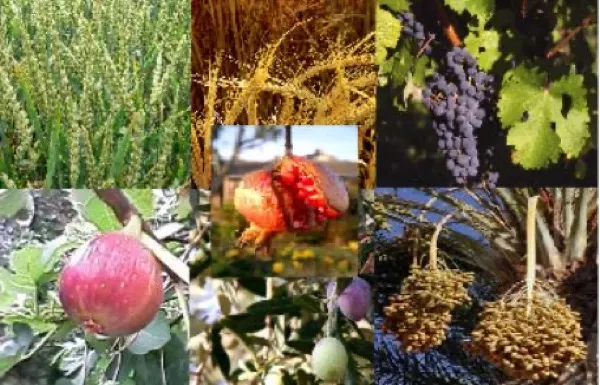 *The seven species of the Land of Israel. Photo by Chesdovi, Public domain, via Wikimedia Commons.*
Each of these foods carries its own symbolism. The wheat and barley represent sustenance and the staff of life. The grape vine speaks of joy and celebration (wine being central to Jewish ritual). The fig is associated with wisdom — the Talmud says that Torah is like a fig tree, where each time you return, you find new sweetness. The pomegranate, with its many seeds, is said to contain 613 seeds, one for each commandment. The olive represents endurance and peace. And the date (tamar) symbolizes righteousness — “The righteous shall flourish like a palm tree” (Psalm 92:13).
On Tu BiShvat, tables are laden with these seven species alongside other fruits, especially those native to Israel. It is a feast of the land — a sensory celebration of the connection between the Jewish people and the soil of their ancestral home.
Tree Planting: A Modern Tradition
Perhaps the most widely recognized Tu BiShvat custom today — especially in Israel — is tree planting. This tradition, however, is relatively modern, born not from ancient texts but from the Zionist movement of the late 19th and early 20th centuries.
When early Jewish settlers arrived in Ottoman and then British-controlled Palestine, they encountered a landscape that had been heavily deforested over centuries. Planting trees became both a practical necessity and a powerful symbol — of putting down roots, of rebuilding a homeland, of transforming the land.
The Jewish National Fund (Keren Kayemeth LeIsrael), founded in 1901, made tree planting one of its central missions. Tu BiShvat became the natural occasion for mass planting events. Israeli schoolchildren still go out to plant saplings on Tu BiShvat, and the iconic blue JNF collection boxes that once stood in Jewish homes around the world funded the planting of millions of trees in Israel.
Today, Israel is one of the few countries in the world that entered the 21st century with more trees than it had at the start of the 20th — a remarkable achievement that Tu BiShvat celebrates each year.
Ecological Judaism
In recent decades, Tu BiShvat has undergone another transformation, becoming the focal point of Jewish environmentalism. For a growing number of Jews, the holiday offers a framework for thinking about humanity’s relationship with the natural world through a Jewish lens.
The Torah contains several environmental commandments that resonate with modern ecological concerns. The prohibition of bal tashchit (do not destroy) forbids the cutting down of fruit trees even during wartime (Deuteronomy 20:19-20). The laws of shmita (the sabbatical year) require that agricultural land lie fallow every seventh year, allowing the earth to rest and regenerate.
Tu BiShvat seders today often incorporate readings about climate change, biodiversity, and sustainable agriculture alongside the traditional Kabbalistic texts. Organizations like Hazon (now Adamah) have promoted “eco-seders” that pair each fruit with a discussion about food systems, land use, and environmental justice.
This evolution would likely not have surprised the Kabbalists of Safed. Their seder was, at its heart, about the interconnection of all things — the idea that a piece of fruit on a plate in the Galilee is connected, through invisible threads of divine energy, to the highest spiritual realms. Modern ecology tells a similar story in scientific terms: everything is connected. The tree in your backyard is connected to the atmosphere, the water cycle, the soil microbiome, and ultimately to the health of the planet.
Customs and Celebrations
Beyond the seder and tree planting, Tu BiShvat is celebrated in various ways across Jewish communities:
Eating new fruits: Many families make a point of eating a fruit they have not yet tasted that season, reciting the shehecheyanu blessing (“who has given us life, sustained us, and brought us to this season”). There is a special pleasure in seeking out an exotic or unusual fruit for the occasion — a starfruit, a persimmon, a fresh date.
Dried fruits and nuts: In Ashkenazi communities, where fresh fruit was scarce in winter, the tradition of eating dried fruits — figs, dates, raisins, apricots — became central. A bowl of dried fruit and nuts remains a quintessential Tu BiShvat table setting.
Charity: Some communities use Tu BiShvat as an occasion for giving to environmental charities or sponsoring tree planting in Israel or elsewhere.
Study: The day provides an opportunity to study Jewish texts about nature, trees, and the land — from the Torah’s creation narrative to the Talmud’s discussions of agriculture to contemporary Jewish environmental thought.
The Tree as Metaphor
Trees hold a special place in Jewish imagination. The Torah itself is called an etz chayyim — a “tree of life” — and the wooden poles around which the Torah scroll is wound bear the same name. When the scroll is lifted during services, the congregation sings: “It is a tree of life to those who hold fast to it.”
The image recurs throughout Jewish literature. Humans are compared to trees — their roots invisible, their fruits visible, their growth slow but steady. The psalm says: “They shall be like a tree planted by streams of water, that yields its fruit in its season, and its leaf does not wither” (Psalm 1:3).
Tu BiShvat asks us to take this metaphor seriously. What are our roots? What fruit are we producing? What do we need — what light, what water, what nourishment — to keep growing? And what do we owe to the ground that sustains us?
In a world increasingly aware of environmental fragility, a holiday dedicated to the birthday of trees feels less quaint and more urgent with each passing year. Tu BiShvat reminds us that Judaism has always understood what ecology now confirms: we are not separate from nature. We are part of it. And our flourishing depends on its flourishing.
Frequently Asked Questions
What is Tu BiShvat?
Tu BiShvat is the 'New Year of the Trees,' falling on the 15th of the Hebrew month of Shevat (usually January or February). Originally a date for calculating the age of trees for tithing purposes, it has evolved into a celebration of nature, ecology, and the Land of Israel.
What is a Tu BiShvat seder?
A Tu BiShvat seder is a mystical meal developed by 16th-century Kabbalists in Safed. Participants drink four cups of wine (white to red, symbolizing the seasons) and eat fruits and nuts in a specific order representing different spiritual worlds.
What are the seven species?
The seven species are the agricultural products the Torah associates with the Land of Israel: wheat, barley, grapes, figs, pomegranates, olives, and dates. These foods are traditionally eaten on Tu BiShvat.
Test Your Knowledge
Think you know this topic? Try our quiz!
Take the Jewish Holidays: Advanced Quiz →Sources & Further Reading
Related Articles
The Jewish Calendar: How an Ancient Lunar-Solar System Shapes Jewish Life
The Jewish calendar is a sophisticated lunar-solar system that has kept Jewish holidays, Shabbat, and lifecycle events anchored in their proper seasons for over two thousand years.
Kabbalah: An Introduction to Jewish Mysticism
Beyond the law and the stories lies a hidden dimension of Judaism — Kabbalah, the mystical tradition that seeks to understand the nature of God, creation, and the human soul.
Passover (Pesach): The Festival of Freedom
The story of the Exodus comes alive each spring as Jewish families gather for the Seder — the most widely observed Jewish ritual.