Lag BaOmer: Bonfires, Mysticism, and Celebration
On the 33rd day of the Omer count, the mourning lifts and the bonfires blaze — Lag BaOmer is a day of fire, mysticism, first haircuts, and the memory of Rabbi Shimon bar Yochai.
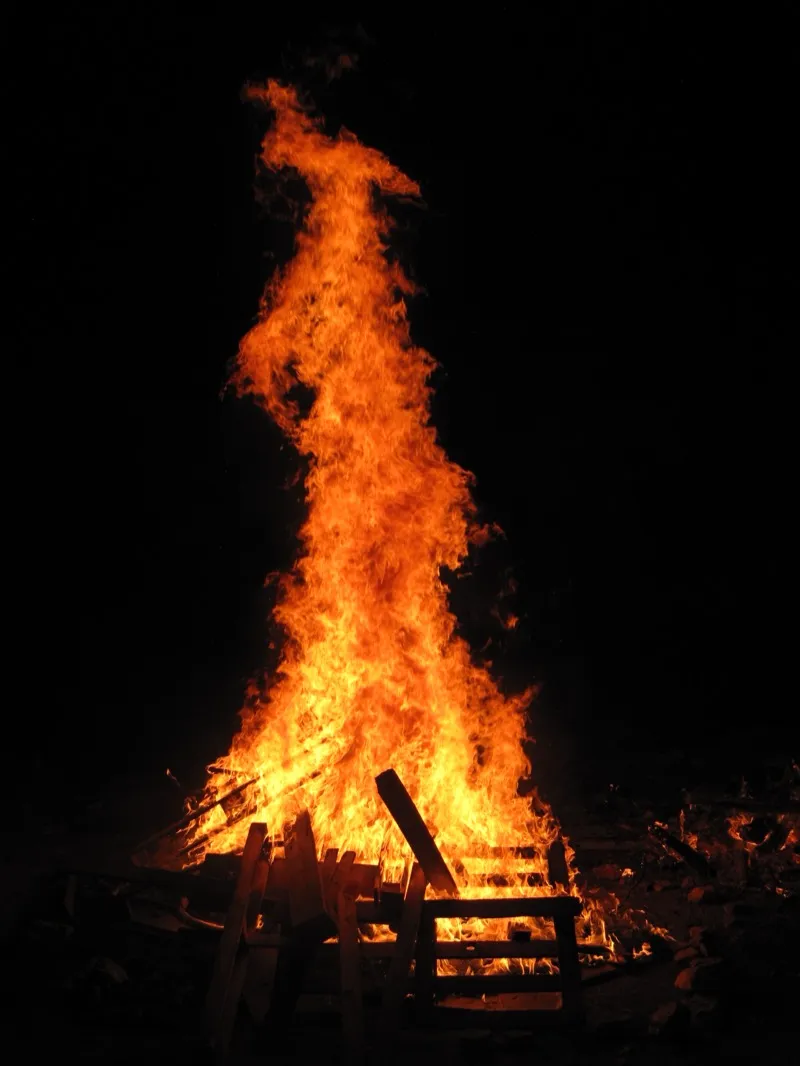
The Night the Sky Glows Orange
If you are anywhere in Israel on the evening of Lag BaOmer, you will know it before anyone tells you. The smell reaches you first — woodsmoke, thick and sweet, drifting across neighborhoods from hundreds of bonfires. Then the glow: from every park, vacant lot, schoolyard, and beach, columns of flame rise into the darkness. Children have been collecting wood for days, even weeks, building elaborate pyres that they guard with fierce territorial pride. By nightfall, the entire country seems to be on fire.
It is a strange and wonderful sight — a modern nation lit up by an ancient custom, a holiday that most of the world has never heard of but that, in Israel, rivals Independence Day for sheer festive energy. This is Lag BaOmer — the 33rd day of the Omer count — a holiday of fire and mysticism, of rebellion and remembrance, of bonfires blazing under the stars.
Counting the Omer
To understand Lag BaOmer, you need to understand what it interrupts.
The Omer is a period of 49 days counted between Passover and Shavuot. Originally an agricultural marker — the Torah commands that an omer (measure) of barley be brought to the Temple on the second day of Passover, with a wheat offering on Shavuot — the counting took on deeper meaning after the destruction of the Temple. It became a period of spiritual preparation, linking the liberation from Egypt (Passover) to the giving of the Torah at Sinai (Shavuot).
But the Omer is also a period of semi-mourning. The Talmud records that during this time, a plague struck the students of Rabbi Akiva, one of the greatest sages of the 2nd century CE. Twenty-four thousand students died, the tradition says, “because they did not treat each other with respect.” As a result, the Omer became a time when weddings are not held, music is not played, and haircuts are avoided.
On the 33rd day, the plague ceased. The mourning lifts. Joy returns. Lag BaOmer is a crack of light in a somber season — and Jews have filled that crack with fire, music, celebration, and meaning.
Rabbi Shimon bar Yochai: The Light of the Zohar
The figure most associated with Lag BaOmer is Rabbi Shimon bar Yochai (known by his acronym, Rashbi), a 2nd-century sage and mystic who, according to tradition, died on this day.
Rashbi’s story reads like a legend — because much of it is. A student of Rabbi Akiva, he was condemned to death by the Romans for speaking against their rule. He fled with his son, Rabbi Elazar, to a cave in the Galilee, where they hid for thirteen years, sustained (the Talmud says) by a miraculous carob tree and a spring of water. During those years of isolation, Rashbi and his son devoted themselves entirely to the study of Torah’s deepest mysteries.
When they emerged, Rashbi was so spiritually intense that his gaze could set the world on fire — literally, according to the Talmud. A heavenly voice had to send him back to the cave for another year to temper his intensity before he could reenter human society.
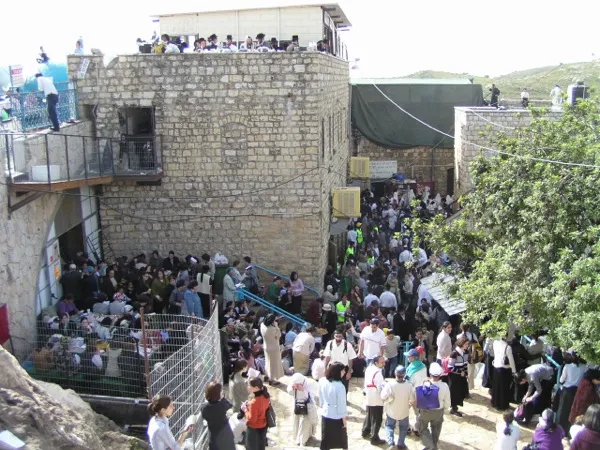 *The tomb of Rabbi Shimon bar Yochai at Mount Meron, thronged with Lag BaOmer pilgrims. Photo by Jonathan Stein, Public domain, via Wikimedia Commons.*
Rashbi is traditionally credited as the author of the Zohar — the foundational text of Kabbalah, Jewish mysticism. (Modern scholars generally date the Zohar to the 13th century, attributing it to Rabbi Moses de Leon in Spain, though this remains debated.) Whether or not Rashbi actually wrote it, the association is absolute in popular tradition: Rashbi is the great revealer of Torah’s hidden light.
According to the mystical tradition, on the day of his death — Lag BaOmer — Rashbi revealed the most profound secrets of the Torah, and his face shone with such radiance that his students could not look at him. The house was filled with fire and light. He asked his students to make the day one of rejoicing, not mourning — a hillula, a celebration of ascension rather than a funeral.
This is why the bonfires burn: they symbolize the spiritual light that Rashbi released into the world.
The Meron Pilgrimage
The largest Lag BaOmer celebration in the world takes place at Mount Meron in the Upper Galilee, where Rashbi is believed to be buried. Each year, hundreds of thousands of people — primarily from Haredi and Hasidic communities, but also traditional Sephardi and Mizrachi Jews — make the pilgrimage to Meron for an all-night celebration.
The scene is extraordinary. A massive bonfire is lit on the roof of the building housing Rashbi’s tomb, traditionally by the Boyaner Rebbe (a Hasidic leader). The surrounding hillside becomes a sea of people — singing, dancing, praying, eating. Music blasts from competing sound systems. Tents and food stalls stretch for kilometers.
The Meron celebration also features one of the most distinctive Lag BaOmer customs: the upsherin (also called chalakeh in Sephardi tradition). This is the first haircut given to a Jewish boy at the age of three. Many families travel to Meron specifically for this purpose, cutting their son’s hair at the tomb of Rashbi as a rite of passage marking the transition from infancy to early childhood, when Torah education traditionally begins.
The Meron pilgrimage has not been without controversy and tragedy. In 2021, a crowd crush at the site killed 45 people and injured over 100 — one of the deadliest civilian disasters in Israeli history. The tragedy prompted major safety reforms and a painful national reckoning about infrastructure, crowd management, and the responsibilities that come with mass gatherings at sacred sites.
Bar Kokhba and the Spirit of Rebellion
Lag BaOmer carries another historical layer: its association with the Bar Kokhba revolt (132-135 CE), the last great Jewish uprising against Roman rule.
Shimon bar Kokhba — whose name means “Son of a Star” — led a massive rebellion that, for a brief time, succeeded in establishing an independent Jewish state. Rabbi Akiva himself reportedly declared Bar Kokhba to be the Messiah. The revolt ultimately failed catastrophically: the Romans crushed it, killed hundreds of thousands of Jews, and banned them from Jerusalem. It was a devastating defeat that shaped Jewish history for centuries.
The connection to Lag BaOmer is partly historical (the plague that killed Rabbi Akiva’s students is sometimes interpreted as a coded reference to their deaths in the revolt) and partly symbolic. In the early 20th century, Zionist youth movements embraced Lag BaOmer as a day of Jewish physical courage and resistance — a counterpoint to the image of the passive, studious Jew. Bonfires, archery, and outdoor activities became associated with the holiday through this lens.
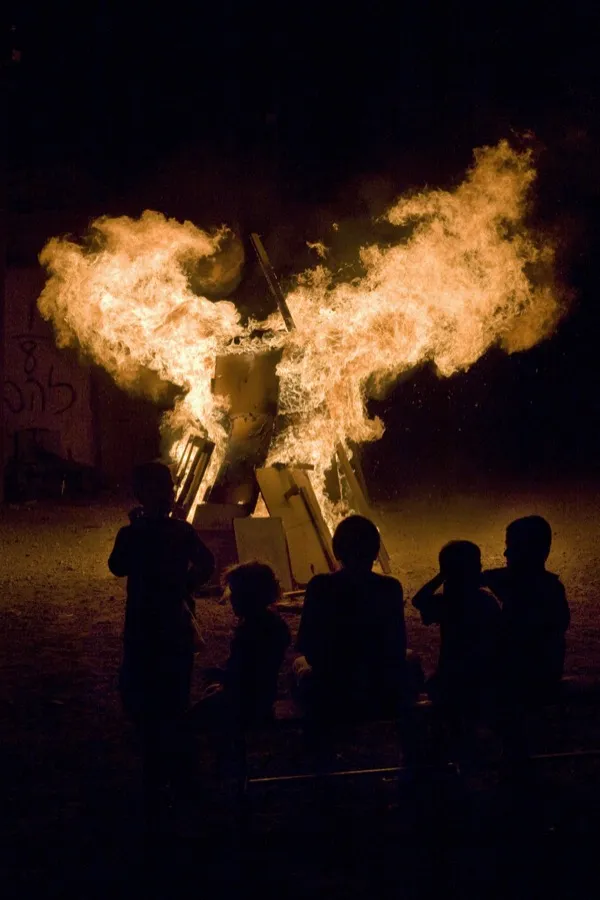 *A Lag BaOmer bonfire on a Tel Aviv beach. Photo by Roi Boshi, CC BY-SA 3.0, via Wikimedia Commons.*
Israeli schoolchildren still play with toy bows and arrows on Lag BaOmer — a custom that references the legend that no rainbow appeared during Rashbi’s lifetime (because his merit alone protected the world, making the rainbow’s sign of God’s covenant unnecessary). The Hebrew word for rainbow (keshet) also means “bow,” creating a playful double meaning.
Customs and Celebrations
Beyond bonfires and pilgrimages, Lag BaOmer is marked by several customs:
Weddings and celebrations: Because the Omer mourning period is suspended on Lag BaOmer, it is an extraordinarily popular day for Jewish weddings. Wedding halls across Israel and the Jewish world are booked solid. Couples who have been waiting through the Omer period rush to marry on this day.
Music and haircuts: The restrictions on music, haircuts, and celebrations that characterize the Omer period are lifted for Lag BaOmer. Barbers do brisk business, and live music returns to Jewish communities.
Outdoor activities: Especially in Israel, Lag BaOmer has become a day for outdoor excursions, picnics, and hikes. The bonfire tradition extends to backyard barbecues, camping trips, and beach gatherings.
Study of the Zohar: In mystical circles, Lag BaOmer is a day devoted to the study of Kabbalistic texts, particularly the Zohar. Special readings and study sessions honor Rashbi’s legacy and explore the hidden dimensions of Torah.
Fire and Light
Lag BaOmer sits at the intersection of several Jewish themes that do not always seem to fit together: ancient mysticism and modern nationalism, mourning and joy, fire that destroys and fire that illuminates. It is a holiday that resists neat categorization.
Perhaps that is appropriate for a day associated with Rashbi, a figure who bridged the visible and invisible worlds, who saw fire in Torah and Torah in fire. The bonfires of Lag BaOmer are, at their simplest, children piling wood and striking matches. But they are also something more: a tradition of light in the middle of a dark period, a refusal to let mourning have the last word, a celebration of the idea that hidden within the ordinary world are secrets of extraordinary radiance.
On the 33rd night of the Omer, the smoke rises and the flames reach upward, and for a few hours, the ancient and the modern, the mystical and the physical, the grief and the joy, all burn together under the same sky.
Frequently Asked Questions
Why is it called Lag BaOmer?
The Hebrew letters lamed (ל) and gimel (ג) have the numerical values 30 and 3, totaling 33. 'Lag BaOmer' means the 33rd day of the Omer — the 49-day counting period between Passover and Shavuot.
Why do people light bonfires on Lag BaOmer?
Bonfires symbolize the spiritual light that Rabbi Shimon bar Yochai (Rashbi) brought to the world through his mystical teachings, traditionally compiled in the Zohar. According to tradition, his face shone with fire when he revealed the deepest secrets of Torah on the day of his death — the 33rd of the Omer.
What is an upsherin?
An upsherin (Yiddish for 'shearing off') is the traditional first haircut given to a Jewish boy at age three. Many families time this ceremony for Lag BaOmer, especially at the tomb of Rabbi Shimon bar Yochai in Meron, connecting the child's growth to the spiritual light of the day.
Test Your Knowledge
Think you know this topic? Try our quiz!
Take the Jewish Holidays: Advanced Quiz →Sources & Further Reading
Related Articles
The Jewish Calendar: How an Ancient Lunar-Solar System Shapes Jewish Life
The Jewish calendar is a sophisticated lunar-solar system that has kept Jewish holidays, Shabbat, and lifecycle events anchored in their proper seasons for over two thousand years.
Kabbalah: An Introduction to Jewish Mysticism
Beyond the law and the stories lies a hidden dimension of Judaism — Kabbalah, the mystical tradition that seeks to understand the nature of God, creation, and the human soul.
Shavuot: The Festival of Weeks
Seven weeks after Passover, the Jewish world celebrates the giving of the Torah at Mount Sinai — with all-night study, dairy feasts, and the reading of the Book of Ruth.