Hanukkah vs Christmas: A Respectful Comparison of Two December Holidays
Hanukkah and Christmas both fall in December and involve lights and gifts — but that's where the similarities end. Here's a respectful, honest comparison of two very different holidays.
The December Question
Every December, it happens. The Christmas decorations go up — on houses, in malls, across entire cities — and someone asks: “So, is Hanukkah like the Jewish Christmas?”
The answer is no. But it is a completely understandable question, and the reasons behind it are worth exploring with honesty and respect.
Hanukkah and Christmas are two very different holidays that happen to fall in the same month. They have different origins, different religious significance, different histories, and different places within their respective traditions. The comparison between them tells us less about the holidays themselves and more about what happens when a minority culture exists within a majority culture — and how both navigate that relationship.
The Comparison Table
| Feature | Hanukkah (Jewish) | Christmas (Christian) |
|---|---|---|
| Origin | Maccabean revolt, 164 BCE | Birth of Jesus, ~1st century CE |
| Religious significance | Minor holiday | Major holiday (one of the most important) |
| Duration | 8 nights and days | 1 day (December 25) + season |
| Date | 25 Kislev (Jewish calendar) — varies in December | December 25 (fixed) |
| Central symbol | Menorah/Hanukkiah (9-branched candelabrum) | Christmas tree, nativity scene |
| Light tradition | Candles lit each night (adding one per night) | Christmas lights on trees and houses |
| Gift-giving | Modern tradition (historically minor) | Central tradition |
| Traditional foods | Latkes (potato pancakes), sufganiyot (doughnuts) | Varies by culture (turkey, ham, etc.) |
| Music | ”Maoz Tzur,” “Hanukkah Oh Hanukkah” | Extensive carol tradition |
| Religious services | Additional prayers, Torah reading | Church services, midnight mass |
| Time off work/school | Not a day off (not a biblical holiday) | National holiday in many countries |
| Commercial presence | Modest | Enormous |
What Hanukkah Actually Celebrates
Hanukkah commemorates events that took place in 164 BCE — more than a century before the birth of Jesus. The story, told primarily in the books of 1 and 2 Maccabees (which are not part of the Jewish biblical canon), goes like this:
The Seleucid Greek empire, under King Antiochus IV Epiphanes, occupied Judea and attempted to suppress Jewish religious practice. The Temple in Jerusalem was desecrated, Torah study was banned, and Jews were forced to worship Greek gods. A priestly family — the Maccabees, led by Judah Maccabee — launched a guerrilla revolt. Against extraordinary odds, they defeated the Greek army, recaptured Jerusalem, and rededicated the Temple.
The Talmud (Shabbat 21b) adds the famous miracle: when the Maccabees came to relight the Temple’s menorah, they found only one small jug of pure olive oil — enough for a single day. Miraculously, the oil burned for eight days, until new oil could be prepared.
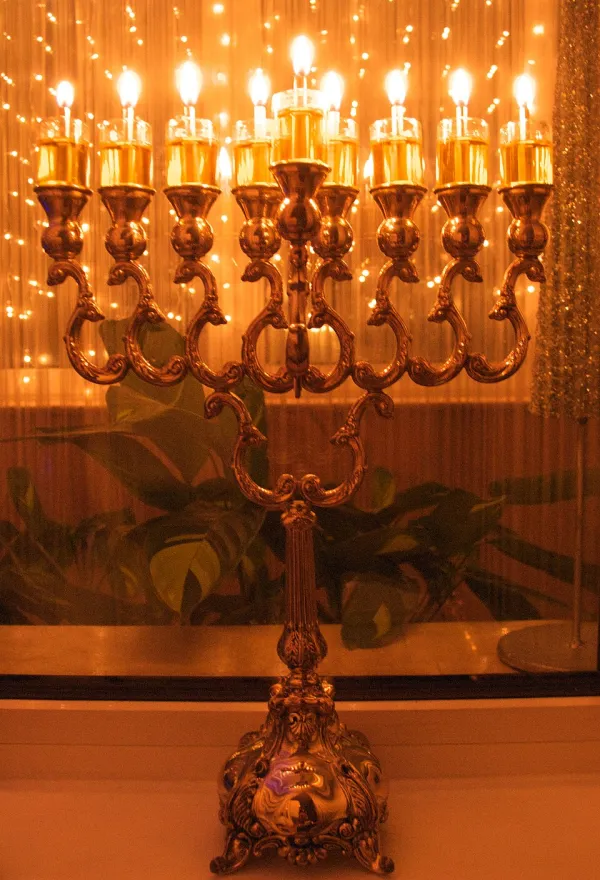
Hanukkah celebrates this miracle of oil and the victory of religious freedom. The central observance is lighting the hanukkiah (a nine-branched menorah) — one candle on the first night, two on the second, and so on, until all eight candles blaze on the final night.
What Christmas Actually Celebrates
Christmas celebrates the birth of Jesus of Nazareth, whom Christians believe is the Son of God and the Messiah prophesied in the Hebrew Bible. The nativity story — the manger in Bethlehem, the star, the shepherds, the wise men — is told in the Gospels of Matthew and Luke.
Christmas is one of the two most important holidays in Christianity (alongside Easter). It is a theological celebration of the Incarnation — the Christian belief that God became human in the person of Jesus.
The December 25th date was established in the 4th century CE and may have been chosen to coincide with existing Roman winter solstice celebrations. Many Christmas traditions — trees, gift-giving, feasting — developed over centuries and vary enormously across cultures.
The Significance Gap
Here is the most important thing to understand: Hanukkah is a minor holiday in Judaism. Christmas is a major holiday in Christianity. This asymmetry is the root of most misunderstandings.
In the Jewish calendar, the major holidays are Rosh Hashanah (New Year), Yom Kippur (Day of Atonement), Passover, Shavuot, and Sukkot. These are the heavy hitters — the days with serious religious obligations, extended synagogue services, and deep theological significance.
Hanukkah, by contrast, is a post-biblical holiday. There are no restrictions on work. There is no special synagogue service beyond additional prayers. Historically, it was celebrated modestly — candles, songs, dreidel games, and fried foods. It was lovely but low-key.
The elevation of Hanukkah to a major gift-giving event is largely a 20th-century American phenomenon, driven by Jewish families’ desire to give their children something to celebrate during December, when Christmas dominates every store, school, and television screen. This is not a criticism — it is a natural and understandable adaptation. But it does mean that the modern prominence of Hanukkah reflects its proximity to Christmas more than its traditional importance within Judaism.
The Gift-Giving Question
Traditional Hanukkah gift-giving was modest: children received gelt (small amounts of money or chocolate coins) and perhaps small presents. The emphasis was on the candles, the songs, the story, the food.
The transformation of Hanukkah into an eight-nights-of-presents extravaganza is directly linked to the American Christmas gift culture. Jewish parents, watching their children feel left out in December, began expanding Hanukkah gift-giving to match (or at least approach) Christmas expectations.
Many Jewish leaders have mixed feelings about this development. On one hand, it makes Hanukkah more fun for children. On the other hand, it risks turning a holiday about religious freedom and miracles into a holiday about presents — and it implicitly accepts the framework that Hanukkah needs to “compete” with Christmas.
Light in the Darkness
Both holidays feature prominently displayed lights, and this is not a coincidence — but the connection is not what most people think.
Both Hanukkah and Christmas fall near the winter solstice, the darkest time of the year in the Northern Hemisphere. Cultures around the world have celebrated light during this period for thousands of years. The Roman Saturnalia, the Norse Yule, the Iranian Yalda — all involve lights, feasting, and celebration during the longest nights.
The Hanukkah menorah and Christmas lights both serve as declarations against darkness — but they mean different things. The hanukkiah recalls a specific historical miracle and is lit according to precise Jewish law (one candle the first night, adding one each subsequent night). Christmas lights evolved from the tradition of candles on Christmas trees, first documented in 17th-century Germany, and have become an elaborate decorative art.
Christmukkah and Interfaith Families
In the United States and other diaspora countries, a growing number of families include both Jewish and Christian members. These families face the December question directly: which holiday do we celebrate? Both? How?
The informal concept of “Christmukkah” — celebrating both holidays — has gained cultural visibility, particularly since a 2003 O.C. television episode popularized the term. Some interfaith families embrace it with humor and warmth. Others find it uncomfortable, feeling that blending two distinct traditions dilutes both.
Religious leaders from both traditions generally emphasize that Hanukkah and Christmas are distinct holidays with distinct meanings, and that combining them risks losing what makes each one special. But the reality of interfaith family life is more nuanced than any religious ruling, and millions of families navigate it with creativity, love, and the occasional awkward conversation.
Why the Comparison Is Misleading but Understandable
The Hanukkah-Christmas comparison exists because of cultural proximity, not theological similarity. In a world where Christmas were not the dominant December holiday, Hanukkah would simply be what it has always been: a lovely, relatively minor Jewish holiday with candles, oil, and a great story.
But we do not live in that world. We live in a world where December is Christmas season, where Jewish children ask why they do not have a tree, and where well-meaning colleagues wish Jewish coworkers “Happy Holidays” while privately wondering if Hanukkah is “their Christmas.”
It is not. But the fact that the question keeps being asked is itself a fascinating window into how cultures interact, adapt, and maintain their distinctness — even when they share a calendar month.
Both holidays, in their own ways, are about light. Both are about stories that endure. Both bring families together in the darkest part of the year. And both, at their best, remind us that there is something worth celebrating — even when the nights are long.
Sources
- My Jewish Learning — Hanukkah 101 — Comprehensive overview of Hanukkah history and practice
- Encyclopaedia Britannica — Christmas — History and traditions of Christmas
- Talmud, Shabbat 21b — The Talmudic source for the Hanukkah miracle of oil
- Jewish Virtual Library — Hanukkah — Historical context of the Maccabean revolt and holiday
Frequently Asked Questions
Is Hanukkah the Jewish Christmas?
No. Hanukkah is not the Jewish equivalent of Christmas. Christmas is one of Christianity's most important holidays, celebrating the birth of Jesus. Hanukkah is a relatively minor Jewish holiday commemorating a military victory and miracle of oil in 164 BCE. The comparison exists mainly because both fall in December.
Why do people compare Hanukkah and Christmas?
The comparison is understandable because both holidays fall in December, both involve gift-giving (in modern practice), and both feature prominent displays of light. In countries where Christmas dominates the cultural calendar, Hanukkah has become more visible as Jewish families seek to give their children a holiday experience during the same season.
What is Christmukkah?
Christmukkah is an informal term for celebrating both Christmas and Hanukkah, typically in interfaith families where one parent is Jewish and the other is Christian. It reflects a growing reality: many families navigate both traditions with love and creativity, even as religious leaders from both faiths emphasize the distinctness of each holiday.
Test Your Knowledge
Think you know this topic? Try our quiz!
Take the Jewish Holidays: Advanced Quiz →Sources & Further Reading
Related Articles
Hanukkah: The Festival of Lights
Eight nights of candles, latkes, and dreidels — the story and customs of the beloved winter holiday.
The Jewish Calendar: How an Ancient Lunar-Solar System Shapes Jewish Life
The Jewish calendar is a sophisticated lunar-solar system that has kept Jewish holidays, Shabbat, and lifecycle events anchored in their proper seasons for over two thousand years.
Judaism vs Christianity: Key Differences and Shared Roots
A respectful comparison of Judaism and Christianity — two faiths that share roots but diverge profoundly on God, Messiah, salvation, afterlife, and the meaning of scripture.