The Dreidel: History & How to Play
The dreidel is the iconic spinning top of Hanukkah — with four Hebrew letters, a simple set of rules, and a history that connects Jewish resistance to modern celebration. Here's how to play.
The Little Top That Could
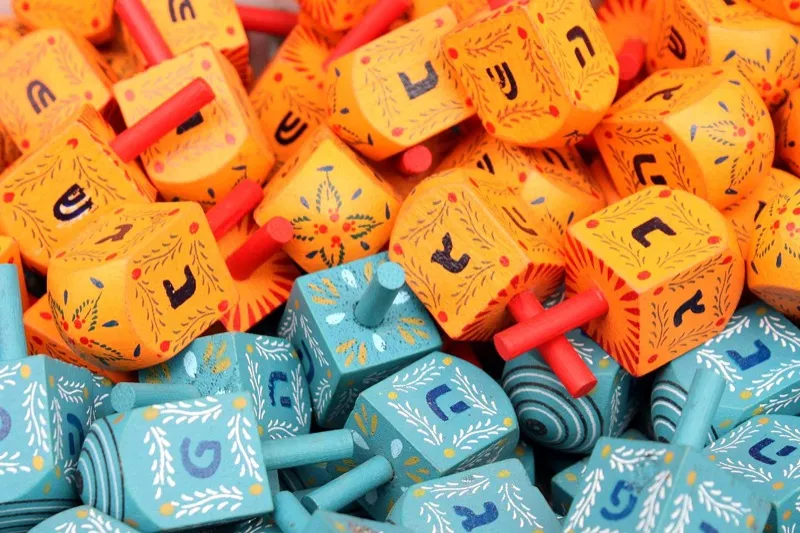
It is, by any objective measure, a simple toy. Four sides. Four letters. A point at the bottom for spinning. You can buy one for a dollar or make one from clay (as the song goes). Children outgrow it by age eight. Adults play it once a year, if that.
And yet the dreidel — the small spinning top played during Hanukkah — is one of the most recognizable symbols of Jewish life. It appears on greeting cards, gift wrap, holiday decorations, and kitchen towels from November through December. It has been made in wood, plastic, clay, silver, glass, and crystal. It is the subject of songs, stories, and surprisingly heated tournament rules.
Behind this humble toy lies a story — part legend, part history, part marketing genius — that connects ancient resistance to modern celebration.
The Legend
The story most Jewish children learn goes like this: During the reign of the Greek-Syrian king Antiochus IV Epiphanes (2nd century BCE), Torah study was forbidden on pain of death. Jewish children would gather in secret to study, keeping dreidels nearby. If Greek soldiers approached, they would quickly hide their texts and start spinning dreidels, pretending to be gambling. The dreidel was a disguise — a cover story for forbidden learning.
It is a wonderful story. It connects the dreidel to the Hanukkah narrative of resistance and miracle. It gives a children’s toy the weight of martyrdom and courage.
It is also, historians tell us, almost certainly not true.
The Real History
The dreidel’s actual origins are more prosaic — but no less interesting. Scholars like David Golinkin have traced the dreidel to European gambling tops that were common in Germany, Ireland, and England during the Middle Ages:
- The German trendl (or dreidl, from the German/Yiddish word drehen, “to turn”) was a four-sided gambling top
- The English teetotum was an identical toy with four letters: T (take all), H (half), P (put in), N (nothing)
- The Irish equivalent used similar rules
Ashkenazi Jews adopted the gambling top, likely during the late medieval period, and replaced the letters with Hebrew ones. The letters Nun, Gimel, Hei, and Shin were then reinterpreted as an acronym for Nes Gadol Hayah Sham — “A great miracle happened there” — connecting the toy to the Hanukkah story.
This process — taking a secular practice and investing it with Jewish meaning — is actually a common pattern in Jewish history. The Passover seder borrowed elements from Roman banquets. The Hanukkah menorah may have been influenced by Roman candelabra. The dreidel’s transformation from gambling top to symbol of Jewish identity is part of a long tradition of creative adaptation.
The Four Letters
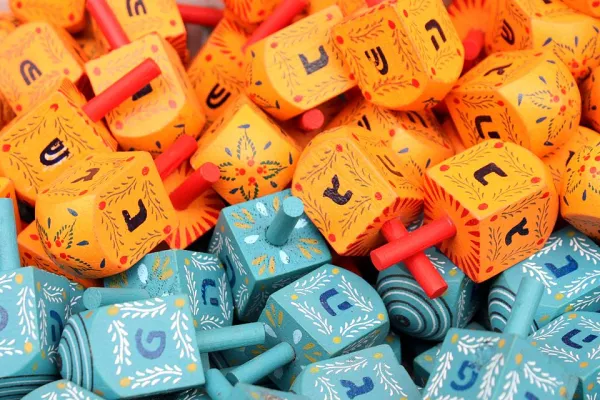
Each side of the dreidel bears one Hebrew letter:
נ (Nun) — Stands for Nes (miracle). In the game: nothing happens — the player does nothing.
ג (Gimel) — Stands for Gadol (great). In the game: the player takes everything in the pot. (Gimel is the dreidel player’s dream.)
ה (Hei) — Stands for Hayah (happened). In the game: the player takes half the pot. (Round up if it’s an odd number.)
ש (Shin) — Stands for Sham (there). In the game: the player puts one token in the pot. (Shin is the dreidel player’s nightmare.)
Together: Nes Gadol Hayah Sham — “A great miracle happened there,” referring to the miracle of the oil in the Temple that lasted eight days.
The Israeli Version
In Israel, the dreidel is called a sevivon (from the Hebrew root s-v-v, “to turn”). The Israeli version has one crucial difference: the Shin (ש) is replaced with a Pei (פ), standing for Po (“here”). The phrase becomes Nes Gadol Hayah Po — “A great miracle happened here.”
This single letter change carries enormous significance. For Diaspora Jews, the miracle happened there — in a distant land, in a different time. For Israeli Jews, the miracle happened here — on this soil, in this place. The dreidel, in its Israeli version, is a small but powerful statement of return and sovereignty.
How to Play
The rules of dreidel are simple enough for a four-year-old — which is part of the toy’s genius:
Setup:
- Each player starts with an equal number of tokens — traditionally gelt (chocolate coins wrapped in gold foil), but also candies, nuts, pennies, or poker chips
- Each player puts one token into the center pot
- Players sit in a circle
Gameplay:
- Players take turns spinning the dreidel
- When it lands, follow the letter:
- Nun (נ): Nothing. Pass to the next player
- Gimel (ג): Take the entire pot. Everyone then adds one token to restart the pot
- Hei (ה): Take half the pot (round up)
- Shin (ש): Add one token to the pot
- When the pot is empty, everyone adds one token
- A player who runs out of tokens is eliminated (or, in the generous version, given a loan)
- The last player with tokens wins
Pro tips:
- Play with odd numbers of tokens for faster game resolution
- Chocolate gelt melts in warm hands — play quickly or switch to coins
- The game works best with 3-6 players; larger groups can be slow
Gelt: The Dreidel’s Best Friend
The dreidel’s natural companion is Hanukkah gelt — money or, more commonly today, chocolate coins wrapped in gold or silver foil. The tradition of giving money on Hanukkah predates the modern gift-giving custom and has roots in the practice of giving coins to teachers and the poor during the holiday.
Today, gelt serves double duty: it is both a gift and the currency of the dreidel game. For many Jewish families, pouring out a bag of chocolate gelt and playing a few rounds of dreidel is as essential to Hanukkah as lighting the menorah.
The Dreidel in Culture
The dreidel has inspired one of the best-known Hanukkah songs: “I Have a Little Dreidel” (also known as “The Dreidel Song”), with its simple, catchy melody: “I have a little dreidel, I made it out of clay, and when it’s dry and ready, then dreidel I shall play.”
In recent years, the dreidel has been the subject of unexpected cultural moments:
- Competitive dreidel tournaments have emerged, with elaborate rules and genuine prizes
- Giant dreidels are displayed in public squares during Hanukkah
- Artisan dreidels — handcrafted from exotic woods, blown glass, or precious metals — have become collectible items
- The Major League Dreidel tournament in New York combined hipster irony with genuine Hanukkah celebration
A Spinning Symbol
The dreidel’s appeal is ultimately about more than the game. It is a tactile, physical connection to Jewish tradition — something you hold in your hand, spin with your fingers, and share with the people around you. In a religion rich with abstract ideas and textual study, the dreidel is refreshingly concrete: a simple toy that tells a simple story about a great miracle.
Whether the miracle happened there or here, the dreidel spins on — connecting generations of Jewish families through a game that is easy to learn, impossible to master, and just unpredictable enough to keep everyone at the table.
Frequently Asked Questions
What do the four letters on a dreidel stand for?
The four Hebrew letters on a dreidel are Nun (נ), Gimel (ג), Hei (ה), and Shin (ש), which stand for 'Nes Gadol Hayah Sham' — 'A great miracle happened there,' referring to the Hanukkah miracle in ancient Israel. In Israel, the Shin is replaced with Pei (פ), changing the phrase to 'Nes Gadol Hayah Po' — 'A great miracle happened here.'
How do you play dreidel?
Each player starts with an equal number of tokens (coins, candy, nuts). Everyone puts one token in the pot. Players take turns spinning the dreidel: Nun = nothing happens; Gimel = take everything in the pot; Hei = take half the pot; Shin = put one in. When the pot is empty, everyone adds one. A player with no tokens is out. The last player with tokens wins.
Is the dreidel story about hiding Torah study true?
The popular legend says Jews under Greek-Syrian persecution used the dreidel to disguise Torah study — if soldiers approached, they would pull out dreidels and pretend to be gambling. While this is a beloved tradition, historians note that the dreidel likely derives from European gambling tops (particularly the German 'trendl' or the Irish 'teetotum') adapted by Ashkenazi Jews in the Middle Ages. The letters were reinterpreted to reference the Hanukkah miracle.
Test Your Knowledge
Think you know this topic? Try our quiz!
Take the Jewish Holidays: Advanced Quiz →Sources & Further Reading
Related Articles
Hanukkah: The Festival of Lights
Eight nights of candles, latkes, and dreidels — the story and customs of the beloved winter holiday.
Hanukkah Songs: A Complete Guide to the Music of the Festival of Lights
From the ancient hymn Maoz Tzur to the children's favorite Dreidel Song — discover the melodies that make Hanukkah one of the most musical Jewish holidays.
The Hebrew Alphabet: A Complete Guide to Aleph-Bet
22 letters, written right to left, each with its own character and history — the Hebrew alphabet is the script of the Torah, modern Israel, and 3,000 years of Jewish civilization.