Hanukkah Songs: A Complete Guide to the Music of the Festival of Lights
From the ancient hymn Maoz Tzur to the children's favorite Dreidel Song — discover the melodies that make Hanukkah one of the most musical Jewish holidays.
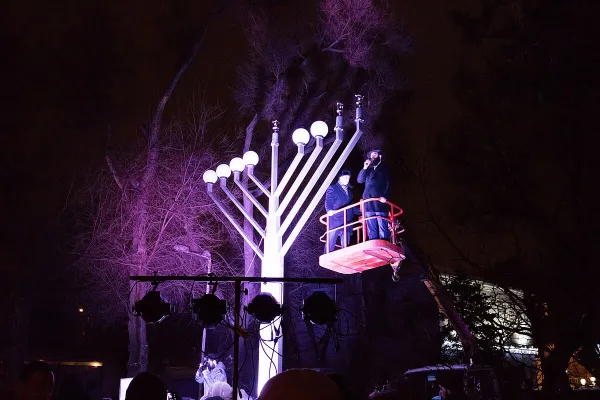
The Melody That Starts With a Match
The candles are lined up in the menorah. Someone strikes a match — or maybe holds a long shamash already flickering — and as the first flame catches, a voice begins. Maybe it is a grandmother who remembers every word. Maybe it is a child who only knows the tune but hums along anyway. Within a few notes, everyone joins in, because this melody has been sung so many times, in so many homes, that it has worn a groove into the collective memory.
Hanukkah is one of the most musical Jewish holidays. While every holiday has its prayers and hymns, Hanukkah has something extra: it is a holiday of the home, of children, of flickering light in dark windows — and music is woven into every night of it. The songs range from a 13th-century Hebrew hymn to a Yiddish folk song to an American novelty hit, and somehow they all belong together.
Here are the songs that make the Festival of Lights sing.
Maoz Tzur — Rock of Ages
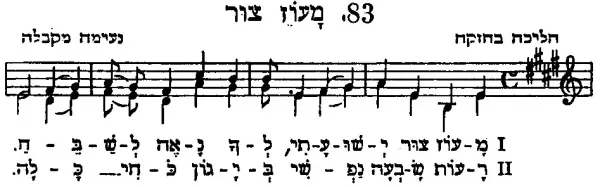
If Hanukkah has an anthem, it is Maoz Tzur. Sung immediately after the candles are lit, this hymn has been the soundtrack to Hanukkah evenings for nearly eight centuries.
The Text
Written in the 13th century, likely by a poet whose name was Mordechai (his name is embedded as an acrostic in the first letters of each stanza), Maoz Tzur consists of six stanzas. The first is a general praise of God as a refuge and protector. The remaining five recount specific moments when God delivered the Jewish people from danger:
- Egypt — the Exodus from slavery
- Babylon — the exile and return
- Persia — the story of Purim and Haman’s defeat
- Greece — the Maccabean revolt that Hanukkah celebrates
- A final plea — for future redemption
Most people know only the first stanza, which begins: “Maoz Tzur yeshuati, lekha na’eh l’shabeach” — “Rock of Ages, let our song praise Your saving power.”
The Melody
The melody most Ashkenazi Jews know is not the original tune. It dates to approximately the 15th century and shows clear influence from German church chorales and folk songs of that era. The tune is so catchy and memorable that it has become inseparable from the words, even though Sephardic and Mizrahi Jews sing entirely different melodies — or different hymns altogether.
There is something deeply comforting about the Maoz Tzur melody. It is not complex or virtuosic. It is the kind of tune a five-year-old can follow, and that is exactly the point: it brings the whole family — every age, every skill level — into the same song at the same moment.
Hanerot Halalu — We Kindle These Lights
Less famous but equally traditional is Hanerot Halalu, a prayer-song recited or chanted while the Hanukkah candles burn. Its words declare that the candles are sacred — lit to commemorate the miracles, wonders, and salvations God performed for our ancestors — and that we have no right to use them for ordinary purposes, only to look at them and give thanks.
In many homes, Hanerot Halalu is spoken rather than sung. But in communities with strong liturgical music traditions, it becomes a chant with its own distinctive melody, often gentle and meditative — a contrast to the rousing Maoz Tzur that preceded it.
Oh Chanukah — The Yiddish Classic
If Maoz Tzur is the sacred anthem, Oh Chanukah (Oy Khanike in Yiddish) is the party. This exuberant folk song captures the sheer fun of the holiday: dancing, spinning dreidels, eating latkes, and celebrating.
The song originated in the Yiddish-speaking communities of Eastern Europe, though its exact authorship is unknown — like many folk songs, it belongs to everyone and no one. The English version, often beginning “Oh Chanukah, Oh Chanukah, come light the menorah,” became popular in North America in the mid-20th century and is now a staple of school holiday concerts and family singalongs.
What makes Oh Chanukah special is its energy. The tempo is fast, the rhythm bouncy, and the melody practically demands that you clap your hands or stamp your feet. It is impossible to sing this song and sit still.
The Dreidel Song — An American Classic
“I have a little dreidel, I made it out of clay…”
There may be no Hanukkah song more widely known in America than The Dreidel Song. Written by Samuel Goldfarb around 1927, it is deceptively simple — a children’s song about a spinning top. But its simplicity is its genius: the melody is so easy to learn that toddlers can sing it, and the image of a child making a dreidel and playing with it captures the warmth and innocence of the holiday.
Goldfarb, a Jewish music educator and composer, understood something important: children need songs that belong to them. The Dreidel Song gave Jewish children in America an English-language Hanukkah song that was entirely their own — not a translation, not a hymn borrowed from the synagogue, but a simple, joyful tune about play.
The song has been recorded hundreds of times, in styles ranging from folk to rock to hip-hop. It has been parodied, reimagined, and adapted. But the original remains: a small, bright song about a small, bright toy, sung during a holiday about small, bright lights.
Al Hanissim — For the Miracles
Al Hanissim (“For the Miracles”) is not exclusively a song — it is a prayer inserted into the daily liturgy and the Grace After Meals during all eight days of Hanukkah. But in many communities, it is chanted or sung with a distinctive melody that makes it feel like a song.
The text thanks God “for the miracles, for the salvation, for the mighty deeds, for the victories, and for the battles” — and then recounts the Hanukkah story: the Greek oppression, the Maccabean revolt, the rededication of the Temple. Hearing it sung in a room full of people, especially after a festive meal, gives the words a power that silent reading cannot match.
Sephardic Hanukkah Songs
The Hanukkah music most Americans know is overwhelmingly Ashkenazi in origin. But Sephardic and Mizrahi communities have their own rich traditions of Hanukkah song, often in Ladino (Judeo-Spanish) or Arabic.
Ocho Kandelikas
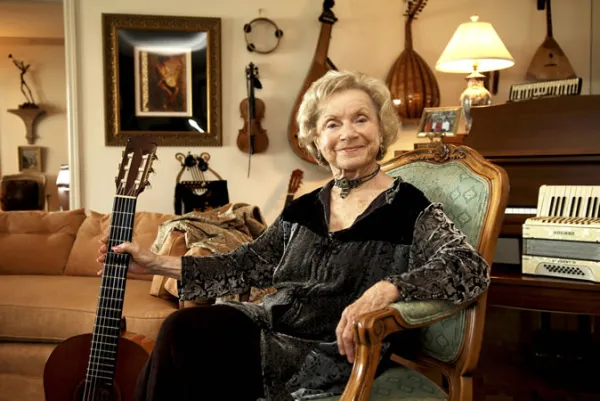
The most beloved Sephardic Hanukkah song is “Ocho Kandelikas” (Eight Little Candles), written in Ladino by Flory Jagoda (1923–2022). Born in Bosnia to a family of Sephardic musicians, Jagoda survived World War II and eventually settled in the United States, where she became the foremost ambassador of Ladino music.
“Ocho Kandelikas” is deceptively simple — a cheerful counting song about the eight candles of Hanukkah. But Jagoda infused it with the warmth and rhythm of Balkan folk music, and the Ladino language gives it a texture that is at once familiar and exotic to English-speaking ears. The song has become so popular that it is now sung in Ashkenazi communities too, bridging a cultural gap that Jagoda would have loved.
Other Sephardic Traditions
Sephardic communities also sing various piyyutim (liturgical poems) during Hanukkah, many with melodies rooted in the maqam system of Middle Eastern music. These songs tend to be more ornate and melodically complex than their Ashkenazi counterparts, reflecting the musical cultures of the Ottoman Empire, North Africa, and the Iberian Peninsula.
Modern Hanukkah Music
Adam Sandler’s “The Chanukah Song”
In 1994, comedian Adam Sandler performed “The Chanukah Song” on Saturday Night Live, and Jewish pop culture was never the same. The song — a humorous list of celebrities who are Jewish (“David Lee Roth lights the menorah…”) — became an instant classic, not because it was musically brilliant but because it filled a gap: Jewish kids in America finally had a Hanukkah song that was funny, contemporary, and played on the radio alongside Christmas music.
Sandler has released multiple versions over the years, updating the celebrity list. The song is not sacred, not traditional, and not particularly deep. But it matters. For a generation of Jewish Americans, “The Chanukah Song” was the moment Hanukkah stopped feeling like an afterthought during the holiday season and started feeling like something to be proud of.
Matisyahu and Beyond
Matisyahu, the Hasidic reggae and hip-hop artist, brought Jewish themes — including Hanukkah imagery — into modern music with songs like “Miracle” and his broader catalog of spiritually infused music. His work represents a different kind of Hanukkah music: not a novelty, not a children’s song, but a genuine artistic expression of Jewish identity through contemporary musical forms.
Other artists — from the Maccabeats (an a cappella group whose Hanukkah videos go viral annually) to Daveed Diggs to Six13 — have continued to expand the universe of modern Hanukkah music, proving that the tradition of Hanukkah song is not a museum piece but a living, evolving art form.
Across Communities, One Impulse
What connects Maoz Tzur to “The Chanukah Song”? What links a Ladino lullaby about eight candles to a klezmer-inflected hora? It is the same impulse that drives the holiday itself: the need to celebrate light in darkness, to make joy audible, and to pass something precious from one generation to the next.
When a family gathers around the menorah and sings — even badly, even off-key, even when half the people are just humming because they have forgotten the words — they are doing something that Jews have done for centuries. The melodies change. The languages shift. But the act of singing together, in the glow of small flames, remains. That is the music of Hanukkah: not perfection, but presence. Not performance, but participation. The candles are lit. The song begins. And for a moment, the darkness does not stand a chance.
Frequently Asked Questions
What is the most traditional Hanukkah song?
Maoz Tzur ('Rock of Ages') is the most traditional Hanukkah hymn, sung after lighting the menorah. Written in the 13th century, it recounts God's salvation of the Jewish people throughout history. The melody used by Ashkenazi Jews dates to 15th-century Germany.
What are the words to the Dreidel Song?
The most popular English version begins: 'I have a little dreidel, I made it out of clay. And when it's dry and ready, then dreidel I shall play.' Written by Samuel Goldfarb around 1927, it's become the most widely known Hanukkah song in English.
Do Sephardic Jews have different Hanukkah songs?
Yes. Sephardic communities sing different Hanukkah hymns, often in Ladino or Arabic. Popular Sephardic songs include 'Ocho Kandelikas' (Eight Little Candles) in Ladino by Flory Jagoda, and various piyyutim (liturgical poems) with Middle Eastern melodies.
Sources & Further Reading
Related Articles
Hanukkah: The Festival of Lights
Eight nights of candles, latkes, and dreidels — the story and customs of the beloved winter holiday.
Klezmer: The Soul Music of Eastern European Jews
From shtetl weddings to world stages — klezmer is the joyful, weeping, irresistible music of the Jewish soul.
Jewish Liturgical Music: The Sound of Prayer
From the haunting chant of Kol Nidre to joyful Shabbat melodies — liturgical music is the soundtrack of Jewish spiritual life.