The Complete Guide to Bar and Bat Mitzvah
Everything you need to know about Bar and Bat Mitzvah — from the meaning of the ceremony and months of preparation to the Torah reading, celebration, and gifts.
A Voice That Steadies
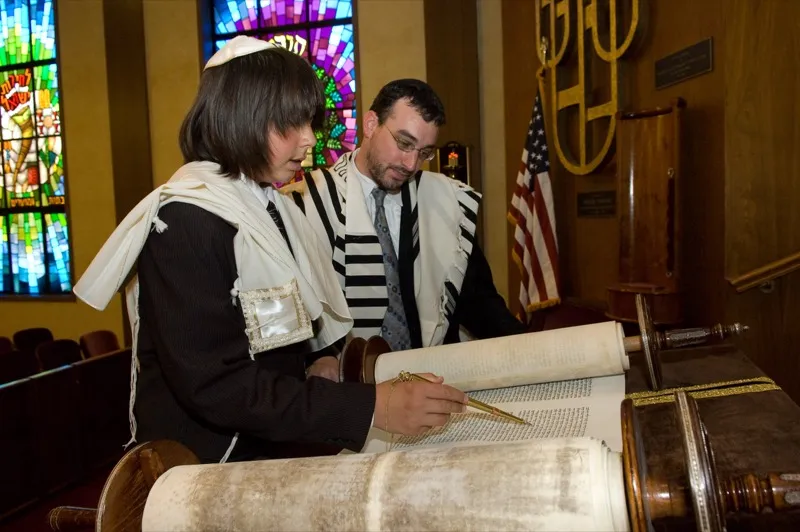
There is a moment that every parent who has stood in a synagogue on a Saturday morning will recognize. A thirteen-year-old steps up to the bimah — the raised platform at the center of the sanctuary — and looks down at the open Torah scroll. The parchment is ancient. The letters have no vowels, no punctuation. The congregation is watching. The rabbi steps back. And then the young person begins to chant.
The voice trembles at first. It is thin and uncertain in the high-ceilinged room. But line by line, word by word, it finds its footing. It grows stronger. By the second verse, something has changed — not just in the sound, but in the person making it. Parents grip each other’s hands. Grandparents reach for tissues. And the congregation witnesses, in real time, what Jewish communities have witnessed for centuries: a child stepping into the chain of tradition and becoming someone who can carry it forward.
This is the Bar Mitzvah. Not the party. Not the gifts. Not the DJ or the candle-lighting ceremony — though all of those may follow. The Bar Mitzvah, at its heart, is this: a young person standing before the Torah and saying, with their voice and their presence, I am ready.
What Does Bar Mitzvah Mean?
The term bar mitzvah is Aramaic and Hebrew for “son of the commandment.” Bat mitzvah means “daughter of the commandment.” But the phrase does not describe a ceremony — it describes a person. A Jewish boy does not “have” a bar mitzvah; he becomes a bar mitzvah. The same is true for a girl becoming a bat mitzvah.
What this means, in practical terms, is that the young person is now considered personally responsible for observing the commandments (mitzvot) of Jewish law. Before this age, the parents bear that responsibility. Afterward, the obligation belongs to the child — now, in the eyes of the community, a young adult. They can be counted in a minyan (the quorum of ten needed for communal prayer), be called to the Torah for an aliyah, lead services, fast on Yom Kippur, and be held accountable for their own moral and religious choices.
The milestone is automatic. It happens whether or not there is a ceremony, a party, or even an acknowledgment. But in practice, nearly every Jewish community marks the occasion — because a community that does not celebrate its young people stepping into responsibility is a community that has forgotten what it is for.
The Age
For boys, the bar mitzvah occurs at age 13. For girls, the bat mitzvah occurs at age 12 in Orthodox tradition, or 13 in Conservative, Reform, and Reconstructionist communities. The age of 13 for boys comes from the Mishnah (Pirkei Avot 5:21), which states: “At thirteen, one is ready for the commandments.” The age of 12 for girls reflects the traditional understanding that girls mature earlier.
These ages are not arbitrary. In the ancient world, 12 and 13 were the threshold of adulthood — the age at which young people began taking on real responsibilities within the family and community. Jewish law formalized what every parent already senses: there comes a point when a child is ready to be treated as more than a child.
Preparation: The Months Before
Most bar and bat mitzvah preparation begins six to twelve months before the ceremony. This is not casual study — it is an intensive period that shapes the young person in ways that last far beyond the day itself.
Learning the Torah portion (parashah). Each Shabbat has an assigned Torah reading. The bar or bat mitzvah child learns to chant their portion directly from the handwritten scroll, which contains no vowels, no punctuation, and no musical notation. Everything must be memorized or learned through the cantillation system (trope).
Chanting the Haftarah. A passage from the Prophets, thematically linked to the Torah portion, is chanted with its own set of melodies. Many b’nai mitzvah find the Haftarah even more challenging than the Torah reading.
Writing a d’var Torah. A speech or commentary on the Torah portion, connecting the ancient text to the young person’s own life and values. This is often the most personal part of the ceremony — the moment when the community hears not just the child’s voice, but their mind.
Learning prayer melodies. Depending on the community, the bar or bat mitzvah may lead portions of the Shabbat service, requiring fluency in the liturgy and its melodies.
Working with a tutor. Most families hire a private tutor or work with the synagogue’s cantor. Weekly sessions become a fixture of the child’s life, often alongside regular Hebrew school attendance.
The mitzvah project. Many communities encourage or require a community service project — volunteering at a food bank, raising money for a cause, tutoring younger students — that puts Jewish values of tikkun olam (repairing the world) into practice.
The Ceremony: Step by Step
The bar or bat mitzvah ceremony typically takes place during the Shabbat morning service at the synagogue. While customs vary by community and denomination, the general structure follows a recognizable pattern:
-
The aliyah. The bar or bat mitzvah is called to the Torah. They recite the blessings before and after the reading — the same blessings Jews have recited for centuries.
-
The Torah reading. The young person chants their portion from the scroll. In some communities, they read the entire weekly portion; in others, a selected section.
-
The Haftarah. The prophetic reading follows, chanted with its own distinctive melodies.
-
The d’var Torah. The young person delivers their speech, interpreting the Torah portion and often reflecting on what this moment means to them.
-
The rabbi’s blessing. The rabbi addresses the bar or bat mitzvah directly, offering words of wisdom, encouragement, and blessing for the journey ahead.
-
The parents’ blessing. In many communities, the parents recite the traditional blessing: “Baruch she-petarani me-onsho shel zeh” — “Blessed is the One who has freed me from responsibility for this one.” It is a line that draws laughter and tears in equal measure — the formal handing over of spiritual accountability from parent to child.
-
Candy shower. In many Ashkenazi congregations, the moment the Torah reading is complete, the congregation showers the bimah with candy — a chaotic, joyful tradition symbolizing the sweetness of Torah.
The Celebration
After the synagogue service, the celebration begins. The scale ranges from modest to extravagant, but the spirit is the same: joy.
The kiddush lunch. Many families host a kiddush — a meal after the Shabbat service — for the entire congregation. Challah, wine, and a spread of food are shared communally. In smaller or more traditional communities, this may be the extent of the celebration.
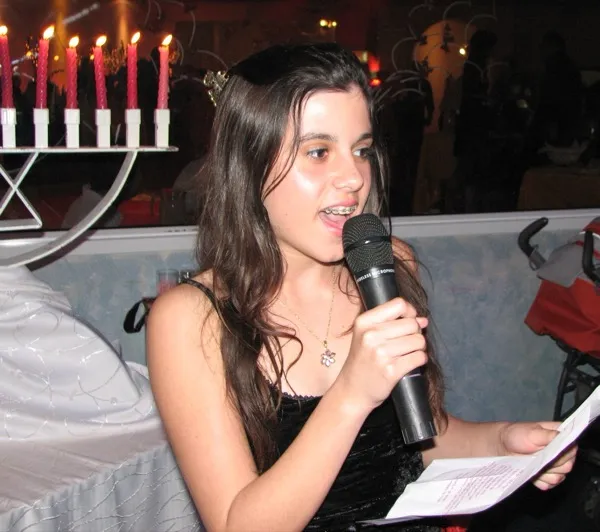
The evening reception. In many American communities especially, families host an evening party that can rival a wedding in scale: catered dinner, DJ or band, dancing, photo booths, and elaborate decor. The centerpiece is often the candle-lighting ceremony, where the bar or bat mitzvah invites thirteen special people or groups to light a candle on a ceremonial candelabra, each accompanied by a personal tribute.
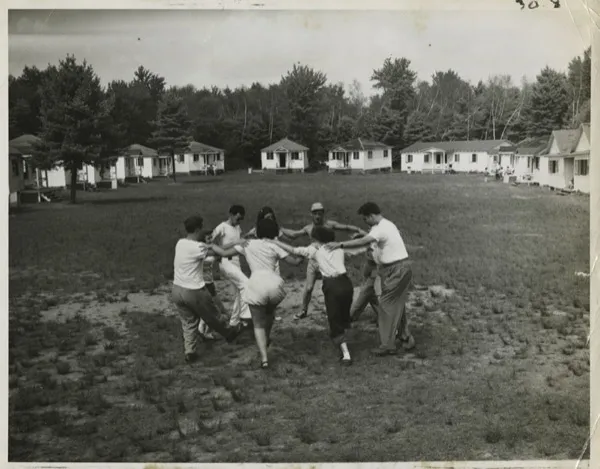
The hora. At many celebrations, guests lift the bar or bat mitzvah (and often the parents) on chairs while dancing the hora, a traditional circle dance. It is exhilarating, slightly terrifying, and unforgettable.
The montage video. A fixture of American bar and bat mitzvah parties — a video tracing the child’s life from infancy to the present moment, set to music, played on a big screen while the room laughs and cries.
In Israel, celebrations may take a different form entirely: a hike to Masada at dawn, a ceremony at the Western Wall, or a gathering at a family kibbutz.
Gifts and Etiquette
Monetary gifts are traditional, and in many Ashkenazi communities, they are given in multiples of 18 — because the Hebrew letters that spell chai (life) have a numerical value of 18. Common amounts are $36, $54, $72, $108, or $180, depending on the giver’s relationship to the family and community norms. Sephardi customs may differ.
Other appropriate gifts include Jewish books, a quality kiddush cup, a mezuzah, Israel bonds, or a donation to charity in the child’s name.
What to wear as a guest. Synagogue services require modest dress. Men should expect to wear a kippah (head covering), which is usually provided. Women in Orthodox synagogues should dress modestly (covered shoulders and knees). Evening celebrations may have their own dress code, from casual to black-tie.
For non-Jewish guests. You are warmly welcome. You are not expected to know the prayers or follow along — simply standing and sitting when others do is sufficient. A gift is customary but not required. If in doubt, ask the family.
Bar and Bat Mitzvah for Adults
One of the most meaningful developments in recent decades is the growing trend of adult b’nai mitzvah. Adults who never had a bar or bat mitzvah — because their family was not observant, because they grew up before bat mitzvah ceremonies were common, because they converted to Judaism, or simply because life got in the way — are choosing to claim this milestone on their own terms.
Many synagogues now offer adult b’nai mitzvah classes, where participants study Torah, learn to chant, and prepare over the course of a year or more. The ceremonies carry a particular poignancy: a 45-year-old woman reading from the Torah for the first time, a 70-year-old man fulfilling a promise he made to his grandmother decades ago. These moments remind the community that it is never too late to step forward.
Across Communities
Ashkenazi traditions. The bar mitzvah ceremony as we know it — with the Torah reading, d’var Torah, and festive celebration — developed primarily in Ashkenazi communities during the Middle Ages. By the 14th century, the custom was well established. The emphasis on a large celebration has grown considerably in modern times, particularly in America.
Sephardi traditions. In many Sephardi communities, the bar mitzvah boy wraps himself in a tallit (prayer shawl) for the first time at the ceremony — a moment of great emotion, often accompanied by special piyutim (liturgical poems) and communal singing. Celebrations feature traditional dishes from the family’s country of origin — Moroccan, Turkish, Syrian, or Iraqi cuisine.
Ethiopian Jewish traditions. In Beta Israel tradition, the coming-of-age process was marked through community recognition and demonstrated religious knowledge rather than a specific Torah-reading ceremony. As Ethiopian Jews have integrated into Israeli life, many families blend the standard bar mitzvah format with their own cultural elements.
Yemenite traditions. Yemenite Jewish communities have their own distinctive chanting melodies and customs. The bar mitzvah boy may read from the Torah using the unique Yemenite cantillation, which scholars consider among the oldest surviving musical traditions in Judaism.
Beyond the Day
The party ends. The gifts are opened. The thank-you notes are — eventually — written. But what remains?
At its best, the bar or bat mitzvah plants something that grows for a lifetime. The months of preparation teach discipline, perseverance, and the ability to stand before a community and speak with your own voice. The ceremony itself provides a moment of public accomplishment that many adults remember as the first time they felt truly capable. And the underlying message — you are responsible now, you are part of something larger than yourself — is one that deepens with every passing year.
In a Sephardi synagogue in Brooklyn, a boy wraps himself in a tallit for the first time, his father’s hands guiding the white fabric over his shoulders. In a Reform temple in Los Angeles, a girl connects the story of Miriam to her own work with a refugee resettlement organization. In a small Orthodox shul in Jerusalem, candy rains down from the women’s section while children scramble on the floor. The customs vary, the melodies differ, the celebrations range from a quiet lunch to an elaborate gala — but the message is the same everywhere, and it is as old as the tradition itself:
You are no longer a spectator. You are part of the story now. The Torah is yours to carry.
As the Talmud teaches: “At thirteen, one is ready for the commandments.” Every bar and bat mitzvah, in every community, in every generation, answers that ancient statement with a single word: Hineni — here I am.
Frequently Asked Questions
How long does it take to prepare for a Bar Mitzvah?
Most children begin preparation 6-12 months before the ceremony. This includes learning to read from the Torah and Haftarah, studying their Torah portion's meaning, writing a d'var Torah (speech), and learning the prayer melodies. A tutor or the synagogue's cantor typically guides the preparation.
How much money do you give for a Bar Mitzvah gift?
Gift amounts vary by community and relationship. In many Ashkenazi communities, gifts are given in multiples of 18 (chai, meaning 'life') — common amounts are $54, $72, $108, or $180. Sephardi customs may differ. Bonds, books, and meaningful Jewish items are also appropriate gifts.
What is the difference between a Bar Mitzvah and Bat Mitzvah?
Bar Mitzvah (for boys, age 13) and Bat Mitzvah (for girls, age 12 in Orthodox, 13 in other denominations) mark the same milestone — becoming responsible for the commandments. Orthodox Bat Mitzvah celebrations are typically more modest, while Conservative and Reform communities hold identical ceremonies for both.
Key Terms
Sources & Further Reading
Related Articles
Bar and Bat Mitzvah: Coming of Age
At age 12 or 13, a Jewish child becomes responsible for the commandments — a milestone celebrated with joy and meaning.
The Jewish Wedding: A Complete Guide to the Ceremony
Under the chuppah, surrounded by family and tradition, two lives become one — the Jewish wedding ceremony is a beautiful blend of ancient law, symbolism, and joy.
The Synagogue: House of Prayer, Study, and Assembly
More than just a place of worship — the synagogue is the heart of Jewish community life, combining prayer, learning, and social gathering under one roof.
The Torah: The Heart of Judaism
The Torah is more than a book — it is the living constitution of Jewish life, studied and debated for over three millennia.