Yad Vashem: The World Holocaust Remembrance Center
On 180 acres of a Jerusalem hillside, Yad Vashem holds 4.8 million names, millions of documents, and one mission: to ensure that the Holocaust is never forgotten and never repeated.
The Mountain of Memory
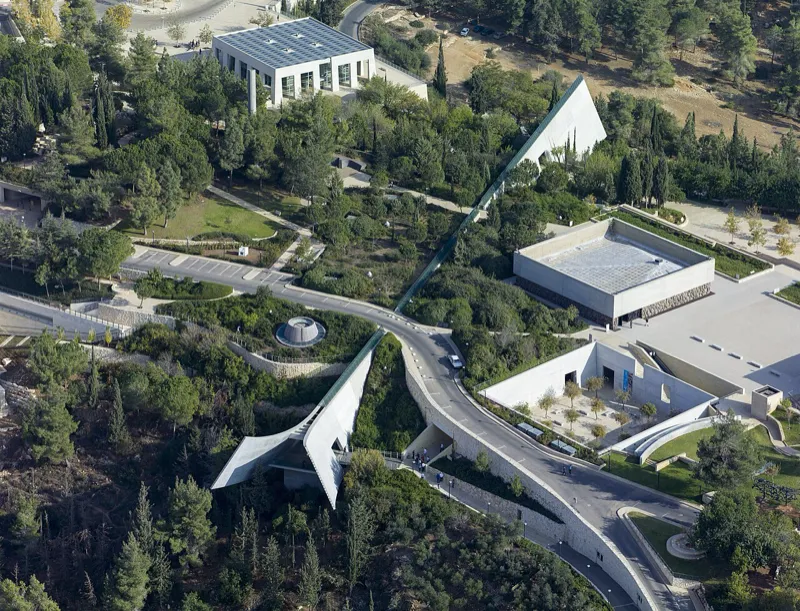
There is a hill on the western edge of Jerusalem — a place called Har HaZikaron, the Mount of Remembrance — where the largest and most comprehensive Holocaust memorial on earth stands among the pines. It is called Yad Vashem, and it is not merely a museum. It is an institution, a research center, an archive, an educational campus, and a sacred trust — a place where the Jewish people have concentrated their collective effort to remember what happened and to say each victim’s name.
Every Israeli soldier visits Yad Vashem. Every foreign dignitary visiting Israel is brought here. Every year, on Yom HaShoah (Holocaust Remembrance Day), the nation’s memorial ceremony is held on its grounds. And every day, thousands of ordinary visitors — Israelis, tourists, students, survivors, children of survivors, people with no personal connection to the Holocaust at all — walk through its doors and emerge, hours later, changed.
The History of the Institution
Yad Vashem was established by an act of the Israeli Knesset (parliament) in 1953, eight years after the end of World War II and five years after Israeli independence. The timing was deliberate: the young state, still absorbing hundreds of thousands of Holocaust survivors, needed a national institution to honor the dead and preserve their memory.
The name comes from the prophet Isaiah (56:5): “And to them will I give in My house and within My walls a memorial and a name (yad vashem) that shall not be cut off.” The phrase captures the institution’s dual mission — to create both a physical memorial and a personal record. Not statistics. Names.
The Holocaust History Museum
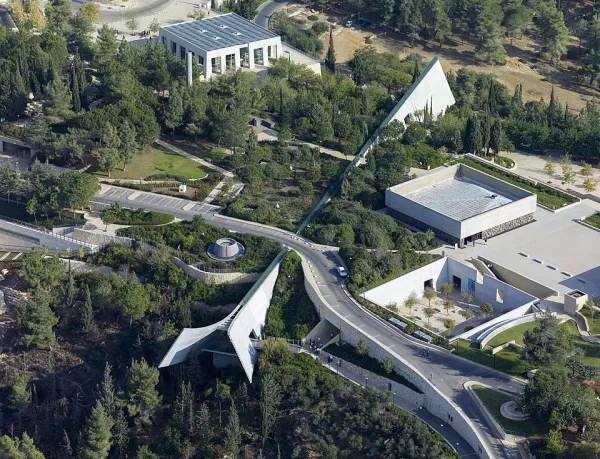
The museum — redesigned by architect Moshe Safdie and reopened in 2005 — is one of the most powerful museums in the world. It is built as a long, triangular prism that cuts through the hillside of Mount Herzl, with the narrative flowing through a series of galleries that trace the Holocaust chronologically — from the rise of Nazism through the final years of the war and liberation.
The architecture itself tells a story. The concrete walls press in. The spaces narrow and darken. At certain points, the floor drops away beneath glass, revealing the rocky hillside below. And at the very end, the tunnel opens to a stunning view of the Jerusalem hills — a deliberate transition from darkness to light, from destruction to the land where the survivors came to rebuild.
The exhibits combine artifacts, photographs, documents, video testimonies, and reconstructed environments. You see a railcar used to transport Jews to the camps. You see children’s shoes — thousands of them. You see personal belongings: a hairbrush, a prayer book, a photograph of a family that no longer exists.
The Hall of Names
The Hall of Names is the spiritual heart of Yad Vashem. It is a circular room with a cone-shaped ceiling reaching ten meters high, lined with 600 photographs and fragments of Pages of Testimony — the biographical records of individual victims. Below the floor, a corresponding cone descends into the rock, filled with water — reflecting the faces above.
Around the circumference, floor-to-ceiling shelves hold binders containing 4.8 million Pages of Testimony — handwritten and typed forms documenting individual victims by name, date of birth, place of residence, occupation, and fate. Each page was submitted by a survivor, a relative, or a researcher who wanted to ensure that a specific person would be remembered.
The project is not complete. Approximately 1.2 million victims remain unnamed — people whose families were entirely destroyed, whose communities were erased, whose records were burned. Yad Vashem continues to collect Pages of Testimony, working to recover every name before the last witnesses are gone.
The Children’s Memorial
The Children’s Memorial — dedicated to the approximately 1.5 million Jewish children murdered in the Holocaust — is, for many visitors, the most devastating experience at Yad Vashem.
You enter through a dim passageway. Inside, the darkness is nearly total. Five candles burn, their light reflected by hundreds of mirrors to create the illusion of an infinite field of flickering lights — each one representing a child. And in the darkness, a recorded voice reads names: the name, age, and country of origin of each child victim, one after another, in an unending litany.
The voice reads continuously. To recite all the names takes approximately three months. Then it starts again.
The Avenue of the Righteous Among the Nations
Along the paths of Yad Vashem, trees line the Avenue of the Righteous Among the Nations — each one planted in honor of a non-Jew who risked their life to save Jews during the Holocaust. As of 2025, over 28,000 individuals from more than 50 countries have been recognized as Righteous Among the Nations.
The most famous include Oskar Schindler (Germany), Raoul Wallenberg (Sweden), Irena Sendler (Poland), and Chiune Sugihara (Japan). But the vast majority are ordinary people — farmers, teachers, nuns, diplomats, factory workers — who made extraordinary choices at a time when the cost of compassion could be death.
The recognition process is rigorous. Each case is investigated by a commission of historians and jurists who verify the testimony. The standard is clear: the person must have risked their life, without expectation of reward, to save Jews from persecution or death.
Archives and Research
Beyond its public memorials, Yad Vashem maintains one of the world’s most important archives on the Holocaust. The collection includes:
- Over 210 million pages of documents
- Nearly 600,000 photographs
- Thousands of hours of video testimony
- Maps, films, artwork, personal effects, and artifacts
The archives serve researchers, educators, legal investigators, and family members searching for information about lost relatives. The increasing digitization of these records has made them accessible worldwide — a grandmother in Buenos Aires can search for her family’s fate from her living room.
Yad Vashem’s International School for Holocaust Studies trains educators from dozens of countries in how to teach the Holocaust effectively and responsibly. Its pedagogy emphasizes individual stories over statistics, human agency over passive victimhood, and the universality of the lessons alongside the specificity of the Jewish experience.
Visiting Yad Vashem
Practical information for visitors:
- Location: Mount of Remembrance, western Jerusalem
- Admission: Free
- Hours: Sunday-Thursday, typically 9:00-17:00; Friday and holiday eves, shorter hours; closed Shabbat and Jewish holidays
- Duration: Allow 3-4 hours minimum
- Age restriction: The main museum is not recommended for children under 10
- Audio guides available in multiple languages
- Accessibility: The site is wheelchair accessible
A few words of advice: do not rush. The museum is designed to be experienced slowly. Take breaks when you need them — there are outdoor spaces and cafés. And be prepared for an emotional experience that may stay with you for a very long time.
Why It Matters
Yad Vashem exists because forgetting is easy and remembering is hard. It exists because six million people were murdered, and each one had a name, a face, a life that mattered. It exists because the survivors, who carried the weight of memory in their own bodies, are leaving us — and the responsibility of remembrance must pass to institutions, to archives, to the next generation.
And it exists because the question at the heart of the Holocaust — what human beings are capable of doing to other human beings — is not a historical question. It is a permanent one. Yad Vashem’s answer is not to look away but to look directly, to name the dead, to honor the righteous, and to insist, with every exhibit and every archive and every tree planted along the avenue, that memory is a moral obligation.
Frequently Asked Questions
What does 'Yad Vashem' mean?
The name comes from Isaiah 56:5 — 'And to them will I give in My house and within My walls a memorial and a name (yad vashem) that shall not be cut off.' The phrase literally means 'a monument and a name,' reflecting the institution's mission to preserve the memory and individual identity of each Holocaust victim.
How long should I plan for a visit to Yad Vashem?
Plan at least 3-4 hours for a meaningful visit, though many people spend an entire day. The Holocaust History Museum alone takes 1.5-2 hours. The Children's Memorial, Hall of Names, Hall of Remembrance, Art Museum, and outdoor memorials each require additional time. The site is closed on Shabbat and Jewish holidays. Admission is free. Children under 10 are not admitted to the main museum.
How many names are in Yad Vashem's database?
The Hall of Names contains Pages of Testimony for approximately 4.8 million of the six million Jewish victims. Yad Vashem continues to collect these pages — each one submitted by a family member or researcher documenting a victim's name, biographical details, and photograph when available. The goal is to recover the name and story of every single victim.
Key Terms
Sources & Further Reading
Related Articles
The Holocaust: Remembering the Six Million
The systematic murder of six million Jews during World War II — the darkest chapter in human history and its lasting impact on Jewish identity.
Jerusalem: 3,000 Years of Faith, Conflict, and Hope
For three millennia, Jerusalem has been the spiritual heart of the Jewish people — and a city sacred to three faiths. Its story is one of devotion, destruction, and enduring hope.
Righteous Among the Nations: The Non-Jews Who Saved Jewish Lives
Over 28,000 non-Jews have been recognized by Yad Vashem for risking their lives to save Jews during the Holocaust. Their stories — from Oskar Schindler to Irena Sendler to Chiune Sugihara — illuminate the best of humanity in its darkest hour.