Jews of Germany: From Ashkenaz to Today
Germany is where the term 'Ashkenazi' originates, where the Reform movement was born, and where the Holocaust was conceived. The story of German Jewry is one of extraordinary achievement, devastating betrayal, and improbable rebirth.
The Land Called Ashkenaz
The word Ashkenazi — used today to describe the majority of the world’s Jews, those of Central and Eastern European heritage — traces directly to Germany. In medieval Hebrew, “Ashkenaz” referred to the Rhineland, the region along the Rhine River where some of the earliest known Jewish communities in Northern Europe took root. From this small corner of the world, a civilization would emerge that would reshape Judaism itself.
Jewish settlement in the Germanic lands dates to at least the Roman period. A decree from Emperor Constantine in 321 CE mentions Jews in Cologne — the oldest documented evidence of Jewish life in Northern Europe. By the tenth and eleventh centuries, flourishing Jewish communities had established themselves in the Rhineland cities of Mainz, Worms, and Speyer — collectively known by the Hebrew acronym ShUM.
These Rhineland communities became powerhouses of Jewish learning. Rabbi Gershom ben Judah of Mainz, known as the “Light of the Exile,” issued revolutionary rulings in the eleventh century — including the ban on polygamy for Ashkenazi Jews — that shaped Jewish law for a millennium. His student Rashi, who studied in Worms before returning to France, became the most important commentator on the Torah and Talmud in Jewish history.
Crusades, Persecution, and Resilience
The First Crusade of 1096 brought catastrophe to the Rhineland communities. Crusading mobs, inflamed by religious fervor and greed, massacred thousands of Jews in Mainz, Worms, Cologne, and other cities. Many Jews chose martyrdom rather than forced conversion — a response that became a defining feature of Ashkenazi identity, commemorated in liturgical poems (piyyutim) still recited today.
The centuries that followed brought recurring cycles of persecution and rebuilding. Blood libels, host desecration charges, and accusations of well-poisoning during the Black Death (1348-1349) led to further massacres and expulsions. Jews were confined to specific streets or quarters, restricted in their occupations, and required to wear identifying markers.
Yet the community persisted and created. Yiddish — a fusion of medieval German, Hebrew, Aramaic, and Slavic elements — evolved in the German lands and became the vernacular of Ashkenazi Jews across Europe. Distinctive prayer melodies, legal traditions, food customs, and communal structures all developed in this crucible of creativity and suffering.
Emancipation and the German-Jewish Symbiosis
The eighteenth and nineteenth centuries brought revolutionary change. Moses Mendelssohn, a self-taught philosopher from Dessau, became the bridge between the Jewish and German intellectual worlds. His translation of the Torah into German (written in Hebrew letters) and his advocacy for Jewish participation in secular society launched the Haskalah — the Jewish Enlightenment.
The Napoleonic era and its aftermath gradually broke down legal barriers. Jews gained citizenship, entered universities, and began to participate in German cultural, scientific, and economic life at the highest levels. The list of German-Jewish contributions to Western civilization is staggering: Heinrich Heine in literature, Felix Mendelssohn in music, Albert Einstein in physics, Sigmund Freud in psychology (Austrian, but German-speaking), Franz Kafka in literature, Emmy Noether in mathematics.
This was also the birthplace of Reform Judaism. Seeking to harmonize Jewish identity with modern German life, reformers introduced organ music, vernacular sermons, and modified liturgy. The movement provoked fierce opposition from traditionalists but spread rapidly, eventually crossing the Atlantic to become the largest Jewish denomination in America.
The Catastrophe
The very depth of Jewish integration into German society made the Holocaust all the more incomprehensible. German Jews had fought and died for Germany in World War I. They considered themselves Germans of the Jewish faith, not a foreign element. When the Nazis came to power in 1933, many simply could not believe that the country of Goethe and Beethoven would turn on them.
But it did. The Nuremberg Laws of 1935 stripped Jews of citizenship. Kristallnacht in November 1938 saw synagogues burned, businesses smashed, and thousands arrested. Of approximately 525,000 Jews in Germany in 1933, roughly 300,000 managed to emigrate before the borders closed. Those who remained — along with millions of Jews across Nazi-occupied Europe — were murdered in the camps.
The Holocaust was not merely a catastrophe for individual Jews; it was the destruction of the German-Jewish cultural synthesis that had produced some of the modern world’s greatest achievements. An entire intellectual tradition — the tradition of Mendelssohn, Heine, Buber, Rosenzweig, and Benjamin — was annihilated or scattered to the winds.
Rebirth on Ashes
After 1945, a small community of survivors and displaced persons remained in Germany — often in the very shadow of former concentration camps. For decades, the community was small, aging, and deeply ambivalent about living in the land of the perpetrators. Many Jews worldwide considered it a betrayal to live in Germany at all.
Then, in the 1990s, following the collapse of the Soviet Union, Germany opened its doors to Jewish immigrants from the former USSR. Approximately 200,000 Russian-speaking Jews settled in Germany, transforming and revitalizing the community virtually overnight. Today, Germany’s Jewish community numbers roughly 120,000 to 150,000 registered members — the fastest-growing in Europe.
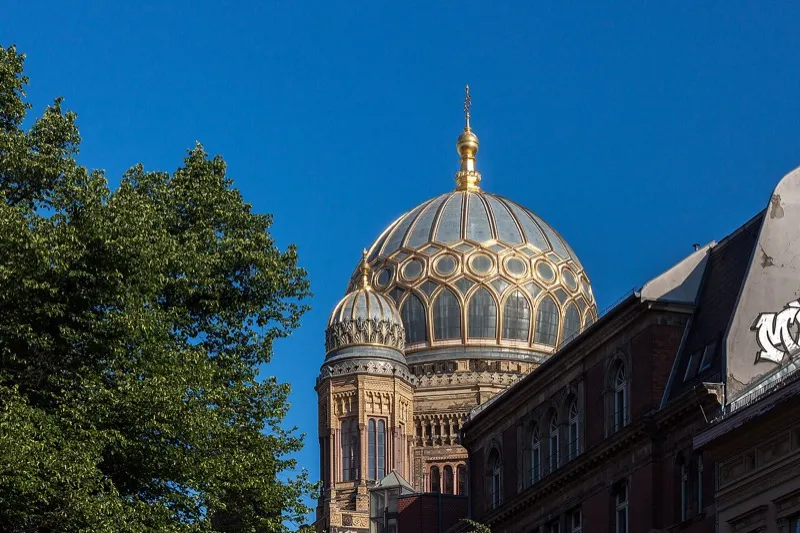
Berlin has become a hub for young Israelis and Jews from around the world. New synagogues have been built. Jewish museums, memorial sites, and cultural institutions dot the German landscape. The Stolpersteine (stumbling stones) project has embedded small brass plaques in sidewalks across the country, each one marking the last freely chosen address of a Holocaust victim.
The story of German Jewry is the story of Ashkenazi Judaism itself — its origins, its flowering, its near-destruction, and its refusal to disappear. Walking through the streets of Berlin today, past the restored synagogues and the memorial stones, you encounter a community that carries the weight of the most terrible history imaginable and yet continues to create, to pray, to argue, and to live. That persistence is not a footnote to the Sephardi-Ashkenazi story — it is its beating heart.
Frequently Asked Questions
Why are European Jews called 'Ashkenazi'?
The term 'Ashkenaz' appears in the Hebrew Bible as a descendant of Noah. Medieval Jewish scholars applied the name to the Rhineland region of Germany, and over time 'Ashkenazi' came to refer to all Jews of Central and Eastern European origin, their customs, liturgy, and Yiddish language.
Where was Reform Judaism founded?
Reform Judaism originated in early nineteenth-century Germany. The first Reform temple was established in Seesen in 1810, and leaders like Abraham Geiger and Samuel Holdheim shaped a movement that sought to modernize Jewish worship, adapt Jewish law to contemporary life, and fully integrate Jews into German society.
How large is the Jewish community in Germany today?
Germany's Jewish community numbers approximately 120,000-150,000 registered members, making it one of the fastest-growing Jewish communities in Europe. This growth is largely due to immigration from the former Soviet Union in the 1990s and 2000s.
Sources & Further Reading
Related Articles
Haskalah: The Jewish Enlightenment That Changed Everything
The Haskalah — the Jewish Enlightenment of the 18th and 19th centuries — transformed Jewish life, sparking debates about tradition, modernity, and identity that continue to this day.
The Holocaust: Remembering the Six Million
The systematic murder of six million Jews during World War II — the darkest chapter in human history and its lasting impact on Jewish identity.
Sephardi vs Ashkenazi: Two Streams of Jewish Life
Sephardi and Ashkenazi Jews share the same Torah but developed distinct languages, liturgies, foods, and customs across centuries of separation — two rivers from one source.