The First Temple Period: From Solomon's Glory to Babylon's Flames
From Solomon's magnificent Temple to its destruction by Babylon in 586 BCE — the pivotal era that shaped Judaism's prophetic tradition, theological identity, and longing for restoration.
A House for the Divine
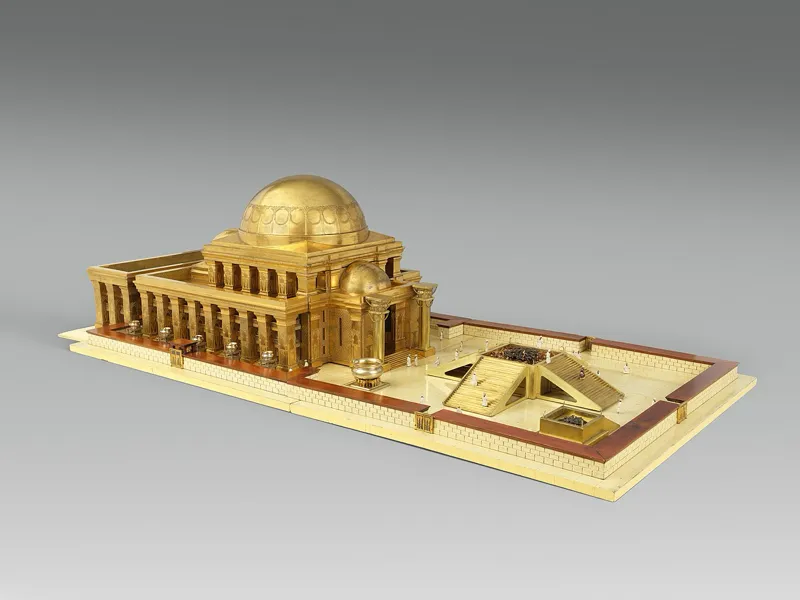
Stand today at the Western Wall in Jerusalem and you are standing at the retaining wall of the Temple Mount — the place where, nearly three thousand years ago, King Solomon built a house for God. That first Temple stood for almost four hundred years. Its construction, its rituals, its corruption, and its fiery end shaped Jewish consciousness in ways that persist to this day. Every prayer toward Jerusalem, every broken glass at a wedding, every reference to exile and return — these are echoes of the First Temple period, a story that begins in gold and glory and ends in ash and tears.
The First Temple period stretches roughly from 957 BCE, when Solomon completed the Temple, to 586 BCE, when the Babylonians burned it to the ground. In between lies a saga of kings and prophets, faithfulness and betrayal, political cunning and spiritual vision that reads like the greatest drama ever written — because, in a sense, it is.
Solomon Builds the Temple
King David had wanted to build a Temple. God said no — David was a man of war, with blood on his hands. The honor would go to his son Solomon, whose very name (Shlomo) comes from shalom — peace. Solomon ascended the throne around 970 BCE and set about the task with extraordinary ambition.
The biblical account in 1 Kings 5–8 describes a building project of staggering scale. Solomon conscripted tens of thousands of laborers. Cedar wood came from King Hiram of Tyre in Lebanon. Stones were quarried and dressed before arriving at the building site — the text notes that “no hammer, chisel, or any iron tool was heard in the Temple while it was being built” (1 Kings 6:7). The silence was deliberate: iron, used for weapons, had no place in a house of peace.
The Temple itself was not enormous by modern standards — roughly 90 feet long, 30 feet wide, and 45 feet high. But its interior was breathtaking. The walls were lined with cedar and overlaid with gold. Carved cherubim, palm trees, and open flowers decorated every surface. The innermost chamber — the Holy of Holies (Kodesh HaKodashim) — housed the Ark of the Covenant, flanked by two enormous golden cherubim whose wings spanned the entire width of the room.
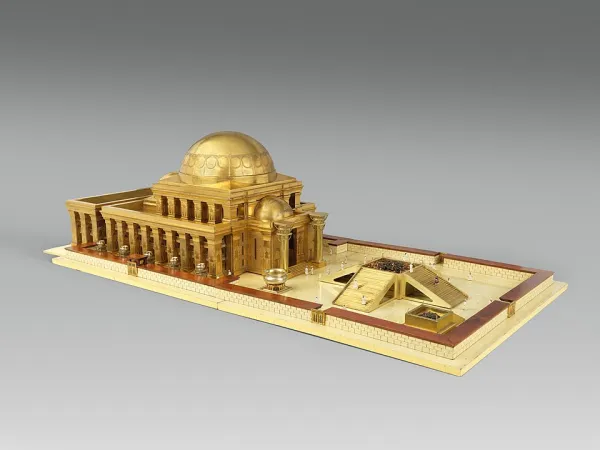
When the Temple was completed, Solomon dedicated it in a ceremony of overwhelming grandeur. The Ark was carried in by the priests. A cloud filled the Temple — the Shekhinah, God’s visible presence. Solomon offered a prayer of dedication that remains one of the most beautiful passages in the Hebrew Bible: “But will God really dwell on earth? The heavens, even the highest heaven, cannot contain you. How much less this temple I have built!” (1 Kings 8:27).
The United Monarchy Fractures
Solomon’s Temple was magnificent, but his kingdom was strained. The massive building projects — the Temple, his own palace, fortified cities throughout the land — required heavy taxation and forced labor. The northern tribes bore a disproportionate burden. Resentment simmered beneath the surface of imperial glory.
When Solomon died around 930 BCE, his son Rehoboam faced a delegation from the northern tribes asking for relief. His older advisors counseled leniency. His younger friends urged a show of strength. Rehoboam chose badly: “My father scourged you with whips; I will scourge you with scorpions” (1 Kings 12:14).
The northern tribes revolted. Under Jeroboam, they formed the breakaway Kingdom of Israel with its capital eventually at Samaria. The southern Kingdom of Judah — the tribes of Judah and Benjamin — retained Jerusalem and the Temple. The united monarchy of David and Solomon lasted barely two generations.
This split had profound consequences. Jeroboam, fearing that his people’s continued pilgrimage to the Temple in Jerusalem would erode their loyalty, set up alternative worship sites at Dan and Bethel, with golden calves as icons. The biblical authors viewed this as catastrophic apostasy — and traced every subsequent disaster back to this original sin of division.
The Age of Prophets
The divided monarchy era produced one of Judaism’s greatest contributions to human civilization: the prophetic tradition. The prophets were not fortune-tellers. They were moral voices — individuals called by God to confront kings, challenge injustice, and hold the people accountable to their covenant.
In the northern Kingdom of Israel, Elijah confronted King Ahab and Queen Jezebel over their promotion of Baal worship. The dramatic contest on Mount Carmel — Elijah versus 450 prophets of Baal — remains one of the Bible’s most vivid scenes. His successor Elisha continued the struggle. Amos, a shepherd from the south, traveled north to denounce economic exploitation: “You trample on the poor and force them to give you grain” (Amos 5:11). Hosea used the metaphor of a broken marriage to describe Israel’s unfaithfulness to God.
In the southern Kingdom of Judah, the prophetic tradition reached its literary peak. Isaiah, active in the 8th century BCE, delivered visions of breathtaking scope — from denunciations of empty ritual (“I have no pleasure in the blood of bulls and lambs and goats”) to universal peace (“They shall beat their swords into plowshares”). Micah distilled the prophetic message into a single sentence that still resonates: “What does the Lord require of you? To do justice, to love mercy, and to walk humbly with your God” (Micah 6:8).
The prophets did not merely predict the future. They insisted that the present mattered — that ritual without ethics was meaningless, that power without justice was tyranny, and that God cared more about how people treated each other than about the smoke of sacrifices.
The Assyrian Storm
The northern Kingdom of Israel fell first. The Assyrian Empire, the superpower of the ancient Near East, had been expanding relentlessly. In 722 BCE, the Assyrian king Shalmaneser V (completed by his successor Sargon II) conquered Samaria, the capital of Israel, and deported much of the population. These deportees became the famous Ten Lost Tribes — scattered across the Assyrian Empire and eventually assimilated into surrounding populations.
The southern Kingdom of Judah survived — barely. When the Assyrian king Sennacherib besieged Jerusalem in 701 BCE, the city held out. The biblical account credits divine intervention; the Assyrian account claims Judah paid enormous tribute. Either way, Jerusalem endured, and the experience reinforced a powerful belief: God would protect the Temple and the city of David.
This belief would prove both sustaining and dangerous.
Jeremiah and the Final Warning
By the late 7th century BCE, Assyria was declining and Babylon was rising. King Josiah of Judah (reigned c. 640–609 BCE) launched a dramatic religious reform after the discovery of a “book of the law” in the Temple — likely an early form of Deuteronomy. Josiah centralized all worship in the Jerusalem Temple, destroyed pagan altars, and reinstituted the Passover celebration. For a brief moment, it seemed like renewal was possible.
Then Josiah was killed in battle at Megiddo in 609 BCE, and everything unraveled. His successors were weak, and the great power of the region was now Babylon under Nebuchadnezzar II.
Jeremiah, the prophet of Jerusalem’s final decades, delivered the most anguished message in biblical literature. He told the people what they did not want to hear: the Temple would not save them. God’s protection was conditional on moral behavior, not guaranteed by a building. “Do not trust in deceptive words and say, ‘This is the temple of the Lord, the temple of the Lord, the temple of the Lord!’” (Jeremiah 7:4). He urged surrender to Babylon as God’s instrument of punishment. For this, he was beaten, imprisoned, and thrown into a cistern.
Destruction: The Ninth of Av, 586 BCE
Nebuchadnezzar besieged Jerusalem in 588 BCE. After eighteen months of horrifying siege — the Lamentations describe cannibalism — the walls were breached on the ninth day of the Hebrew month of Av (Tisha B’Av). The Babylonians burned the Temple, demolished the city walls, and deported the surviving elite to Babylon.
The destruction was total. Solomon’s golden Temple — the place where God’s presence dwelled, the center of Israelite worship for nearly four centuries — was gone. The Ark of the Covenant disappeared, never to be seen again. The Davidic monarchy was effectively ended. The people were scattered.
And yet the story did not end. In the rivers of Babylon, the exiles wept — “How can we sing the Lord’s song in a foreign land?” (Psalm 137:4) — but they also innovated. Without a Temple, they developed synagogue worship. Without sacrifices, they emphasized prayer and Torah study. Without a homeland, they created a portable spiritual identity that could survive anywhere.
The First Temple period ended in catastrophe. But the catastrophe produced something extraordinary: a Judaism that no longer needed a building to survive. The prophets had been right all along. God was not in the stones.
Why the First Temple Period Still Matters
Every year on Tisha B’Av, Jews fast and mourn the Temple’s destruction — both the first and the second. The reading from Lamentations, chanted in a haunting melody in darkened synagogues, is not merely a memorial. It is a confrontation with the consequences of moral failure, political arrogance, and the fragility of even the most sacred institutions.
The First Temple period also bequeathed the prophetic tradition — the insistence that religion must serve justice, that ritual without ethics is empty, and that the powerful will be held accountable. These ideas shaped not only Judaism but Christianity, Islam, and the entire Western moral tradition. When Martin Luther King Jr. quoted Amos — “Let justice roll down like waters” — he was drawing on a tradition born in the shadow of Solomon’s Temple.
The Temple is gone. The prophecies remain.
Frequently Asked Questions
When was the First Temple built and destroyed?
According to biblical tradition, Solomon built the First Temple in Jerusalem around 957 BCE. It stood for nearly four centuries until the Babylonian king Nebuchadnezzar II destroyed it in 586 BCE. The Temple served as the central place of worship for the Israelites, housing the Ark of the Covenant and serving as the focal point of sacrificial worship and pilgrimage.
What caused the split between Israel and Judah?
After Solomon's death around 930 BCE, his son Rehoboam refused to lighten the heavy taxation and forced labor that Solomon had imposed. The ten northern tribes revolted under the leadership of Jeroboam and formed the Kingdom of Israel, while the tribes of Judah and Benjamin remained loyal to the Davidic dynasty, forming the Kingdom of Judah with its capital in Jerusalem.
Who were the major prophets of the First Temple period?
The First Temple period produced some of Judaism's most influential prophets. Isaiah delivered his visions of universal peace and justice in the 8th century BCE. Jeremiah, active during the final decades before the destruction, warned of coming catastrophe and offered hope for renewal. Other major figures include Elijah, Elisha, Amos, Hosea, and Micah — each challenging kings and people alike to uphold God's covenant.
Sources & Further Reading
Related Articles
Ancient Israel: From Abraham to the Kingdoms
The foundational story of the Jewish people — from the call of Abraham through the united monarchy of David and Solomon.
King David and King Solomon: Israel's Golden Age
The story of David the shepherd who became king, established Jerusalem as the capital, and his son Solomon who built the First Temple — the golden age of ancient Israel.
Jerusalem: 3,000 Years of Faith, Conflict, and Hope
For three millennia, Jerusalem has been the spiritual heart of the Jewish people — and a city sacred to three faiths. Its story is one of devotion, destruction, and enduring hope.