Betty Friedan: The Jewish Woman Who Launched a Revolution
Betty Friedan's The Feminine Mystique ignited the second wave of feminism, transforming the lives of millions of women — driven by a Jewish tradition of questioning the status quo.
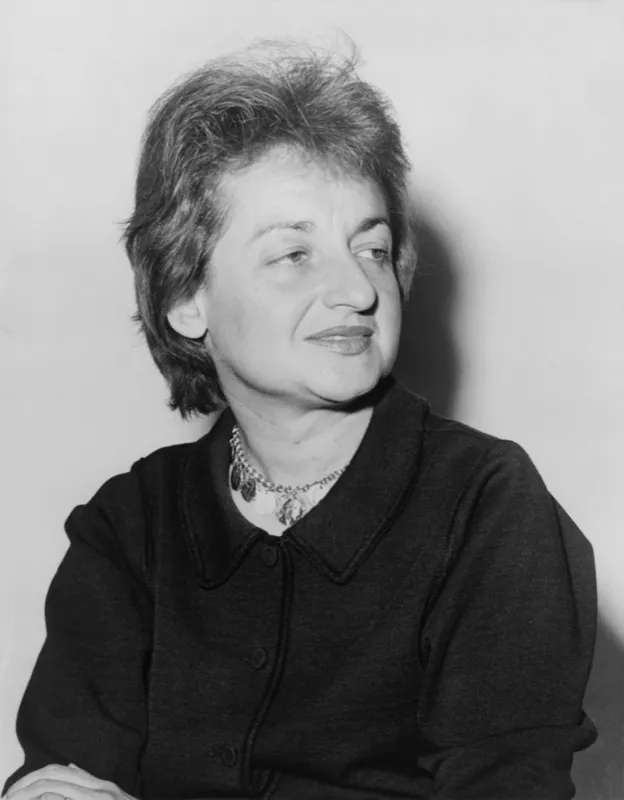
The Problem That Has No Name
In 1963, a forty-two-year-old Jewish housewife from the suburbs published a book that changed the world. The Feminine Mystique began with a simple observation: millions of educated American women were deeply unhappy, and nobody would talk about it. They had the husbands, the houses, the children, the appliances — everything the culture told them they should want. And they were miserable.
Betty Friedan called it “the problem that has no name.” By naming it, she launched the second wave of feminism, transformed the lives of millions of women, and became one of the most important social activists of the twentieth century.
Peoria’s Jewish Outsider
Bettye Naomi Goldstein was born on February 4, 1921, in Peoria, Illinois — as far from the Jewish centers of New York and Chicago as one could imagine. Her father, Harry Goldstein, had emigrated from Russia and built a successful jewelry business. Her mother, Miriam Horwitz, had been a journalist before marriage but gave up her career to become a housewife — a sacrifice that left her bitter and frustrated.
Young Betty was brilliant, ambitious, and acutely aware of being different. As one of very few Jewish families in Peoria, the Goldsteins experienced antisemitism. Betty was excluded from sororities and social clubs. The experience of being an outsider — of watching the mainstream from the margins — would prove formative. “It was because I was a Jew,” she later wrote, “that I understood what it meant to be an outsider in America.”
She graduated as valedictorian of her high school and attended Smith College, where she studied psychology. She won a fellowship to Berkeley for graduate work but gave it up — a decision she later attributed to pressure from her boyfriend, who felt threatened by her ambition. The experience of choosing love over work, and regretting it, would fuel The Feminine Mystique two decades later.
The Book That Changed Everything
After working as a journalist in New York, Friedan married Carl Friedan in 1947 and moved to the suburbs. She had three children and freelanced for women’s magazines. But she was restless and unhappy — and when she surveyed her Smith College classmates for their fifteenth reunion, she discovered that she was not alone.
The survey revealed that most of her highly educated classmates were also unfulfilled. They had been told that education and careers were unfeminine, that a woman’s highest calling was homemaking. They had believed it. And they were suffering.
Friedan spent five years researching and writing The Feminine Mystique. Published in 1963, it sold three million copies and became one of the most influential books of the twentieth century. Friedan argued that the “feminine mystique” — the ideology that women could find fulfillment only through marriage and motherhood — was a fraud, perpetuated by advertisers, psychologists, and educators who had a vested interest in keeping women at home.
NOW and the Movement
In 1966, Friedan co-founded the National Organization for Women (NOW) and served as its first president. Under her leadership, NOW fought for equal pay, access to education, and reproductive rights. In 1970, she organized the Women’s Strike for Equality, a nationwide protest that brought fifty thousand women to march down Fifth Avenue in New York City.
Friedan’s activism was driven by the same impulse that had shaped her intellectual life: the Jewish tradition of tikkun olam — repairing the world — and the prophetic insistence that injustice must be named and confronted. “The women’s movement,” she said, “was not just about women. It was about justice.”
Later Years and Legacy
Friedan’s later career was marked by both achievements and controversies. She clashed with younger feminists, particularly over the inclusion of lesbian rights in the movement (she initially resisted, calling it a “lavender menace,” a position she later regretted and reversed). She published several more books, taught at universities, and continued advocating for women’s rights until her death on February 4, 2006 — her eighty-fifth birthday.
Her legacy is immeasurable. Before The Feminine Mystique, the idea that women deserved equal access to education, employment, and public life was considered radical. Within a generation, it became common sense. Betty Friedan did not do this alone, but she lit the match. And the fire she started — fueled by a Jewish outsider’s refusal to accept the world as it was — continues to burn.
Frequently Asked Questions
What was The Feminine Mystique about?
Published in 1963, The Feminine Mystique argued that American women were suffering from 'the problem that has no name' — a pervasive unhappiness caused by being confined to the roles of housewife and mother. Friedan challenged the post-war assumption that women could find fulfillment only through marriage and domesticity, arguing that women needed meaningful work and public lives.
Was Betty Friedan Jewish?
Yes. Friedan was born Bettye Naomi Goldstein in Peoria, Illinois, to Jewish parents. Her father, Harry Goldstein, was a jeweler who had immigrated from Russia. Her mother, Miriam Horwitz, came from a Hungarian-Jewish family. Friedan experienced antisemitism in Peoria and has said that being an outsider as a Jew helped her understand the experience of women as outsiders.
What was NOW?
NOW — the National Organization for Women — was co-founded by Betty Friedan in 1966. It became the largest feminist organization in the United States, advocating for equal pay, reproductive rights, and an end to sex discrimination. Friedan served as its first president from 1966 to 1970.
Key Terms
Sources & Further Reading
Related Articles
Gloria Steinem: A Life of Feminist Activism
Gloria Steinem became the face of American feminism through Ms. Magazine, tireless activism, and a gift for translating rage into change — guided by her Jewish father's free spirit.
Jewish Feminism: A History
From the Talmudic sage Beruriah to Sally Priesand's historic ordination, Jewish feminism has transformed religious life — reshaping prayer, leadership, and the fight for women's rights within halakha.
Women Rabbis: From Regina Jonas to Today's Leaders
The story of women in the rabbinate — from Regina Jonas, murdered in the Holocaust, to Sally Priesand, Sandy Eisenberg Sasso, Amy Eilberg, and today's Orthodox Maharats.