The Bar Kokhba Revolt: The Last Jewish Stand Against Rome
In 132 CE, Simon bar Kokhba led the last great Jewish revolt against Rome. Initially successful, the rebellion was crushed with devastating consequences — Judaea was renamed Palestine, and the Jewish people's relationship with their homeland was fundamentally altered.
The Spark
Sixty-two years after Rome destroyed the Second Temple, the Jewish people rose up one final time. The Bar Kokhba revolt of 132-135 CE was the last and most devastating of the Jewish-Roman wars — a rebellion so fierce that it shook the Roman Empire, so hopeful that the greatest rabbi of the age declared its leader the Messiah, and so catastrophic in its failure that it reshaped the Jewish relationship with the Land of Israel for two thousand years.
To understand why Jews revolted again, consider the wound that had never healed. In 70 CE, the Romans had destroyed Jerusalem and the Second Temple — the center of Jewish religious life for six centuries. The loss was shattering. Yet in the decades that followed, Jews maintained hope that the Temple would be rebuilt. Hadn’t it happened before? The First Temple had been destroyed by Babylon, and the exiles had returned.
Then Emperor Hadrian shattered that hope. Around 130 CE, Hadrian announced plans to build a pagan temple to Jupiter on the ruins of the Temple Mount and to refound Jerusalem as a Roman colony called Aelia Capitolina. He also reportedly banned circumcision — an assault on the most fundamental marker of Jewish identity.
These provocations pushed the Jewish population of Judaea past the breaking point.
Simon bar Kokhba
The leader who emerged was Simon bar Kosiba — a man of extraordinary charisma and physical strength. The Talmud describes him as a powerful warrior who could uproot a tree while riding on horseback. Whether such stories are legend or fact, bar Kosiba clearly inspired fierce devotion.
Rabbi Akiva, the most prominent sage of the era, applied the biblical verse “A star shall come forth from Jacob” (Numbers 24:17) to bar Kosiba, renaming him “bar Kokhba” — son of a star — and declaring him the Messiah. This was not a casual statement. Rabbi Akiva was the leading religious authority of his time, and his endorsement transformed a military rebellion into a messianic movement.
Not all rabbis agreed. The Talmud records Rabbi Yohanan ben Torta responding: “Akiva, grass will grow through your cheeks and still the son of David will not have come.” This dissent reflects a tension within Judaism about the nature of messianic hope — a tension that reverberates to this day.
A Jewish State Reborn — Briefly
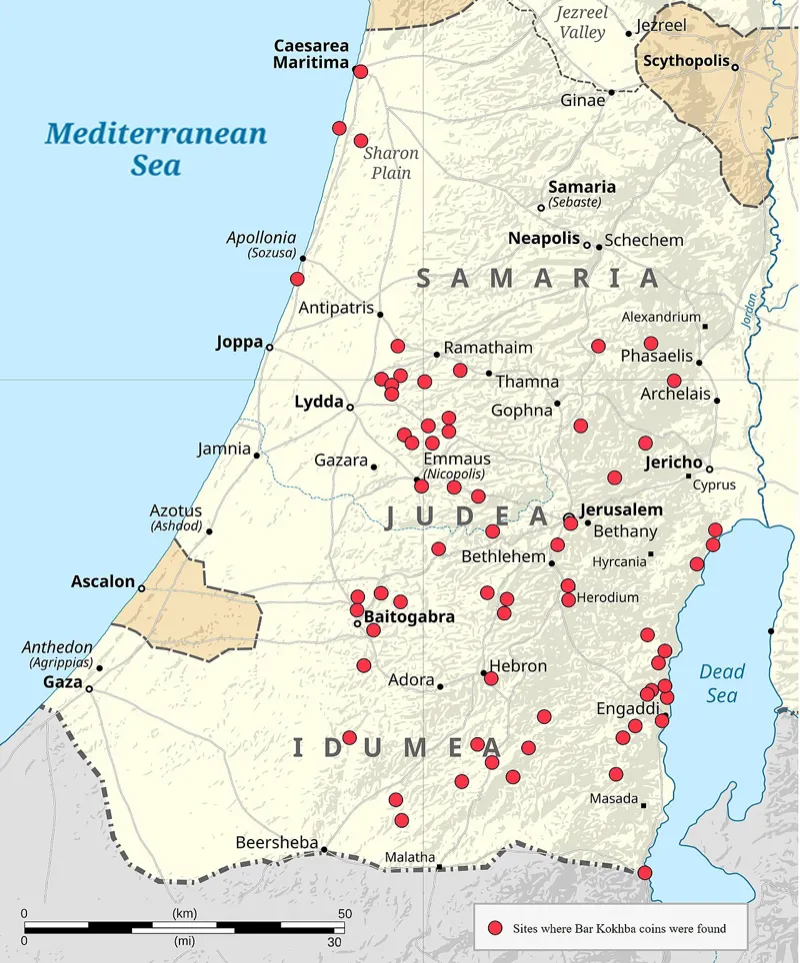
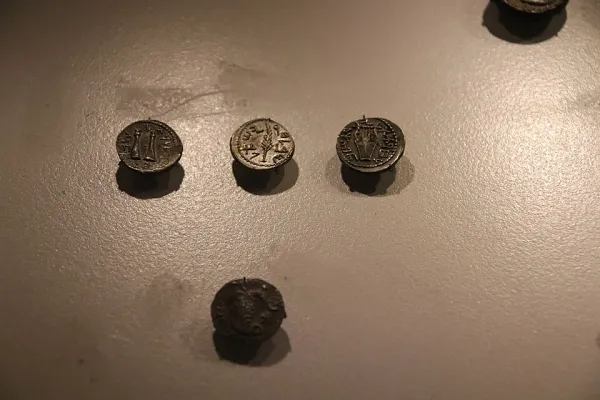
The revolt achieved remarkable initial success. Bar Kokhba’s forces liberated much of Judaea, established a functioning government, minted coins bearing Hebrew inscriptions (“Year One of the Redemption of Israel,” “For the Freedom of Jerusalem”), and may have briefly recaptured Jerusalem itself.
Recent archaeological discoveries — including Bar Kokhba’s personal letters found in caves along the Dead Sea — reveal a leader who was administratively competent, militarily disciplined, and fiercely devoted to Jewish religious practice. In one letter, he orders his officers to ensure that proper palm branches and citrons are sent to his troops for the Sukkot holiday — even in the midst of war.
For approximately three years, something like an independent Jewish state existed in the land of Israel — the last such state until 1948.
Rome’s Crushing Response
Rome took the revolt with deadly seriousness. Hadrian recalled his best general, Julius Severus, from Britain and deployed twelve legions — an enormous military force — to crush the rebellion. Rather than engaging Bar Kokhba’s guerrilla fighters in open battle, the Romans adopted a strategy of methodical siege warfare, starving out fortified positions one by one.
The final stand came at the fortress of Betar, southwest of Jerusalem, in the summer of 135 CE. Bar Kokhba himself was killed in the battle. According to the Talmud, the slaughter was so terrible that “the blood ran to the nostrils of the horses” — a horrifying image that echoes through Jewish memory.

The Roman historian Cassius Dio recorded that 580,000 Jews were killed in battle, 50 fortified towns and 985 villages were destroyed, and large portions of the Jewish population were enslaved or displaced. While these numbers may be exaggerated, the scale of destruction was undeniably catastrophic.
The Consequences
Hadrian’s post-revolt punishments were designed to erase Jewish identity from the land:
- Judaea was renamed Syria Palaestina — a deliberate insult referencing the Philistines, the ancient enemies of Israel. This renaming gave the world the name “Palestine.”
- Jerusalem was rebuilt as Aelia Capitolina, and Jews were banned from entering the city except on Tisha B’Av — when they were permitted to come and weep at the ruins.
- Jewish religious practices were prohibited, and the study of Torah was made a capital crime. The Romans executed numerous rabbis, including Rabbi Akiva himself, who was reportedly tortured to death while reciting the Shema.
- The center of Jewish life shifted to the Galilee and eventually to Babylon, as Judaea was depopulated of its Jewish inhabitants.
The Ten Martyrs — the rabbis killed by Rome in the aftermath of the revolt, including Rabbi Akiva — are commemorated in Jewish liturgy on Yom Kippur and Tisha B’Av. Their deaths are understood not as defeat but as sanctification of God’s name (kiddush Hashem).
Legacy and Meaning
The Bar Kokhba revolt is remembered differently depending on who is doing the remembering. In traditional rabbinic thought, the revolt is a cautionary tale about the dangers of false messianism — a reminder that military action and political hope, however justified, cannot substitute for divine redemption. The Talmud’s treatment of Bar Kokhba is notably ambivalent: he is respected for his courage but implicitly criticized for his hubris. After his defeat, the rabbis renamed him “Bar Koziba” — son of a lie.
In modern Zionist thought, Bar Kokhba was reclaimed as a hero — a symbol of Jewish military prowess and the willingness to fight for sovereignty. Israeli archaeologist Yigael Yadin’s discovery of Bar Kokhba’s letters in the 1960s electrified the young state, connecting modern Israeli soldiers to their ancient predecessor.
The truth, as always, is complex. Bar Kokhba’s revolt was an act of extraordinary courage against overwhelming odds. It was also a catastrophe that accelerated the Jewish people’s separation from their homeland. The tension between these two readings — heroism and tragedy, resistance and its costs — is central to Jewish historical consciousness.
The caves of the Judean Desert still hold secrets. Every few years, archaeologists discover new artifacts from the revolt — coins, letters, weapons, even sandals belonging to refugees who hid from the Roman onslaught. These objects, pulled from the darkness after nearly two thousand years, speak with a quiet intensity about a people who fought for their freedom, believed their leader was the Messiah, and lost everything — except the story itself, which they carried with them into an exile that would last until the twentieth century.
Frequently Asked Questions
Who was Bar Kokhba?
Simon bar Kokhba (also spelled Bar Kochba) was the leader of the last major Jewish revolt against the Roman Empire, from 132 to 135 CE. His original name was likely Simon bar Kosiba. 'Bar Kokhba' — meaning 'son of a star' — was a messianic title given to him by Rabbi Akiva, referencing the biblical prophecy of a star arising from Jacob.
Did Rabbi Akiva really declare Bar Kokhba the Messiah?
According to the Talmud (Jerusalem Talmud, Ta'anit 4:8), Rabbi Akiva declared of Bar Kokhba: 'This is the King Messiah.' Other rabbis reportedly responded: 'Akiva, grass will grow through your cheeks before the son of David comes.' The declaration remains one of the most debated episodes in rabbinic history.
Why did Rome rename Judaea to Palestine?
After crushing the Bar Kokhba revolt in 135 CE, Emperor Hadrian renamed the province of Judaea to 'Syria Palaestina' — referencing the Philistines, the ancient enemies of the Israelites. This was part of a deliberate effort to erase Jewish connection to the land. The name Palestine, in various forms, persisted for centuries.
Sources & Further Reading
Related Articles
Ancient Israel: From Abraham to the Kingdoms
The foundational story of the Jewish people — from the call of Abraham through the united monarchy of David and Solomon.
Jerusalem: 3,000 Years of Faith, Conflict, and Hope
For three millennia, Jerusalem has been the spiritual heart of the Jewish people — and a city sacred to three faiths. Its story is one of devotion, destruction, and enduring hope.
Tisha B'Av: The Saddest Day in the Jewish Calendar
On the ninth of Av, Jews mourn the destruction of both Temples and centuries of tragedy — through fasting, lamentation, and the haunting words of the Book of Lamentations.