Ancient Jewish Coins: Shekels, Revolt Coins, and What They Tell Us
From the half-shekel Temple tax to Bar Kokhba's defiant revolt coins, ancient Jewish coinage tells a story of sovereignty, resistance, and identity that extends to the modern Israeli shekel.
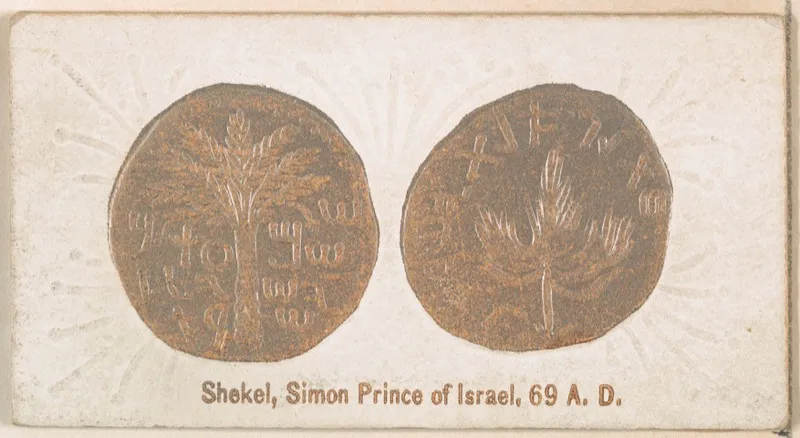
History You Can Hold
There is something almost magical about holding an ancient coin. It sits in your palm — small, worn, green with age — and you realize that two thousand years ago, someone else held this same object, felt its weight, used it to buy bread or pay a tax or drop into a charity box. A coin is history you can touch.
Ancient Jewish coins are more than curiosities for collectors. They are primary documents — tiny, portable witnesses to some of the most dramatic events in Jewish history. They tell us about sovereignty and subjugation, faith and rebellion, the Temple that once stood in Jerusalem and the hopes of people who fought to restore it. And they do something that written texts alone cannot: they show us what ordinary Jews carried in their pockets.
The Half-Shekel: The Temple’s Lifeline
The most famous Jewish coin is one that was not actually Jewish at all. The half-shekel — the annual tax that every adult Jewish male paid to support the Temple in Jerusalem — was paid in Tyrian shekels, silver coins minted in the Phoenician city of Tyre.
Why Tyrian coins? The Torah (Exodus 30:13) specifies that the Temple tax must be paid in a coin of specific weight and purity. Tyrian shekels were the most consistently pure silver coins available in the ancient Near East — approximately 94% silver, compared to the debased coinage of many other mints. Ironically, these coins featured the image of the Phoenician god Melqart (often identified with Heracles) on one side, making them technically idolatrous. But the rabbis, ever practical, ruled that the purity of the silver took precedence over the image stamped on it.
The half-shekel tax was a powerful unifying force. Whether a Jew lived in Jerusalem, Babylon, Alexandria, or Rome, he contributed to the same Temple. The money changers who sat in the Temple courtyard — the same ones Jesus famously overturned — existed to exchange the varied currencies of the Roman Empire for the acceptable Tyrian shekels.
Hasmonean Coins: Sovereignty Stamped in Bronze
The first coins struck by a Jewish authority were minted by the Hasmonean dynasty — the priestly family that led the Maccabean revolt against the Seleucid Greeks in the 2nd century BCE and established an independent Jewish kingdom.
John Hyrcanus I (ruled 134-104 BCE) is generally credited with minting the first Hasmonean coins, though some scholars attribute the earliest issues to his predecessor, Simon. These were small bronze coins called prutot (singular: prutah — the “widow’s mite” of the New Testament). They were modest in size and value but enormous in significance: for the first time in centuries, Jews were issuing their own currency.
Hasmonean coins are notable for what they show — and what they don’t:
- No human images. In keeping with the Second Commandment’s prohibition against graven images, Hasmonean coins feature symbols: a double cornucopia (horn of plenty), a pomegranate, an anchor, a palm branch, a star.
- Bilingual inscriptions. Many coins bear inscriptions in both Hebrew (“Yehohanan the High Priest and the Council of the Jews”) and Greek, reflecting the bilingual reality of Jewish life in the Hellenistic world.
- Priestly and royal titles. The inscriptions reveal the evolving self-image of the Hasmonean rulers, who started as high priests and gradually adopted royal titles — a shift that was controversial within Jewish society.
Alexander Jannaeus (ruled 103-76 BCE) minted the most common Hasmonean coins, featuring an anchor on one side and a star surrounded by a diadem on the other. These coins are so abundant that they remain among the most affordable ancient coins available to collectors today.
Herodian Coins: A Complicated Legacy
Herod the Great (ruled 37-4 BCE) was a prolific builder and a ruthless politician, and his coins reflect both qualities. Herod, who was of Idumean (Edomite) descent and not accepted by many Jews as a legitimate king, was careful to avoid images that might offend Jewish sensibilities. His coins feature anchors, cornucopias, eagles, helmets, and incense tables — but no human portraits.
His sons were less restrained. Herod Philip, who ruled a predominantly non-Jewish territory in the northeast, minted coins with the portrait of the Roman emperor Augustus — the first Jewish ruler to place a human image on his coins. Herod Antipas kept to the aniconic tradition. The contrast tells us something about the different audiences these rulers were trying to please.
The Great Revolt: Coins of Defiance
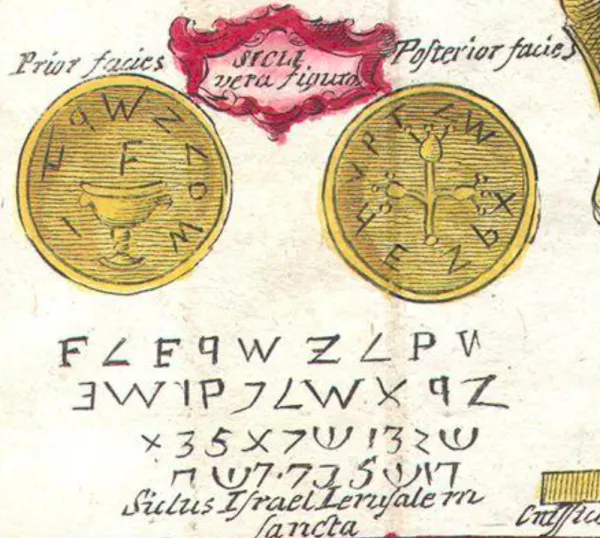
The most historically significant Jewish coins come from the Great Jewish Revolt against Rome (66-70 CE). When the revolt began, the rebel government in Jerusalem began minting its own silver and bronze coins — an act of supreme defiance, since the right to mint silver was a jealously guarded Roman prerogative.
The silver shekels of the Great Revolt are among the most iconic coins in all of numismatics. They feature:
- A chalice (likely the Temple vessel used for collecting the blood of sacrifices) with the inscription “Shekel of Israel” and a date (“Year One,” “Year Two,” etc.)
- A branch with three pomegranates and the inscription “Jerusalem the Holy”
These coins were minted for five years (66-70 CE). Year Five coins — struck during the final, desperate months before the Temple’s destruction — are the rarest and most valuable. They are artifacts of a doomed hope: a people who minted currency for a nation that was about to be destroyed.
The bronze coins of the revolt carry equally powerful imagery. Amphora (ceremonial jugs), vine leaves, lulav and etrog (symbols of Sukkot), and the facade of the Temple appear on various denominations. Every symbol was chosen deliberately — these were coins that proclaimed Jewish identity, Jewish sovereignty, and Jewish faith in the face of the most powerful empire on earth.
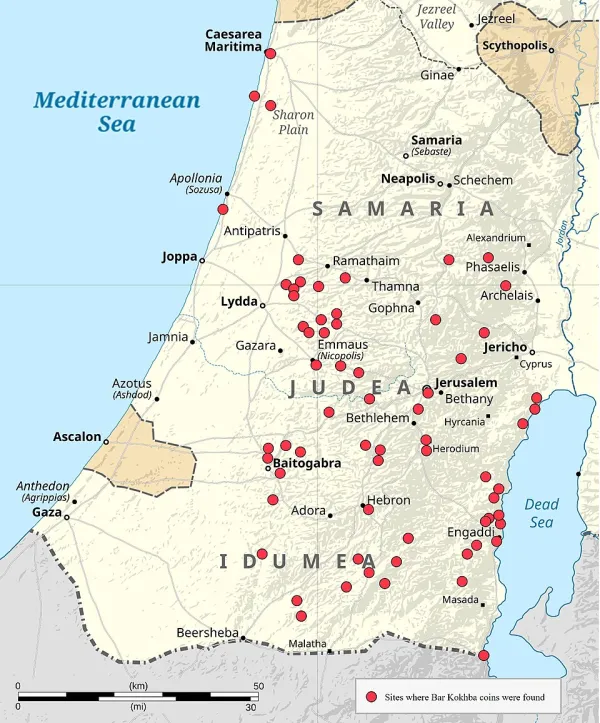
Bar Kokhba Revolt Coins: The Last Stand
Sixty-five years after the Temple’s destruction, Simon bar Kokhba led a second revolt against Rome (132-135 CE). The rebels controlled significant territory for nearly three years, and during that time, they issued their own coins — some of the most emotionally charged artifacts in Jewish history.
Bar Kokhba coins were overstruck on existing Roman coins. A rebel mint would take a Roman denarius — bearing the image of the emperor Hadrian — and stamp over it with Jewish imagery. The act itself was a statement: literally effacing Rome and replacing it with Jewish sovereignty.
The imagery on Bar Kokhba coins is extraordinary:
- The facade of the Temple — destroyed 65 years earlier but still the central symbol of Jewish hope
- The lulav and etrog — symbols of Sukkot and of Jewish religious practice
- A lyre — perhaps representing the music of the Temple
- A palm tree — a symbol of Judea
- Inscriptions reading “For the Freedom of Jerusalem” and “Year One of the Redemption of Israel”
These coins tell us that Bar Kokhba’s revolt was not merely a military uprising. It was a theological and national project — an attempt to restore Jewish sovereignty, rebuild the Temple, and inaugurate a messianic era. The coins were propaganda, prayer, and political statement all at once.
From Ancient to Modern
When the State of Israel was established in 1948, its founders chose to call the national currency the Israeli lira (later the shekel — revived in 1980). The choice of “shekel” was deliberate: a direct link to the ancient currency, a statement that modern Israel saw itself as the continuation of ancient Jewish sovereignty.
Modern Israeli coins draw heavily on ancient designs. The current one-shekel coin features a lily inspired by ancient Jewish coins. The ten-agorot coin bears a Hasmonean-era menorah design. The coins you use to buy coffee in Tel Aviv carry echoes of coins minted two thousand years ago in the shadow of the Temple.
What the Coins Tell Us
Ancient Jewish coins are more than metal. They are answers to questions: What did Jews value? (The Temple, the harvest, the commandments.) How did they see themselves? (As a sovereign people, even when subjugated.) What did they hope for? (Freedom, Jerusalem, the restoration of what was lost.)
Hold one in your hand, and you are holding a piece of that hope.
Frequently Asked Questions
What was the half-shekel Temple tax?
Every adult Jewish male was required to contribute a half-shekel annually to support the Temple in Jerusalem. This tax, mandated in Exodus 30:13, funded the daily sacrifices and Temple maintenance. The coins used had to be of specific purity, which is why money changers operated in the Temple courtyard — to exchange common Roman and local currencies for the acceptable Tyrian shekels.
Are ancient Jewish coins valuable?
Values vary enormously. Common Hasmonean bronze coins (prutot) can be purchased for $20-$100. Rarer coins from the Jewish War (66-70 CE) range from hundreds to thousands of dollars. The most valuable — silver shekels from the Great Revolt and Bar Kokhba revolt coins — can sell for $10,000 to over $1 million at auction, depending on condition, rarity, and historical significance.
Why don't ancient Jewish coins show human faces?
Jewish coins generally avoided human images in accordance with the Second Commandment's prohibition against graven images. Instead, they featured symbols like the menorah, palm tree, lulav, etrog, chalice, cornucopia, anchor, and the facade of the Temple. This stands in contrast to Roman and Greek coins, which prominently featured portraits of rulers and deities.
Sources & Further Reading
- Israel Museum — Numismatics Collection ↗
- Jewish Virtual Library — Ancient Coins ↗
- Ya'akov Meshorer, A Treasury of Jewish Coins
Related Articles
Ancient Israel: From Abraham to the Kingdoms
The foundational story of the Jewish people — from the call of Abraham through the united monarchy of David and Solomon.
The Bar Kokhba Revolt: The Last Jewish Stand Against Rome
In 132 CE, Simon bar Kokhba led the last great Jewish revolt against Rome. Initially successful, the rebellion was crushed with devastating consequences — Judaea was renamed Palestine, and the Jewish people's relationship with their homeland was fundamentally altered.
The Maccabees and the Hasmonean Era
The dramatic story of the Maccabean revolt against Greek oppression — from Mattathias's defiance to Judah Maccabee's victories, the Temple rededication, and the rise and fall of the Hasmonean dynasty.