Yom HaAtzmaut: Israel's Independence Day
From the solemnity of Yom HaZikaron to the joy of independence — Yom HaAtzmaut celebrates the founding of the State of Israel with barbecues, fireworks, flags, and a complex mix of pride and reflection.
From Tears to Joy
There is no transition in the Jewish calendar as emotionally dramatic as the one that occurs on the evening of Yom HaAtzmaut — Israel’s Independence Day.
Just hours earlier, the nation was immersed in Yom HaZikaron, the Memorial Day for Israel’s fallen soldiers and victims of terrorism. Ceremonies were held at military cemeteries. Sirens sounded — first in the evening, then in the morning — and the country stood still, just as it does on Yom HaShoah one week earlier. Parents wept at the graves of their children. Videos of the fallen played on every television screen. The mood was grief, raw and unmediated.
Then, as the sun sets, something astonishing happens. The flags that flew at half-mast are raised to full height. Stages that stood dark are suddenly ablaze with lights. Music erupts from speakers in public squares. Fireworks explode over the Mediterranean. Within minutes — sometimes within the same ceremony — the tears become dancing. The memorial becomes a party.
This abrupt transition is not accidental. It is by design. The message is stark and intentional: the joy of independence is inseparable from the price of independence. You cannot celebrate one without acknowledging the other.
The Declaration
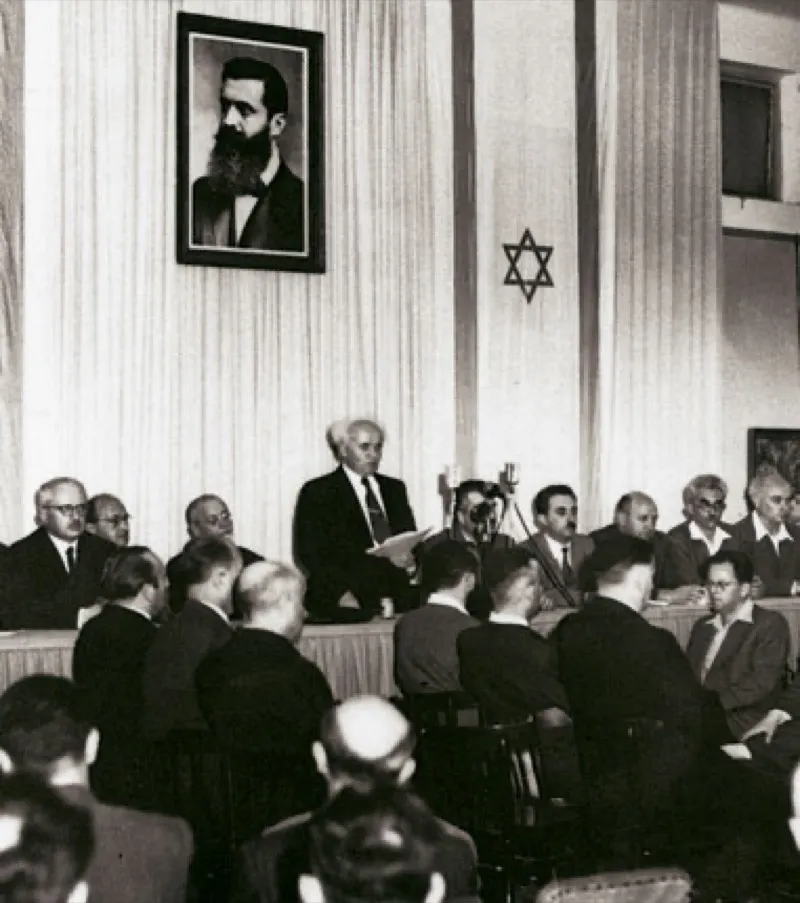
On May 14, 1948 (the 5th of Iyyar, 5708, in the Hebrew calendar), David Ben-Gurion stood beneath a portrait of Theodor Herzl in the Tel Aviv Museum and read aloud the Declaration of the Establishment of the State of Israel. The ceremony lasted thirty-two minutes. The Palestine Philharmonic Orchestra played Hatikva. And after nearly two thousand years of exile, dispersion, persecution, and longing, the Jewish people had a sovereign state.
The declaration was made under extraordinary circumstances. The British Mandate was ending at midnight. Five Arab armies were preparing to invade. The new state had no defined borders, a tiny military, limited resources, and a population of just 600,000 Jews. Ben-Gurion’s closest advisors were divided on whether to declare independence at all — some feared it would be suicidal.
He declared it anyway. Within hours, the United States recognized the new state. Within minutes of the British departure, the invasion began. The War of Independence that followed would cost Israel over 6,000 lives — nearly one percent of its Jewish population — and displace hundreds of thousands of Palestinians, an event known in Arabic as the Nakba (“catastrophe”). The founding of Israel was, from its first moments, a story of triumph and tragedy intertwined.
Celebrating in Israel
For Israelis, Yom HaAtzmaut is a national holiday — schools and most businesses are closed, and the day is devoted to celebration.
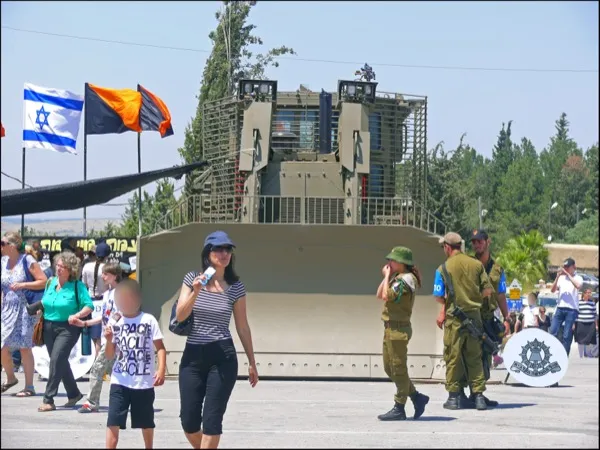 *Israelis celebrating Yom HaAtzmaut. Photo by MathKnight and Zachi Evenor, CC BY 3.0, via Wikimedia Commons.*
The celebrations begin with an official ceremony on Mount Herzl in Jerusalem. The ceremonial lighting of twelve torches — one for each of the twelve tribes of Israel — marks the transition from Yom HaZikaron to Yom HaAtzmaut. The torches are lit by citizens chosen for their contributions to Israeli society: soldiers, scientists, educators, immigrants, community leaders.
Then comes the party. And in Israel, Yom HaAtzmaut is the party of the year.
Barbecues (known universally in Israel as al ha-esh — “on the fire”) are the quintessential Yom HaAtzmaut activity. On Independence Day, every park, beach, balcony, and rooftop in the country is wreathed in charcoal smoke. Families stake out their spots early in the morning, setting up grills, folding chairs, and portable speakers. The menu is remarkably consistent: grilled chicken, kebabs, steaks, corn on the cob, hummus, pita, and Israeli salads. It is, in its way, a secular communion — the entire nation eating together under the open sky.
Flags are everywhere. Blue and white Israeli flags fly from apartment windows, car antennas, bicycles, and baby strollers. Children carry inflatable hammers (a quirky tradition no one can fully explain) and spray foam at each other in the streets.
Fireworks light up the night sky in major cities. Municipal stages host concerts featuring Israel’s biggest pop stars. In Tel Aviv, the waterfront and streets fill with hundreds of thousands of revelers. In Jerusalem, the celebrations tend to be more formal but no less enthusiastic.
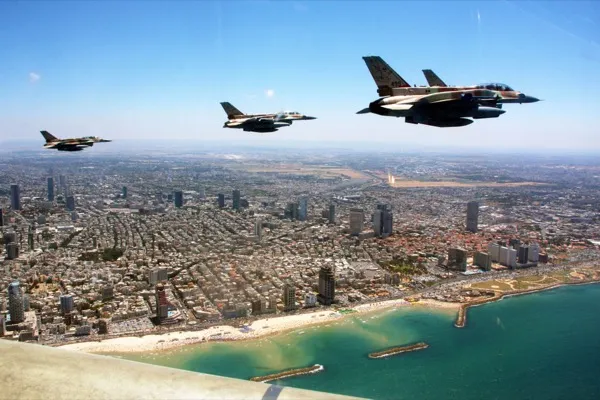 *An Israeli Air Force flyover during Yom HaAtzmaut celebrations. Photo by Israel Defense Forces, CC BY 2.0, via Wikimedia Commons.*
The Israel Defense Forces open military bases to the public, displaying equipment and putting on demonstrations. The IAF flyover — jets trailing blue and white smoke across the sky — is a beloved tradition, and Israelis gather on rooftops and hillsides to watch.
Hatikva: The Hope
No Yom HaAtzmaut celebration is complete without the singing of Hatikva (“The Hope”), Israel’s national anthem. Written by Naftali Herz Imber in 1878 — seventy years before the state was founded — the poem expresses the ancient Jewish longing for a return to Zion:
“As long as in the heart, within, The Jewish soul still yearns, And onward, toward the ends of the east, An eye still gazes toward Zion — Our hope is not yet lost, The hope of two thousand years, To be a free people in our land, The land of Zion and Jerusalem.”
When Israelis sing Hatikva on Yom HaAtzmaut, they are not merely performing a national anthem. They are affirming that the dream expressed in those words — which seemed impossibly idealistic when Imber wrote them — has been realized. For many, especially older Israelis whose parents or grandparents survived the Holocaust or fled persecution, the emotion of singing Hatikva on Independence Day is overwhelming.
Religious Dimensions
Yom HaAtzmaut occupies a complex place in religious Jewish life. It is not a holiday ordained by the Torah or the rabbis of the Talmud — it is a modern creation, marking a political event. This means its religious status is, and always has been, debated.
Religious Zionists — who see the establishment of Israel as a step toward messianic redemption — embrace Yom HaAtzmaut wholeheartedly as a religious occasion. Chief Rabbi Shlomo Goren composed special prayers for the day, including the recitation of Hallel (psalms of praise normally reserved for major holidays) and a reading from the Prophets. Many Religious Zionist synagogues treat Yom HaAtzmaut as a full religious holiday, with festive services, new clothes, and special meals.
Haredi (Ultra-Orthodox) communities, by contrast, generally do not observe Yom HaAtzmaut as a holiday. Some view the secular state as spiritually irrelevant or even problematic — a human attempt to force a redemption that should come only through divine will. In some Haredi neighborhoods, the day passes without acknowledgment; in a few, there is active opposition.
Conservative and Reform movements have embraced Yom HaAtzmaut with varying degrees of liturgical innovation. Many have added prayers for the State of Israel to their regular services and mark the day with community celebrations.
The Diaspora Experience
For Jews outside Israel, Yom HaAtzmaut is both a celebration and a mirror — reflecting their own complicated relationship with the Jewish state.
Many diaspora communities hold Israel festivals with food, music, Israeli folk dancing, and educational programming. Synagogues recite special prayers. Jewish day schools organize assemblies with Israeli flags, songs, and presentations about Israeli history and culture.
But the emotional register is different from Israel’s. Diaspora Jews did not fight in the War of Independence. They do not experience the Yom HaZikaron-to-Yom HaAtzmaut transition. Their celebration is, inevitably, at one remove — an expression of solidarity and connection rather than personal lived experience.
For some diaspora Jews, particularly younger ones, Yom HaAtzmaut has become a day of reflection as well as celebration — an occasion to grapple with the complexities of Israeli society, the ongoing conflict, and what it means to support a country that is both a fulfillment of Jewish hopes and a source of moral difficulty. These conversations, though sometimes uncomfortable, are themselves a form of engagement and care.
A Work in Progress
Israel is, as of 2026, seventy-eight years old — ancient by the standards of modern nation-states in the region, yet still young by the standards of Jewish history. Yom HaAtzmaut celebrates not a finished project but an ongoing one — a country that is still defining itself, still debating its character, still navigating the extraordinary challenge of building a democratic Jewish state in one of the world’s most contested landscapes.
The holiday’s power lies precisely in this tension. Yom HaAtzmaut is not a day of uncomplicated triumph. It carries within it the grief of Yom HaZikaron, the weight of the Holocaust, the unresolved questions of peace and justice, and the stubborn, defiant hope that gave the country its anthem and its name.
On Yom HaAtzmaut, the flags go up, the grills are lit, and Hatikva is sung once more. It is a birthday party for a country that almost was not — and a reminder that the hope of two thousand years, once realized, requires constant tending.
Frequently Asked Questions
When is Yom HaAtzmaut?
Yom HaAtzmaut falls on the 5th of Iyyar in the Hebrew calendar, which corresponds to May 14, 1948, the date Israel declared independence. Because Hebrew dates move relative to the Gregorian calendar, it usually falls in April or May.
What is the connection between Yom HaZikaron and Yom HaAtzmaut?
Yom HaZikaron (Israel's Memorial Day for fallen soldiers and terror victims) immediately precedes Yom HaAtzmaut. As the memorial siren ends at sundown, the mood shifts dramatically from grief to celebration — a deliberate pairing that reminds Israelis that independence came at a profound cost.
How do Jews in the diaspora celebrate Yom HaAtzmaut?
Diaspora celebrations vary widely. Many synagogues recite special prayers and Hallel (psalms of praise). Communities organize Israel-themed festivals with food, music, and Israeli dancing. Some Jews feel deep connection to the day while others engage with it in more complex or ambivalent ways.
Test Your Knowledge
Think you know this topic? Try our quiz!
Take the Jewish Holidays: Advanced Quiz →Sources & Further Reading
Related Articles
The Jewish Calendar: How an Ancient Lunar-Solar System Shapes Jewish Life
The Jewish calendar is a sophisticated lunar-solar system that has kept Jewish holidays, Shabbat, and lifecycle events anchored in their proper seasons for over two thousand years.
The Birth of Modern Israel
From the rise of Zionism to the declaration of independence in 1948 — the story of how the Jewish homeland was reestablished.
Yom HaShoah: Holocaust Remembrance Day
Each spring, a siren sounds across Israel and the nation stands still — remembering the six million. Yom HaShoah is a day of solemn witness, survivor testimony, and the sacred obligation to never forget.