Simchat Torah: The Joy of Completing the Torah
On Simchat Torah, the final words of Deuteronomy are read and Genesis begins again — and the synagogue erupts in singing, dancing, and unrestrained joy with the Torah scrolls.
The Night the Synagogue Dances
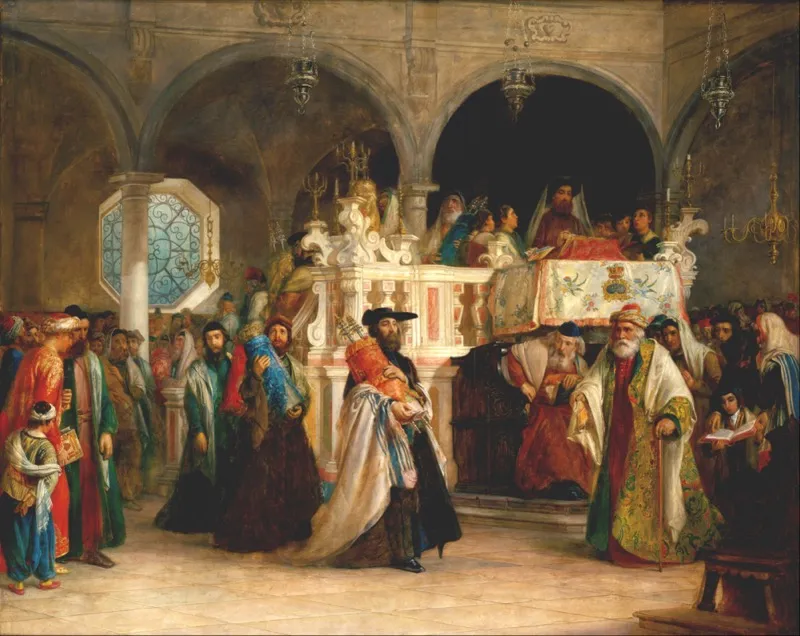
There is a night each autumn when something extraordinary happens in synagogues around the world. The ark doors swing open. Every Torah scroll is lifted from its resting place. And then — instead of the usual reverent silence — the room explodes. Singing. Clapping. Stomping. Children hoisted onto shoulders. Elderly men dancing with a lightness that defies their years. Torah scrolls, heavy and precious, cradled like partners in a dance that may go on for hours.
This is Simchat Torah — literally, “the Rejoicing of the Torah” — and it is unlike any other moment in the Jewish year. If Shabbat is the weekly heartbeat of Jewish life, and the High Holidays are its annual reckoning, then Simchat Torah is its annual celebration of the one thing that holds everything together: the scroll itself, the story itself, the endless cycle of reading, learning, and beginning again.
Ending and Beginning
At its core, Simchat Torah marks the completion of the annual Torah reading cycle. Throughout the Jewish year, a portion of the Torah — the Five Books of Moses — is read each Shabbat in synagogue. The cycle begins with Bereshit (Genesis 1:1, “In the beginning…”) and concludes, fifty-four portions later, with the final verses of V’zot HaBracha (Deuteronomy 34), which describe the death of Moses on Mount Nebo, within sight of the Promised Land he would never enter.
It is a bittersweet ending. Moses, the greatest prophet, the liberator and lawgiver, dies alone on a mountaintop. The text says simply: “And there arose not a prophet since in Israel like unto Moses.”
But Judaism does not linger at endings. The moment the final verse of Deuteronomy is chanted, the congregation turns back to the very first words of Genesis: “In the beginning, God created the heavens and the earth.” The story does not end. It circles. It renews. The Torah, like life, is not a line but a wheel.
The Talmud teaches: “Turn it and turn it again, for everything is in it.” Simchat Torah enacts that teaching physically — the scroll is rolled from end to beginning.
The Hakafot: Seven Circles of Joy
The most visible and beloved custom of Simchat Torah is the hakafot — seven circuits around the synagogue in which congregants carry Torah scrolls while singing, dancing, and rejoicing.
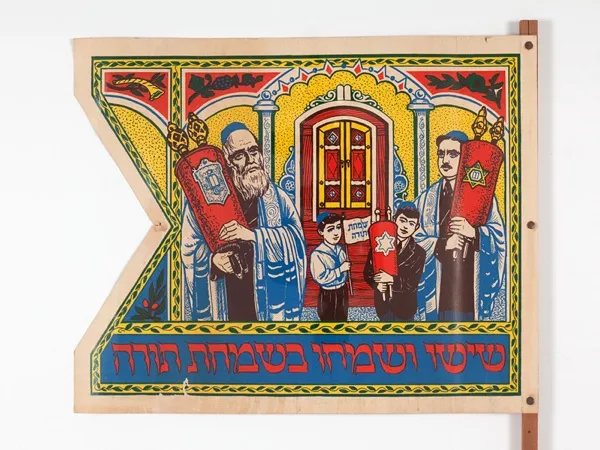 *A handmade Simchat Torah flag — children carry these during the hakafot processions. Photo by LGLou, CC BY-SA 4.0, via Wikimedia Commons.*
The hakafot begin on the evening of Simchat Torah. The chazan (cantor) chants a series of liturgical verses, and then one by one, every Torah scroll in the synagogue is removed from the ark. In a large congregation, this might mean five or six scrolls; in a small one, perhaps just one or two. Each scroll is carried by a different person, and the procession begins.
The atmosphere is electric. In many communities, the dancing is vigorous and uninhibited — men and women (together or separately, depending on the community) circling the bimah, linking arms, singing popular Jewish melodies and niggunim (wordless tunes). Children dart through the crowd waving flags — often topped with small candles or apples — a custom that dates back centuries and gives the evening a festive, almost carnival atmosphere.
Between each hakafah (circuit), there is a pause for singing. But the pauses often dissolve back into dancing. In Israeli cities like Tel Aviv and Jerusalem, the hakafot overflow into the streets, becoming impromptu block parties. In New York, Chabad communities hold “hakafot shniyot” (second hakafot) in public spaces, inviting passersby to join. The Lubavitcher Rebbe famously encouraged these public celebrations, seeing them as a way to share the joy of Torah with everyone.
Chatan Torah and Chatan Bereshit
Two congregants receive special honors on Simchat Torah that are among the most prestigious in Jewish life.
The Chatan Torah (“Bridegroom of the Torah”) is called up for the final aliyah of Deuteronomy — the conclusion of the entire Torah. The Chatan Bereshit (“Bridegroom of Genesis”) receives the first aliyah of the new cycle, chanting the majestic opening of Bereshit: “In the beginning, God created the heavens and the earth.”
The language of “bridegrooms” is intentional. The metaphor of the Jewish people’s relationship with the Torah as a love story — even a marriage — runs deep in Jewish thought. On Simchat Torah, that love is celebrated openly. In some Sephardi communities, the honorees are draped in a tallit held aloft like a chuppah (wedding canopy), and the congregation showers them with candy and sweets, just as at a wedding.
In egalitarian communities, women serve as Kallat Torah and Kallat Bereshit (“Brides of the Torah” and “Brides of Genesis”), and the celebration is equally joyous.
Unrolling the Scroll
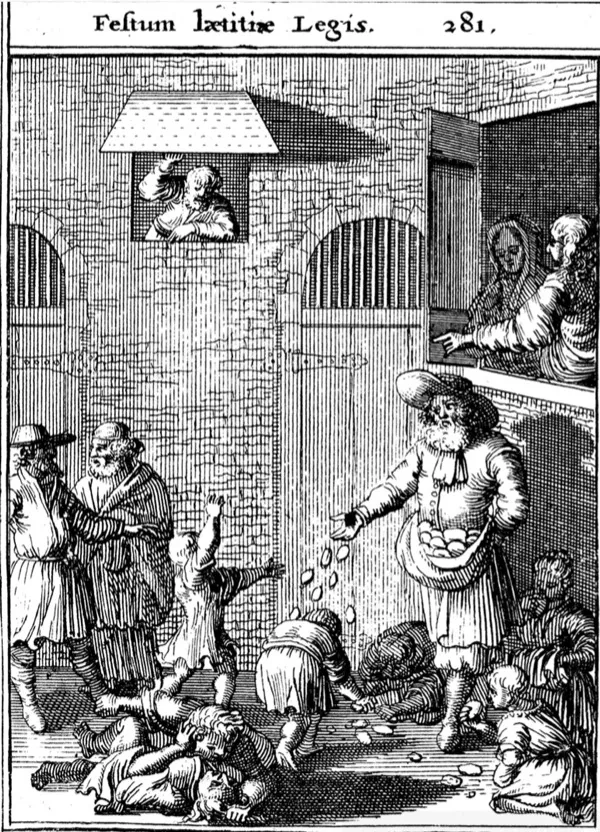 *A 17th-century illustration of Simchat Torah celebrations. From Leusden, "Philologus Hebraeo-Mixtus," Utrecht, 1657. Public domain, via Wikimedia Commons.*
One of the most dramatic customs of Simchat Torah is the unrolling of the entire Torah scroll. In some communities, the scroll is carefully opened and held aloft by dozens of congregants standing in a large circle, each person supporting a section of the parchment. Seen from above, it is a breathtaking sight — the entire Five Books of Moses, handwritten on a continuous scroll of animal skin, stretching around the room.
This ritual makes visible what is otherwise abstract: the Torah is not a collection of separate books but one unbroken narrative, one continuous conversation between God and humanity. Holding it in this way — together, as a community — is a powerful reminder that no one person can hold the whole Torah alone.
Children at the Center
Simchat Torah is, in many ways, a children’s holiday. In most congregations, every child receives an aliyah — a collective call-up to the Torah, often sheltered under a large tallit held by adults. This is one of the few times children are formally included in the Torah reading service, and for many, it is a formative memory.
The flags are a cherished tradition. In Eastern European communities, children carried small paper flags decorated with images of Torah scrolls, menorahs, and Stars of David. Today, the flags may be store-bought or handmade, but the delight of marching around the synagogue waving them has not changed. For a child, Simchat Torah sends an unmistakable message: the Torah belongs to you too. You are part of this story.
When Is Simchat Torah?
The timing of Simchat Torah differs between Israel and the diaspora, and the difference reveals something about the holiday’s evolution.
In Israel, Simchat Torah is celebrated on Shemini Atzeret (the 22nd of Tishrei), the day immediately following the seven days of Sukkot. The two holidays merge into one, combining the prayers for rain (Shemini Atzeret’s signature liturgy) with the joyous Torah celebrations.
In the diaspora, the holiday calendar adds an extra day, so Simchat Torah falls on the 23rd of Tishrei, the day after Shemini Atzeret. This gives the celebration its own distinct identity — a full day devoted entirely to the Torah’s completion and renewal.
Why the Joy?
It is worth pausing to ask: why so much joy? Jews celebrate many holidays, but few with this kind of physical, ecstatic energy. What makes the completion of a reading cycle so worthy of dancing in the streets?
Different voices in the tradition offer different answers. Some emphasize gratitude — the Torah is understood as God’s greatest gift to the Jewish people, and completing its reading is cause for profound thankfulness. Others stress achievement — the cycle represents a full year of dedicated study and engagement. Still others point to the renewal: the fact that we immediately begin again means that Torah learning is never finished, never exhausted, always fresh.
Perhaps the deepest answer is this: on Simchat Torah, the usual hierarchies of Jewish learning dissolve. The scholar and the child, the rabbi and the newcomer, all dance together. No one reads from the scroll during the hakafot — the Torah is simply held and celebrated. In that moment, the relationship with Torah is not intellectual but embodied, not analytical but joyous. Everyone, regardless of their level of knowledge, can hold the scroll and dance.
A Living Tradition
Simchat Torah has also become a symbol of Jewish resilience. During the Soviet era, when Jewish practice was suppressed, Simchat Torah celebrations outside Moscow’s main synagogue became one of the few public expressions of Jewish identity, drawing thousands. In October 2023, the holiday was indelibly marked by the Hamas attack on southern Israel — a tragedy that has added new layers of meaning, grief, and determination to subsequent celebrations.
The holiday continues to evolve. Some communities now incorporate contemporary songs alongside traditional melodies. Others emphasize ecological themes, connecting the Torah’s cycle to natural cycles. But the essential spirit remains unchanged: a community gathered around its most sacred text, celebrating the privilege of starting the story over again.
On Simchat Torah, the message is beautifully simple: the end is a beginning. The story is never finished. And the best response to a great book is to dance with it.
Frequently Asked Questions
What is Simchat Torah?
Simchat Torah ('Rejoicing of the Torah') is a Jewish holiday that celebrates the completion of the annual Torah reading cycle. The final portion of Deuteronomy is read, followed immediately by the opening verses of Genesis, symbolizing that Torah study never ends.
What are hakafot?
Hakafot are joyous processions in which congregants carry Torah scrolls around the synagogue, dancing and singing. There are seven hakafot on Simchat Torah, and the celebration often spills outside into the streets.
When is Simchat Torah celebrated?
In Israel, Simchat Torah falls on the 22nd of Tishrei, combined with Shemini Atzeret. In the diaspora, it is celebrated the following day, on the 23rd of Tishrei, as a separate holiday.
Test Your Knowledge
Think you know this topic? Try our quiz!
Take the Jewish Holidays: Advanced Quiz →Sources & Further Reading
Related Articles
Shabbat: The Weekly Day of Rest
Every week, Jewish life pauses for 25 hours of rest, reflection, and togetherness — discover the beauty of Shabbat.
Sukkot: The Festival of Booths
For seven days each autumn, Jewish families build and eat in temporary huts — celebrating the harvest, remembering the desert journey, and embracing the fragility and beauty of life.
The Torah: The Heart of Judaism
The Torah is more than a book — it is the living constitution of Jewish life, studied and debated for over three millennia.