Mazel Tov: What It Really Means and When to Say It
Mazel Tov doesn't mean 'good luck' — it means a good fortune has already occurred. Learn the real meaning, when to say it, and when you definitely shouldn't.
It Does Not Mean What You Think It Means
You have heard it a thousand times. In movies, at weddings, shouted across crowded rooms. Someone announces good news and the response comes instantly: Mazel tov! Most people — including many Jews — assume this means “good luck.” It does not. Not even close.
Mazel tov (מזל טוב) is one of the most widely known Jewish expressions in the world, and one of the most widely misunderstood. To say mazel tov is not to wish someone good luck for the future. It is to acknowledge that something good has already occurred. The difference matters enormously, and it reveals something important about how Jewish tradition thinks about fortune, fate, and the proper response to life’s great moments.
The Real Meaning: Stars and Fortune
The word mazal (מזל) comes from the Hebrew root meaning “to flow down” and originally referred to a constellation or zodiac sign. In ancient Semitic cultures, your mazal was the star under which you were born — your celestial fortune. The Talmud (Shabbat 156a) has a famous discussion about whether Israel is subject to mazal — to astrological influence — or whether the Jewish people operate beyond the stars, under God’s direct providence.
So when you say mazel tov, you are literally saying “a good constellation has occurred” — a favourable alignment has descended upon this person. It is a declaration, not a wish. Something wonderful has happened, and the universe has smiled.
This is why mazel tov is said after the event, never before. You do not say mazel tov to a bride walking down the aisle — you say it after the glass is broken and the marriage is sealed. You do not say it to a pregnant woman — you say it after the baby arrives safely. The timing is everything.
When to Say Mazel Tov
The beauty of mazel tov is its versatility. It fits nearly every moment of Jewish celebration:
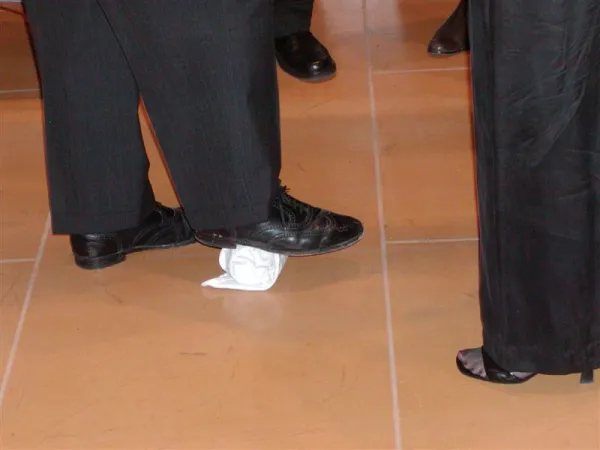
At a wedding: The most iconic use. The moment the groom breaks the glass under the chuppah, the entire room erupts with “Mazel tov!” It is the signal that the marriage is complete — the covenant is sealed — and joy can commence.
At a birth: When a baby is born, mazel tov is the natural first response. At a brit milah (circumcision ceremony) or baby naming, guests will say it repeatedly.
At a bar or bat mitzvah: When a young person is called to the Torah for the first time, the congregation responds with mazel tov. You have reached adulthood in the eyes of Jewish law — congratulations, and also, good luck (though we do not say that).
Upon hearing good news: Engagement, new job, graduation, recovery from illness, buying a house. Any moment of genuine achievement or blessing warrants a mazel tov.
After an aliyah: When someone is called up to read from the Torah in synagogue, it is customary to say “yasher koach” (may your strength be firm) or “mazel tov,” depending on the community and occasion.
When NOT to Say Mazel Tov
Jewish tradition is careful about celebrating too early. There is a deep-rooted cultural instinct — call it superstition, call it wisdom — against inviting misfortune by announcing good news before it is certain.
You do not say mazel tov:
- Before a baby is born. Many traditional Jewish families will not even set up a nursery or buy baby clothes before the birth. Saying mazel tov to a pregnant woman can feel like tempting the evil eye (ayin hara).
- Before a deal is closed. Until the contract is signed, the ink is dry, and the check has cleared, hold your mazel tovs.
- In response to sad news. Even if someone handles difficult news with grace, mazel tov is not the right word. It is reserved exclusively for joy.
Pronunciation and Variations
The standard pronunciation is MAH-zl tov (Ashkenazi) or mah-ZAL tov (Sephardic/Israeli Hebrew). The Ashkenazi pronunciation, with the emphasis on the first syllable, is the one most commonly heard in American English.
You will sometimes see it spelled “mazal tov,” “mazel tov,” or even “mazeltov” (one word). All are acceptable transliterations. In Hebrew, it is written מזל טוב — two words.
In Yiddish, mazel tov carries the same meaning but is used even more casually. A Yiddish speaker might say it with a particular wry inflection that adds layers of meaning — sometimes genuine, sometimes ironic, sometimes both at once.
The Deeper Layer: Fortune and Faith
There is a tension within Jewish thought about the concept of mazal. On one hand, the Talmud acknowledges that mazal — cosmic fortune — exists and exerts influence. On the other hand, one of Judaism’s core teachings is that human beings have free will and that prayer, repentance, and good deeds can alter one’s destiny.
The phrase mazel tov sits right at this intersection. It acknowledges that good fortune has descended — that something beyond human control has gone well — while simultaneously implying gratitude to God, who ultimately governs the stars. When a room full of people shouts mazel tov at a wedding, they are not just congratulating the couple. They are collectively recognizing a moment of grace.
Rabbi Nachman of Breslov taught that joy is a mitzvah — a sacred obligation. Mazel tov is the verbal instrument of that joy. It is the word that breaks the dam, that gives permission to celebrate, that turns a crowd of individuals into a community united by happiness.
Mazel Tov in Popular Culture
The phrase has traveled far beyond Jewish communities. You will hear it in Hollywood films, on greeting cards, in business settings, and from people who may never have set foot in a synagogue. This widespread adoption is generally welcomed — it is a phrase that carries warmth and generosity wherever it goes.
But it is worth remembering what it actually means. The next time you hear good news from a friend — a new baby, a new job, a long-awaited achievement — and you feel that instinct to say “mazel tov,” know this: you are not wishing them luck. You are recognizing, together with them, that the stars have aligned, that the universe has delivered something good, and that this moment deserves to be named and celebrated.
That is what mazel tov means. Not “I hope things go well.” But rather: They already have. And we are all here to witness it.
Sources
- Talmud Bavli, Shabbat 156a — The Talmudic debate on whether mazal governs Jewish destiny
- My Jewish Learning — Mazel Tov — Overview of the phrase’s meaning and usage
- Chabad.org — The Meaning of Mazal — Deeper exploration of mazal in Jewish thought
- Jewish Virtual Library — Common Jewish expressions and their origins
Frequently Asked Questions
Does Mazel Tov mean good luck?
No. Mazel Tov is not a wish for future good luck — it is an acknowledgment that something good has already happened. The phrase literally means 'good constellation' or 'good fortune has occurred.' Saying Mazel Tov is closer to 'congratulations' than to 'good luck.'
When should you say Mazel Tov?
Say Mazel Tov after a joyful event has occurred: at a wedding when the glass breaks, after a baby is born, when someone is called to the Torah at their bar or bat mitzvah, upon hearing about an engagement, graduation, or promotion. The key is that the event has already happened.
Is it ever inappropriate to say Mazel Tov?
You should not say Mazel Tov before an event happens — for example, don't say it to a pregnant woman before the baby is born. In Jewish tradition, this is considered tempting fate. You also would not say it in response to sad news, even if someone shares difficult news bravely.
Test Your Knowledge
Think you know this topic? Try our quiz!
Take the Jewish Holidays: Advanced Quiz →Key Terms
Sources & Further Reading
Related Articles
Bar and Bat Mitzvah: Coming of Age
At age 12 or 13, a Jewish child becomes responsible for the commandments — a milestone celebrated with joy and meaning.
Common Hebrew Words and Phrases Everyone Should Know
Whether you are visiting Israel, attending a synagogue, or just curious, these essential Hebrew words and phrases — from Shalom to Yalla — will open doors and earn smiles.
The Jewish Wedding: A Complete Guide to the Ceremony
Under the chuppah, surrounded by family and tradition, two lives become one — the Jewish wedding ceremony is a beautiful blend of ancient law, symbolism, and joy.