Jewish Astrology: Mazalot, Zodiac Mosaics, and Cosmic Debate
Ancient synagogue floors blazoned with zodiac wheels, Talmudic debates about destiny and free will, and the enduring Jewish fascination with the stars — mazalot are more complicated than you think.
Stars and Synagogues
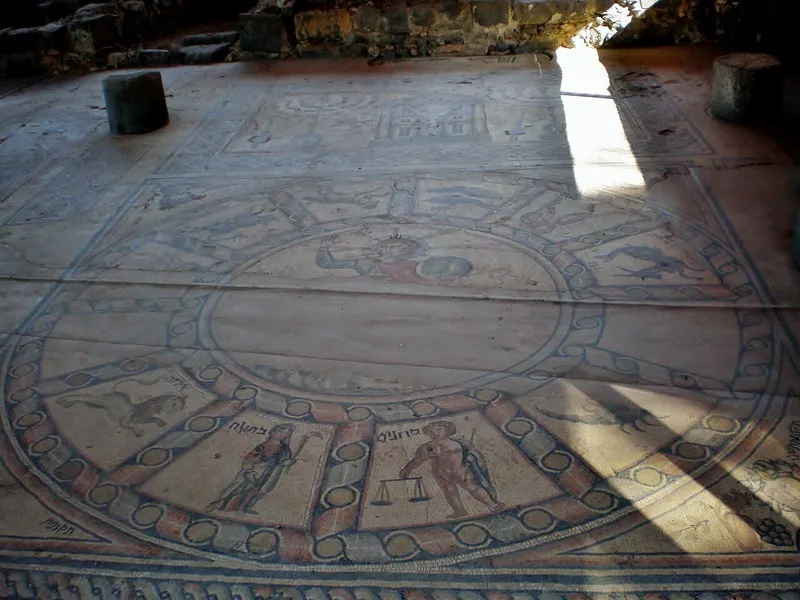
Walk into the ruins of the Beit Alpha synagogue in northern Israel — built in the 6th century CE — and look down at the floor. There, in vivid mosaic, is a complete zodiac wheel: twelve signs arranged in a circle, labeled in Hebrew, surrounding a central image of Helios, the sun god, riding his chariot across the sky. In a synagogue. On the floor where Jews prayed.
This is not an anomaly. At least seven ancient synagogues in Israel contain zodiac mosaics — at Hammat Tiberias, Sepphoris, Huseifa, Na’aran, Ein Gedi, and elsewhere. The zodiacs are prominent, carefully crafted, and clearly intentional. They raise a question that has puzzled scholars and rabbis alike: what on earth was astrology doing in a synagogue?
The answer leads into one of Judaism’s most fascinating and least-discussed internal debates — a conversation about fate and free will, the power of the stars and the sovereignty of God, the line between cosmic wisdom and pagan superstition. The Jewish relationship with astrology is neither simple acceptance nor simple rejection. It is, like so much in Judaism, an argument.
Mazal: More Than “Good Luck”
The Hebrew word mazal is familiar to most people from the phrase “Mazel tov!” — conventionally translated as “Congratulations!” But the literal meaning is “constellation” or “star.” Mazel tov literally means “good constellation” — a wish that the stars align favorably.
This is not mere idiom. The Talmud takes mazalot (constellations/astrological influences) seriously. In a remarkable passage in Shabbat 156a, the rabbis discuss how the day and planetary hour of a person’s birth affect their character:
- Born under the Sun: distinguished and self-sufficient
- Born under Venus: wealthy and promiscuous
- Born under Mercury: wise and sharp-memoried
- Born under the Moon: will suffer illness
- Born under Saturn: plans will be frustrated
- Born under Jupiter: righteous
- Born under Mars: will shed blood (as a surgeon, butcher, circumciser, or murderer)
This is not marginal folklore. It appears in the Babylonian Talmud — the central legal and theological text of rabbinic Judaism — discussed by some of the greatest sages.
”Ein Mazal L’Yisrael”
And yet, in the very same Talmudic passage, a counter-principle emerges. Rabbi Yochanan declares: “Ein mazal l’Yisrael” — “There is no mazal (astrological destiny) for Israel.” The stars may govern the fate of the nations, but the Jewish people, through prayer, repentance, and good deeds, can override astrological influence.
The Talmud illustrates this with stories. Abraham, an astrologer himself according to tradition, saw in the stars that he would never have children. God took him outside and said: “Go beyond the stars” — literally and figuratively transcending astrological destiny. Abraham had children because God’s promise overrode the stars’ decree.
This created a nuanced position: astrology works — the stars do influence human destiny — but Jews can transcend that influence through their covenant with God. The stars set the default; Torah and mitzvot allow you to change the settings.
Maimonides vs. Nachmanides
The debate crystallized in the medieval period between two towering intellects.
Maimonides (Rambam, 1138–1204) was unequivocal: astrology is nonsense. In his famous Letter on Astrology to the Jews of Marseilles, he wrote: “Know, my masters, that every one of these things concerning judicial astrology… none of them is based on reasoning, and none of them is true… Whoever believes in these things and considers them to be words of wisdom is none other than a fool.”
Maimonides considered astrology a form of avodah zarah (idolatry) — attributing power to stars that belongs only to God. He argued that reliance on astrology had contributed to the destruction of the Temple by diverting attention from genuine worship and ethical behavior.
Nachmanides (Ramban, 1194–1270) took the opposite view on astrology’s reality while agreeing on its irrelevance for Jews. He believed the stars genuinely influence earthly events — but that God, Torah, and mitzvot operate on a higher plane. Jews who attach themselves to God directly are not subject to astrological determination. This position — astrology is real but Jews are exempt — became the more common view in traditional circles.
The Sefer Yetzirah System
The Sefer Yetzirah (Book of Creation), one of the earliest Jewish mystical texts (dated variously from the 2nd to 6th century CE), presents an elaborate system connecting:
- 12 Hebrew months to 12 zodiac signs
- Each month/sign to a Hebrew letter
- Each to a tribe of Israel
- Each to a human sense or body organ
- Each to a quality or activity
For example: Nisan (spring) corresponds to Aries (Taleh/lamb), the letter Heh, the tribe of Judah, the sense of speech, and the quality of sight. The system creates a cosmic map linking the heavens, the human body, the Hebrew alphabet, Jewish identity, and the calendar into a unified whole.
This is not astrology in the modern horoscope sense. It is a mystical cosmology — an attempt to read the universe as a text written in Hebrew letters, with the Jewish calendar as the organizing principle.
Zodiac Mosaics: What Were They Thinking?
The ancient synagogue zodiacs remain genuinely puzzling. Several theories attempt to explain them:
Calendar theory: The twelve zodiac signs represent the twelve months of the Jewish calendar. The mosaics are essentially calendrical — marking the cycle of the year and its associated holidays and agricultural seasons.
Decorative/cultural theory: Jews in the late Roman and Byzantine periods adopted widespread Greco-Roman artistic motifs — including the zodiac — without necessarily accepting astrological beliefs. The zodiacs were art, not theology.
Theological theory: The zodiacs represent God’s sovereignty over the cosmos. By placing the zodiac on the synagogue floor — literally under the feet of worshippers — the mosaics assert Jewish mastery over astrological forces. You walk on the stars; they do not walk on you.
Mystical theory: The zodiacs reflect genuine Jewish engagement with cosmic symbolism, connected to the Sefer Yetzirah tradition and to prayers that reference God’s control over the heavenly bodies.
The truth likely involves elements of all these theories. What is undeniable is that for several centuries, Jewish communities in the land of Israel saw no contradiction between synagogue worship and zodiac imagery — a fact that challenges modern assumptions about how strict ancient Judaism was about such matters.
Monthly Mazalot
The traditional association of Hebrew months with zodiac signs runs as follows:
| Hebrew Month | Zodiac Sign | Hebrew Name |
|---|---|---|
| Nisan | Aries | Taleh (Lamb) |
| Iyar | Taurus | Shor (Bull) |
| Sivan | Gemini | Teomim (Twins) |
| Tammuz | Cancer | Sartan (Crab) |
| Av | Leo | Aryeh (Lion) |
| Elul | Virgo | Betulah (Maiden) |
| Tishrei | Libra | Moznayim (Scales) |
| Cheshvan | Scorpio | Akrav (Scorpion) |
| Kislev | Sagittarius | Kashat (Archer) |
| Tevet | Capricorn | Gedi (Kid/Goat) |
| Shevat | Aquarius | D’li (Bucket) |
| Adar | Pisces | Dagim (Fish) |
The associations are not random. The month of Tishrei (Rosh Hashanah, Yom Kippur) corresponds to Libra — the scales of judgment. Nisan (Passover, spring, lambs for sacrifice) corresponds to Aries, the ram/lamb. Av (when the Temple was destroyed) corresponds to Leo — the lion, associated with both divine wrath and messianic hope.
Mazal Today
Modern Jewish attitudes toward astrology range from firm rejection (following Maimonides) to casual interest to serious engagement (particularly in Kabbalistic and Hasidic circles). The Lubavitcher Rebbe occasionally referenced astrological associations in his teachings. Many Hasidic communities pay attention to auspicious dates and times for weddings, business ventures, and other significant events.
For most contemporary Jews, “Mazel tov!” has lost its astrological content and become simply a congratulatory expression. But the word itself — mazal, constellation — carries within it a two-thousand-year debate about fate, free will, and the stars: a debate that the Talmud launched, Maimonides tried to close, and the zodiac mosaics on ancient synagogue floors silently refuse to let die.
Frequently Asked Questions
Does Judaism believe in astrology?
The answer is complicated. The Talmud contains extensive discussions of astrological influence — stating that a person's character and destiny are affected by the day of the week and the planetary hour of their birth. However, the Talmud also contains the famous principle 'ein mazal l'Yisrael' ('there is no mazal/constellation for Israel'), meaning that Jews, through prayer and good deeds, can override astrological destiny. Maimonides firmly rejected astrology as superstition. Nachmanides accepted it but agreed that Jews could transcend it. The tension remains unresolved in Jewish thought.
Why are there zodiac mosaics in ancient synagogues?
At least seven ancient synagogues in Israel feature elaborate zodiac wheel mosaics on their floors, including the famous examples at Beit Alpha, Hammat Tiberias, and Sepphoris (dating from the 4th-6th centuries CE). These mosaics typically show the twelve zodiac signs surrounding a central image of Helios (the sun god) in his chariot. Scholars debate their meaning — some argue they represent the Jewish calendar months, others see them as purely decorative, and others believe they reflect a genuine Jewish engagement with astrological thinking during the late Roman/Byzantine period.
What is the connection between Hebrew months and zodiac signs?
Jewish tradition associates each Hebrew month with a zodiac sign (mazal): Nisan with Aries (Taleh), Iyar with Taurus (Shor), Sivan with Gemini (Teomim), and so on through the year. The Sefer Yetzirah (Book of Creation), an ancient mystical text, connects each month not only to a zodiac sign but also to a Hebrew letter, a sense, a tribe of Israel, and a body organ — creating a comprehensive cosmic system that links the heavens, the body, and Jewish identity.
Test Your Knowledge
Think you know this topic? Try our quiz!
Take the Jewish Holidays: Advanced Quiz →Sources & Further Reading
Related Articles
The Jewish Calendar: How an Ancient Lunar-Solar System Shapes Jewish Life
The Jewish calendar is a sophisticated lunar-solar system that has kept Jewish holidays, Shabbat, and lifecycle events anchored in their proper seasons for over two thousand years.
Kabbalah: An Introduction to Jewish Mysticism
Beyond the law and the stories lies a hidden dimension of Judaism — Kabbalah, the mystical tradition that seeks to understand the nature of God, creation, and the human soul.
Sacred Numbers in Judaism: Why 7, 18, and 40 Keep Showing Up
Numbers in Judaism are never just numbers. Seven means creation and rest. Eighteen means life. Forty means transformation. From gematria to the 613 commandments, discover why certain numbers echo through every corner of Jewish tradition.