Attending a Jewish Funeral: What to Expect and How to Show Respect
A respectful guide for attending a Jewish funeral — no flowers, bring food instead, and know that 'may their memory be a blessing' means more than 'sorry for your loss.'
The Short Answer
A Jewish funeral is simple, dignified, and focused entirely on honoring the dead and comforting the living. If you are attending one for the first time, here is what you need to know: dress in dark, conservative clothing. Do not bring flowers. Be prepared for raw emotion — Jewish funerals do not soften or prettify death. And know that your presence, more than any words, is what matters most to the grieving family.
Jewish tradition teaches that attending a funeral is one of the highest acts of kindness a person can perform — a chesed shel emet (true act of lovingkindness) — because it is a kindness that can never be repaid by the recipient.
Before the Service
Timing
Jewish tradition calls for burial as soon as possible after death — ideally within 24 hours. In practice, funerals usually occur within one to three days. Autopsies and embalming are generally avoided in Jewish law. The body is ritually washed (tahara) by the chevra kadisha (burial society) and dressed in simple white shrouds (tachrichim), emphasizing that in death, all are equal.
What to Wear
Dark, conservative clothing. Men should wear a suit or dark slacks with a dress shirt. Women should wear a modest dark dress or dark separates. This is not the occasion for bright colors, flashy jewelry, or casual attire. A kippah may be provided for men; bring one if you have it.
No Flowers
This is perhaps the most important practical difference from non-Jewish funerals: do not send flowers. In Jewish tradition, flowers are considered inappropriate — they are seen as an unnecessary adornment when the focus should be on the deceased and the mourners’ grief. Some families may find flowers disrespectful or tone-deaf.
Instead, make a donation to a charity that was meaningful to the deceased. Many obituaries will include a line like “In lieu of flowers, donations may be made to…” Follow that guidance. If no charity is specified, a donation to the synagogue or to a Jewish organization is appropriate.
The Funeral Service
Keriah (Tearing)
Before the service begins, you may see immediate family members perform keriah — the ritual tearing of a garment. The rabbi may cut a small tear in the mourner’s clothing (or a black ribbon pinned to their lapel), and the mourner then rips the fabric further. This ancient expression of grief dates to the patriarch Jacob, who tore his garments upon hearing of Joseph’s apparent death.
The tear is made over the heart for a parent, on the right side for other relatives. Mourners wear the torn garment throughout the shiva period. As a guest, you do not perform keriah.
The Service
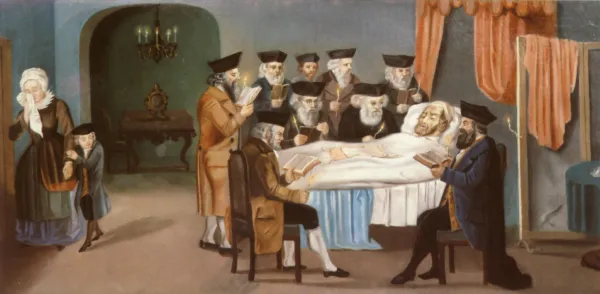
Jewish funeral services are relatively brief — typically 30 to 60 minutes. They include:
- Psalms — particularly Psalm 23 (“The Lord is my shepherd”) and Psalm 91
- A eulogy (hesped) — delivered by the rabbi and often by family members or close friends. Jewish eulogies are meant to be honest — to capture who the person truly was, not to sanitize or idealize them
- El Malei Rachamim — a haunting memorial prayer asking God to shelter the soul “under the wings of the Divine Presence”
There is no open casket viewing in Jewish tradition. The casket is traditionally simple, made entirely of wood (no metal), and unadorned. This reflects the principle that death is the great equalizer — wealthy and poor receive the same plain coffin.
At the Graveside
The graveside service is the most physically and emotionally intense part of a Jewish funeral. After final prayers, the casket is lowered into the ground, and then something happens that many guests find surprising and powerful:
Mourners shovel dirt onto the casket.
This is not symbolic — real shovels, real dirt, real labor. Family members and close friends take turns filling the grave, often until the casket is covered. The sound of earth hitting wood is raw and final and deeply unsettling. That is intentional. Judaism does not believe in protecting mourners from the reality of death. The act of burial — the most primal, physical act of caring for the dead — is performed by the community, not by strangers.
As a guest, you may be invited to take a turn with the shovel. It is considered a great honor. If you are comfortable doing so, place three shovelfuls of earth into the grave. If you prefer not to participate, that is perfectly acceptable — simply stand respectfully.
Note: It is customary to place the shovel in the ground rather than handing it directly to the next person. This small gesture avoids “passing” grief from one person to another.
The Mourner’s Kaddish
The burial concludes with the Mourner’s Kaddish — one of the most recognizable prayers in Judaism. Despite being associated with death, the Kaddish contains no mention of death or mourning. It is a prayer praising God, and its recitation at a funeral is an act of faith in the face of loss.
The Kaddish requires a minyan (a quorum of ten Jewish adults). If you are Jewish and are needed for the minyan, your participation is especially valued.
After the Funeral: Shiva
After the burial, the mourning family begins shiva — a seven-day period of intensive mourning observed at home. Shiva visits are one of the most important ways you can support the bereaved family.
Making a Shiva Visit
- Bring food. This is the Jewish equivalent of sending flowers — and far more practical. The family is mourning, not cooking. Bring prepared meals, baked goods, fruit platters, or bagels with cream cheese and lox. If the family keeps kosher, make sure the food is kosher or clearly labeled.
- Arrive during visiting hours. The family or synagogue will announce shiva hours — respect them.
- Follow the family’s lead. Let them talk about their loved one, share memories, cry, or sit in silence. Your job is not to cheer them up or fix their grief. Your job is to be present.
- Sit lower than the mourners. In traditional shiva homes, mourners sit on low chairs or the floor. Visitors sit in regular chairs.
What to Say
- “May their memory be a blessing” (zichrono/zichronah livracha) — the quintessential Jewish condolence
- “I’m so sorry for your loss” — always appropriate
- “I remember when they…” — sharing a specific memory of the deceased is deeply meaningful
- “HaMakom yenachem etchem b’toch sha’ar avlei Tziyon v’Yerushalayim” — “May God comfort you among the mourners of Zion and Jerusalem” (the formal traditional condolence)
What NOT to Say
- “They’re in a better place” — Judaism’s focus is on this life, and this comment can feel dismissive of the mourner’s pain
- “Everything happens for a reason” — this is not comforting to someone in acute grief, and Jewish theology does not require believing it
- “I know how you feel” — you may mean well, but everyone’s grief is unique
- “At least they lived a long life” — loss hurts regardless of age
- “You’ll feel better soon” — grief has no timeline
The Talmud teaches that when visiting mourners, you should not speak until the mourner speaks first. Sometimes the most powerful thing you can do is simply sit in silence with someone who is suffering.
A Final Word
Jewish funeral practices are designed to honor the dead with simplicity and dignity, and to wrap the living in a community of care. You do not need to be Jewish to appreciate or participate in this. Your presence at the funeral, your visit during shiva, the meal you bring, the memory you share — these are the things that matter. They are acts of human kindness that transcend any religious boundary.
Come. Be present. Listen. That is enough.
Frequently Asked Questions
Should I send flowers to a Jewish funeral?
No. Flowers are not customary at Jewish funerals and are sometimes considered inappropriate. Instead, make a charitable donation in the deceased's name, or bring food to the family during the shiva mourning period. If you want to send something, a fruit basket or a prepared meal is more appropriate than flowers.
What should I say to the family at a Jewish funeral?
The traditional Jewish phrase is 'May their memory be a blessing' (zichrono/zichronah livracha). You can also say the formal condolence: 'May God comfort you among the mourners of Zion and Jerusalem.' Simple, heartfelt words — 'I'm so sorry,' 'I loved them,' 'I'm here for you' — are always appropriate.
Can non-Jews attend a Jewish funeral?
Yes, absolutely. Jewish funerals welcome mourners of all backgrounds. Your presence is itself a comfort to the family. You don't need to know Hebrew or be familiar with the customs — simply attend, dress appropriately, and follow the lead of other mourners.
Sources & Further Reading
Related Articles
Jewish Funeral and Burial Customs: Honoring the Dead
Jewish funeral customs — from tahara and tachrichim to burial, kaddish, and shmirah — reflect a profound theology of dignity, equality, and community care.
Kaddish: The Mourner's Prayer That Never Mentions Death
The Kaddish — Judaism's most famous prayer — is not about death at all. Written in Aramaic, it is a bold declaration of God's greatness, spoken precisely when faith feels most difficult.
Sitting Shiva: The Jewish Practice of Mourning
Shiva — the seven-day Jewish mourning period — transforms a home into a sanctuary of grief, where community gathers to comfort the bereaved with presence, prayer, and food.