Saul Bellow: The Nobel Laureate of Jewish-American Life
Saul Bellow won the Nobel Prize in Literature for novels that captured the immigrant experience, Jewish intellectual life, and the comedy of being fully alive in twentieth-century America.
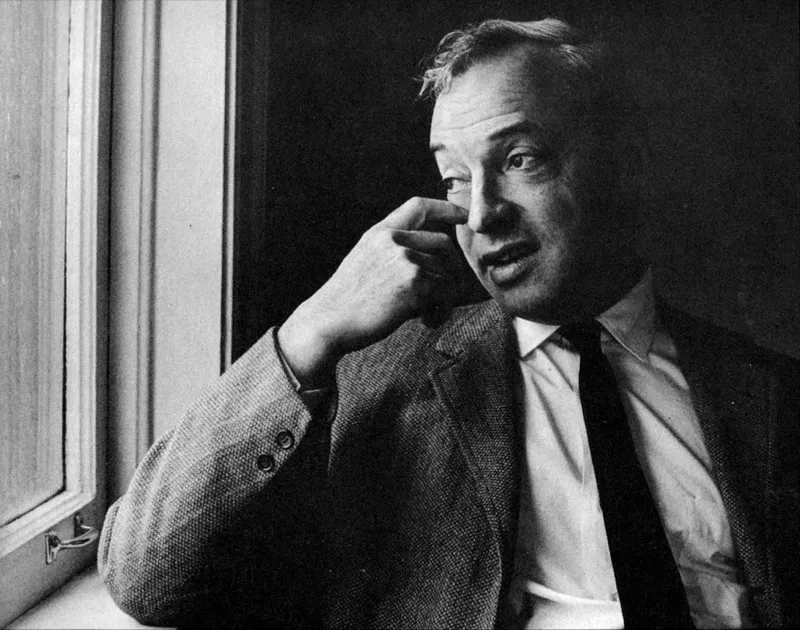
Four Languages, One Voice
Solomon Bellows was born on June 10, 1915, in Lachine, a suburb of Montreal, Quebec. His parents, Abraham and Liza Belo, were Russian-Jewish immigrants who had arrived in Canada two years earlier. The household was multilingual: Yiddish at home, Hebrew at the synagogue, French in the street, and English at school. By the time young Saul (as he renamed himself) was ten, he was fluent in all four languages — a linguistic richness that would infuse his prose with its distinctive music.
In 1924, the family moved to Chicago, the city that would become Bellow’s literary territory as completely as Dublin was Joyce’s or London was Dickens’s. They settled in the Humboldt Park neighborhood, a polyglot immigrant quarter where Jews lived alongside Poles, Ukrainians, and Italians. Abraham Bellow worked variously as a bootlegger, a baker, and a coal dealer. The family was poor but fiercely intellectual.
Chicago’s Literary Voice
Bellow studied at the University of Chicago and Northwestern, where he planned an academic career. But writing pulled him away. His first novel, Dangling Man (1944), was a claustrophobic diary of a man waiting to be drafted. His second, The Victim (1947), explored antisemitism in New York. Both were accomplished but restrained.
Then, in 1953, Bellow unleashed The Adventures of Augie March, and American literature was never the same. The novel — opening with the famous line “I am an American, Chicago born” — was expansive, exuberant, and wildly alive. Augie March, a Jewish kid from the Chicago slums, bounces through life with an appetite for experience that owed as much to Yiddish storytelling as to American optimism. The book won the National Book Award and established Bellow as a major force.
Herzog and the Jewish Intellectual
Herzog (1964) is Bellow’s most characteristic novel — and perhaps the greatest novel about Jewish intellectual life ever written. Moses Herzog, a middle-aged Jewish professor whose second wife has left him for his best friend, spends the novel in a state of comic crisis, writing long, unsent letters to philosophers, politicians, and the dead.
The letters are brilliant — funny, erudite, self-mocking, and desperately sincere. Herzog writes to Nietzsche, to Heidegger, to Eisenhower, to God. He is trying to make sense of his life through ideas, which is the most Jewish thing imaginable. The novel captures the comedy and pathos of the Jewish intellectual tradition — the conviction that if you can just think clearly enough, you can understand anything, combined with the dawning realization that understanding and happiness are not the same thing.
The Nobel Prize
In 1976, Bellow received the Nobel Prize in Literature. The Swedish Academy cited “the human understanding and subtle analysis of contemporary culture” in his work. He was the first American-born writer to win the Nobel since John Steinbeck in 1962.
Bellow used his Nobel lecture to defend the novel against critics who declared it dead. “The novel is the response to the question: ‘What is life for?’” he said. His own novels answered that question with a resounding affirmation: life is for living, for thinking, for arguing, for loving badly and trying again, for engaging with the fullness of human experience even when — especially when — it breaks your heart.
Later Years and Legacy
Bellow continued writing into his eighties, producing novels and stories of remarkable vitality. Ravelstein (2000), his last novel, was a portrait of his friend Allan Bloom — a Jewish intellectual’s elegy for another Jewish intellectual.
He married five times, had four sons, and was accused by various critics of misogyny, racism, and elitism. He was difficult, brilliant, generous, petty, and endlessly productive. He died on April 5, 2005, at the age of eighty-nine.
Bellow’s achievement was to bring the Jewish-American experience into the center of world literature — not as a curiosity or a specialty but as a universal human story. His characters think too much, feel too much, argue too much, and want too much. They are, in short, fully alive. And they are, unmistakably, Jewish.
Frequently Asked Questions
What did Saul Bellow win the Nobel Prize for?
Bellow received the 1976 Nobel Prize in Literature 'for the human understanding and subtle analysis of contemporary culture that are combined in his work.' The Nobel committee praised his ability to portray the modern individual's search for meaning with both intellectual rigor and emotional warmth.
What is Saul Bellow's most famous novel?
Bellow's most celebrated novels are The Adventures of Augie March (1953), Herzog (1964), Mr. Sammler's Planet (1970), and Humboldt's Gift (1975). Herzog — about a Jewish intellectual having a breakdown who writes unsent letters to the living and the dead — is often considered his masterpiece.
Was Saul Bellow an immigrant?
Yes. Bellow was born in Lachine, Quebec, Canada, in 1915 to Russian-Jewish immigrant parents. The family moved to Chicago when he was nine. He grew up speaking Yiddish, Hebrew, French, and English. The immigrant experience — the tension between Old World traditions and New World possibilities — is central to all his work.
Sources & Further Reading
Related Articles
Isaac Bashevis Singer: The Yiddish Storyteller Who Won the Nobel Prize
He wrote in a language that was dying and won the Nobel Prize for it. Isaac Bashevis Singer preserved the vanished world of Polish Jewry in stories of demons, saints, fools, and lovers — all in Yiddish, all in a cafeteria on Broadway.
Jewish Literature: A Survey
Jewish literature spans three thousand years — from the Psalms and Song of Songs through medieval Hebrew poetry, Yiddish masters like Sholem Aleichem, and modern voices from Isaac Bashevis Singer to Amos Oz.
Philip Roth: The Great American Jewish Novelist
Philip Roth spent fifty years excavating the tensions of Jewish-American identity in novels that were brilliant, scandalous, and impossible to ignore.