Robert Oppenheimer: Father of the Atomic Bomb
Robert Oppenheimer led the creation of the atomic bomb, then spent the rest of his life grappling with its consequences — a story of brilliance, tragedy, and Jewish moral reckoning.
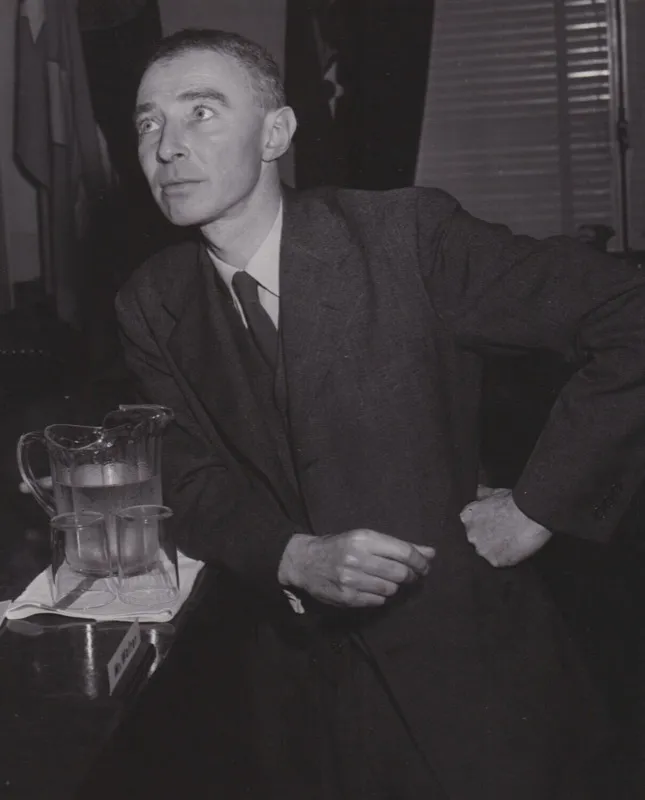
The Weight of a Thousand Suns
On the morning of July 16, 1945, in the desert of New Mexico, the sky turned white. The fireball rose, expanding into a mushroom cloud that climbed forty thousand feet. The ground shook. The blast wave rolled across the desert floor. And J. Robert Oppenheimer, the man who had led the effort to build this weapon, stood watching and thought of ancient scripture.
He would later say that two passages came to mind. One was from the Bhagavad Gita: “Now I am become death, the destroyer of worlds.” The other, less often quoted, was simpler: “It worked.” In that moment, the two sentences captured the duality that would define the rest of his life — the triumphant scientist and the haunted moralist, the man who solved the greatest physics problem of his era and then spent decades regretting that he had.
A Jewish Childhood in Manhattan
Julius Robert Oppenheimer was born on April 22, 1904, in New York City, into a prosperous German-Jewish family. His father, Julius, had emigrated from Germany in 1888 and made a fortune importing textiles. His mother, Ella Friedman, was a painter who had studied in Paris. The family lived in a Riverside Drive apartment filled with original paintings by Van Gogh, Picasso, and Renoir.
The Oppenheimers were secular Jews who belonged to the Society for Ethical Culture, a movement founded by Felix Adler (himself from a Jewish family) that emphasized ethics over theology. Young Robert attended the Ethical Culture School, where he excelled in everything — languages, science, literature, philosophy. He was reading Greek texts in the original by the time he was a teenager.
Despite his secular upbringing, Oppenheimer was aware of his Jewishness. He encountered antisemitism at various points in his academic career, and the rise of Nazism in the 1930s heightened his sense of Jewish identity. He donated money to help Jewish refugees flee Europe and became increasingly politically engaged as the threat to European Jewry became clear.
Harvard, Cambridge, Göttingen
Oppenheimer entered Harvard in 1922 and graduated summa cum laude in just three years. He went to Cambridge for graduate work, then to the University of Göttingen in Germany, where he earned his doctorate under Max Born. At Göttingen, he was at the epicenter of the quantum revolution, working alongside some of the greatest physicists of the century.
He returned to the United States in 1929 and took joint appointments at the University of California, Berkeley, and Caltech. Over the next decade, he built Berkeley into one of the world’s leading centers for theoretical physics. He was a charismatic teacher, a voracious reader (he learned Sanskrit to read Hindu scriptures in the original), and a magnetic personality who attracted brilliant students.
Los Alamos: Building the Bomb
In 1942, General Leslie Groves selected Oppenheimer to lead the secret laboratory at Los Alamos, New Mexico, where the atomic bomb would be designed and built. It was an unlikely choice — Oppenheimer had no administrative experience, no Nobel Prize, and a file full of security concerns related to his left-wing associations. But Groves recognized something essential: Oppenheimer could manage geniuses.
And manage them he did. At Los Alamos, he brought together the greatest collection of scientific talent ever assembled — Einstein, Feynman, Fermi, Bohr, Teller, Bethe, von Neumann — and kept them focused on the goal. He was everywhere at once: resolving technical disputes, soothing egos, making decisions that required both scientific brilliance and political judgment.
The bomb was tested on July 16, 1945, and dropped on Hiroshima on August 6, killing approximately 80,000 people instantly. Three days later, a second bomb fell on Nagasaki. Japan surrendered on August 15. The war was over. And Oppenheimer, the man who had made it possible, began his long moral reckoning.
”The Physicists Have Known Sin”
After the war, Oppenheimer became the most famous scientist in America — his face on the cover of Time magazine, his opinion sought on everything from nuclear policy to the future of civilization. He served as chairman of the General Advisory Committee of the Atomic Energy Commission and used his influence to advocate for international control of nuclear weapons.
But he also opposed the development of the hydrogen bomb, arguing that it was a weapon of genocide that could never be used against a military target. This position put him on a collision course with Edward Teller and the political establishment. In a speech to the American Philosophical Society in 1947, he said: “The physicists have known sin, and this is a knowledge which they cannot lose.”
The language is striking — not guilt, but sin. For a secular Jew who had studied the Bhagavad Gita and the Upanishads, the word carried weight. It suggested not merely a mistake but a fundamental violation of the moral order, a teshuvah that could never be fully achieved.
The Security Hearing
In December 1953, Oppenheimer was informed that his security clearance was being suspended. The following spring, he faced a grueling hearing before a Personnel Security Board. The charges were vague — past Communist associations, opposition to the hydrogen bomb, alleged “defects of character.” The real issue was political: Oppenheimer had made enemies by opposing the arms race, and the McCarthy era provided a convenient mechanism for destroying him.
The hearing was a travesty. Oppenheimer’s own lawyer was denied security clearance to read the classified evidence against his client. Former colleagues testified against him. Edward Teller delivered the devastating line: “I would like to see the vital interests of this country in hands which I understand better.”
The board voted two to one to revoke his clearance. Oppenheimer was effectively exiled from government service. He spent his remaining years as director of the Institute for Advanced Study in Princeton, where he continued to write and think but was permanently diminished.
Legacy and Redemption
In 1963, President Lyndon Johnson awarded Oppenheimer the Enrico Fermi Award, a partial rehabilitation. Oppenheimer, gaunt and weakened by the throat cancer that would kill him, accepted it with characteristic grace. He died on February 18, 1967, at the age of sixty-two.
In 2022, the U.S. Department of Energy formally vacated the 1954 security clearance revocation, declaring that the process had been flawed and driven by political motives. It was a posthumous vindication that came fifty-five years too late.
Oppenheimer’s story resonates with Jewish themes: the burden of knowledge, the moral weight of power, the impossibility of escaping the consequences of one’s actions. He was not a practicing Jew, but his life embodied the Jewish tradition of moral wrestling — the refusal to accept easy answers, the insistence on grappling with the hardest questions, even when the answers offer no comfort.
Frequently Asked Questions
Was Robert Oppenheimer Jewish?
Yes. Oppenheimer was born into a wealthy, secular Jewish family in New York City. His father, Julius Oppenheimer, was a German-Jewish immigrant who made his fortune in textile imports. His mother, Ella Friedman, was a painter from a Jewish family in Baltimore. While Oppenheimer attended the Ethical Culture School rather than a synagogue, his Jewish identity played a significant role in his life and worldview.
Why did Oppenheimer say 'I am become death, destroyer of worlds'?
After witnessing the first successful nuclear test (Trinity) on July 16, 1945, Oppenheimer recalled a verse from the Hindu scripture Bhagavad Gita: 'Now I am become death, the destroyer of worlds.' The quote captured his profound sense of the moral enormity of what he had helped create. He later said the physicists involved 'have known sin.'
Why was Oppenheimer's security clearance revoked?
In 1954, during the McCarthy era, Oppenheimer's security clearance was revoked after a controversial hearing. He was accused of having Communist associations and of opposing the development of the hydrogen bomb. Many saw it as political retaliation for his opposition to the arms race. In 2022, the U.S. government formally vacated the 1954 decision, restoring his reputation.
Key Terms
Sources & Further Reading
Related Articles
Albert Einstein: Genius, Refugee, and Jewish Icon
He revolutionized physics, fled Nazi Germany, was offered the presidency of Israel (and declined), played the violin, and became the most recognized scientist in history. Einstein's Jewish identity shaped his life in ways most people never learn about.
Jewish Contributions to Science: From Ancient Physicians to Nobel Laureates
Jews represent 0.2% of the world's population but have won over 20% of all Nobel Prizes in science. The reasons go deeper than talent — they involve a culture built on questioning, learning, and argument.
Richard Feynman: The Quantum Genius Who Played Bongo Drums
Richard Feynman was a Nobel Prize-winning physicist, brilliant teacher, bongo player, and relentless questioner whose Jewish background shaped his lifelong commitment to intellectual honesty.