Richard Feynman: The Quantum Genius Who Played Bongo Drums
Richard Feynman was a Nobel Prize-winning physicist, brilliant teacher, bongo player, and relentless questioner whose Jewish background shaped his lifelong commitment to intellectual honesty.
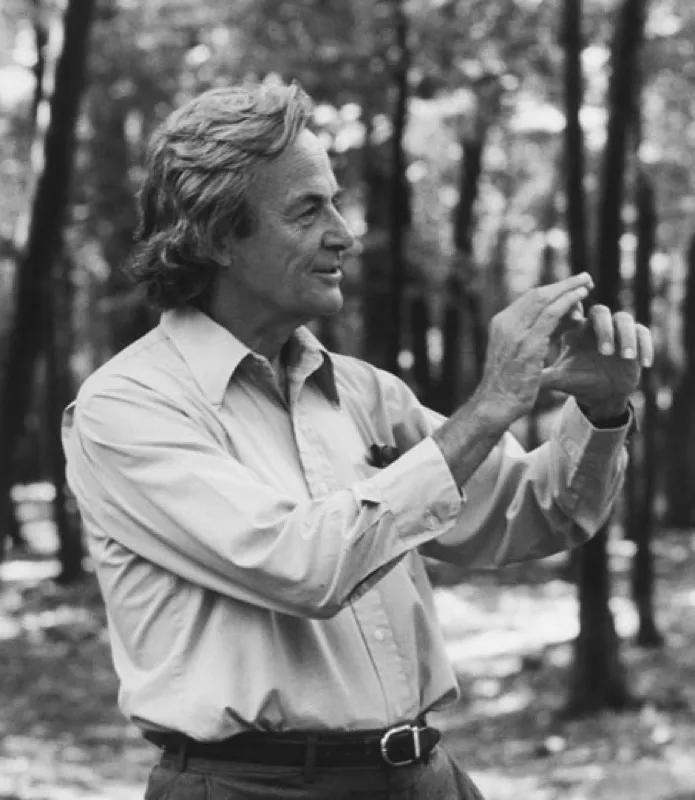
The Kid from Far Rockaway
Richard Phillips Feynman was born on May 11, 1918, in Queens, New York, to a Jewish family that prized curiosity above all else. His father, Melville, who had emigrated from Belarus as a child, made a modest living in the uniform business but spent evenings teaching young Richard to think like a scientist. “He taught me to notice things,” Feynman later recalled. Before the boy could walk properly, his father was arranging colored tiles in patterns, teaching him about mathematics through play.
The Feynman household was Jewish in culture if not in strict practice. The family observed some traditions, and Richard had a bar mitzvah, but what he inherited most deeply from his Jewish background was the tradition of questioning — the Talmudic instinct that no answer is ever final, that the question matters more than the authority giving the answer.
By the time he entered Far Rockaway High School, Feynman was already solving advanced mathematics problems. He taught himself trigonometry, advanced algebra, and calculus before his teachers could get to them. He entered MIT at seventeen and transferred to Princeton for graduate work, where his doctoral adviser, John Archibald Wheeler, recognized something extraordinary: a mind that could see physics not as a collection of rules but as a living, breathing puzzle.
The Manhattan Project and Los Alamos
In 1942, at the age of twenty-four, Feynman was recruited to work on the Manhattan Project at Los Alamos. He was the youngest group leader in the theoretical division. While working on the most destructive weapon in human history, he was also — characteristically — picking the locks on classified file cabinets to demonstrate that the security was inadequate, and playing bongo drums in the desert at night.
The experience at Los Alamos was formative. Feynman witnessed the Trinity test and felt the full moral weight of what they had created. Like his colleague Robert Oppenheimer, who famously quoted the Bhagavad Gita, Feynman grappled with the ethical implications. But while Oppenheimer was consumed by guilt, Feynman channeled his unease into a fierce commitment to honesty and a refusal to let authority go unquestioned.
During this period, Feynman also endured devastating personal loss. His first wife, Arline Greenbaum, also Jewish, was dying of tuberculosis throughout the war years. He married her despite his family’s objections and visited her in a sanatorium in Albuquerque whenever he could. She died in June 1945, weeks before the bomb was dropped on Hiroshima. The loss marked him permanently.
Quantum Electrodynamics and the Nobel Prize
After the war, Feynman fell into a depression that lasted several years. He questioned whether he could ever do important physics again. The breakthrough came when he began developing his own approach to quantum electrodynamics (QED), the theory that describes how light and matter interact at the most fundamental level.
Previous versions of QED were plagued by infinities — calculations that produced nonsensical results. Feynman, along with Julian Schwinger and Shin’ichiro Tomonaga (working independently), developed a technique called renormalization that tamed these infinities. But Feynman’s approach was unique: he invented a visual language — Feynman diagrams — that allowed physicists to calculate particle interactions by drawing simple pictures rather than grinding through pages of algebra.
The Feynman diagrams were revolutionary. They were intuitive, beautiful, and extraordinarily powerful. A single diagram could capture what would otherwise require dozens of equations. For this work, Feynman, Schwinger, and Tomonaga shared the 1965 Nobel Prize in Physics.
The Great Explainer
Feynman was perhaps the greatest physics teacher of the twentieth century. His undergraduate lectures at Caltech, delivered between 1961 and 1963, were collected as The Feynman Lectures on Physics and remain among the most important physics textbooks ever published. He had a gift for making the complex accessible without dumbing it down.
His approach to teaching reflected his Jewish intellectual heritage — the tradition of engaging with ideas through dialogue, of breaking complex concepts down to their essence, of never accepting “because the textbook says so” as an answer. Like a Talmudic scholar questioning a passage of text, Feynman questioned everything: “The first principle is that you must not fool yourself — and you are the easiest person to fool.”
He also became a beloved public figure through his autobiographical books, Surely You’re Joking, Mr. Feynman! and What Do You Care What Other People Think?, which revealed a personality that was playful, irreverent, and endlessly curious. He painted under a pseudonym, played bongo drums in a samba band, and frequented strip clubs — not because he was trying to be outrageous, but because he was genuinely interested in everything.
The Challenger Investigation
In 1986, Feynman was appointed to the Rogers Commission investigating the Space Shuttle Challenger disaster. True to form, he refused to follow the script. While other commissioners sat through formal presentations, Feynman went directly to the engineers, who told him what the managers didn’t want to hear: the O-ring seals in the solid rocket boosters became dangerously stiff in cold weather.
In one of the most memorable moments in the history of televised hearings, Feynman took a piece of O-ring material, dipped it in a glass of ice water, and showed that it lost its elasticity. The demonstration was devastatingly simple. His appendix to the commission’s report concluded with a line that could serve as his epitaph: “For a successful technology, reality must take precedence over public relations, for Nature cannot be fooled.”
Jewish Identity and Legacy
Feynman described himself as an atheist, but his Jewishness ran deeper than religious practice. His relentless questioning, his refusal to accept authority without evidence, his commitment to intellectual honesty — all of these reflected the Jewish intellectual tradition he had absorbed as a child in Queens. When asked about his religion, he would typically say he was “not a Jew in the religious sense,” but he never denied his Jewish heritage and often spoke warmly of his father’s influence.
He also carried the weight of Jewish history. The Holocaust, which killed millions of his fellow Jews while he was building the bomb, informed his views on the responsibilities of scientists. He believed that science was morally neutral but that scientists had an absolute obligation to be honest — about their findings, about their uncertainties, and about the potential consequences of their work.
Richard Feynman died on February 15, 1988, of two rare forms of cancer. His last words, reportedly, were: “I’d hate to die twice. It’s so boring.” He was sixty-nine years old. He left behind a body of work that transformed physics, a teaching legacy that continues to inspire scientists worldwide, and a model of intellectual life that combined rigor with joy, seriousness with play, and deep knowledge with deep humility.
Frequently Asked Questions
Was Richard Feynman Jewish?
Yes. Feynman was born to Jewish parents in Queens, New York. His father, Melville Feynman, came from a Belarusian Jewish family, and his mother, Lucille Phillips, was from a Polish Jewish family. While Feynman was not religiously observant as an adult, his Jewish upbringing profoundly shaped his intellectual curiosity and questioning nature.
What did Richard Feynman win the Nobel Prize for?
Feynman shared the 1965 Nobel Prize in Physics for his work on quantum electrodynamics (QED), a theory that describes how light and matter interact. His approach, which included the now-famous Feynman diagrams, made the theory both more elegant and more practical for calculations.
What was Feynman's role in the Challenger investigation?
In 1986, Feynman served on the Rogers Commission investigating the Space Shuttle Challenger disaster. He famously demonstrated that the O-ring seals became brittle in cold temperatures by dipping a piece of O-ring material into ice water during a televised hearing, revealing the cause of the explosion.
Key Terms
Sources & Further Reading
Related Articles
Albert Einstein: Genius, Refugee, and Jewish Icon
He revolutionized physics, fled Nazi Germany, was offered the presidency of Israel (and declined), played the violin, and became the most recognized scientist in history. Einstein's Jewish identity shaped his life in ways most people never learn about.
Jewish Nobel Prize Winners: A Remarkable Legacy
Jewish laureates have won roughly 22% of all Nobel Prizes despite representing 0.2% of the world's population. Explore the remarkable Jewish contribution across physics, chemistry, medicine, literature, peace, and economics — and why.
Jewish Contributions to Science: From Ancient Physicians to Nobel Laureates
Jews represent 0.2% of the world's population but have won over 20% of all Nobel Prizes in science. The reasons go deeper than talent — they involve a culture built on questioning, learning, and argument.