Bagels: A Jewish History of the World's Favorite Roll
From 17th-century Krakow to modern Manhattan, the bagel's journey from humble Jewish bread to global breakfast icon is a story of immigration, ingenuity, and fierce debate about what counts as the real thing.

More Than a Bread
There is a moment every New Yorker knows — and every visitor discovers — when a fresh bagel, still warm from the oven, is sliced open and the knife meets that perfect resistance: the crust crunches, the interior yields, the steam rises, and everything else on the breakfast menu becomes irrelevant. A good bagel needs nothing. A great bagel demands cream cheese, maybe lox, and your full attention.
But the bagel is more than a breakfast food. It is an immigrant story, a labor history, a cultural artifact, and one of the few Jewish contributions to global cuisine that most people do not even realize is Jewish. The bagel’s journey from the Jewish quarters of Eastern Europe to every Starbucks and airport kiosk in America is a tale of adaptation, preservation, and the eternal question: when does something stop being what it was and become something else entirely?
Origins: Krakow, Circa 1600
The bagel’s precise origins are, like most food histories, wrapped in layers of legend and partial evidence. The most commonly cited story places the first bagel in Krakow, Poland, around 1610, where community regulations mentioned “beygl” among the foods that could be given as gifts to women after childbirth. The word likely derives from the Yiddish beygl, related to the German Bügel (bracelet or ring), describing the bread’s distinctive shape.
What we know with more confidence is that by the seventeenth century, the ring-shaped, boiled-then-baked bread was well established in Polish Jewish communities. It was practical, portable, and durable. Unlike soft breads that went stale quickly, the bagel’s dense texture and hard crust gave it a longer shelf life — a valuable quality in communities where fresh baking was not always possible.
The bagel’s shape also served a commercial purpose: it could be strung on a dowel or string and sold by street vendors, carried through markets, or hung in bakery windows. In the shtetls of Eastern Europe, the bagel became everyday sustenance — cheap, filling, and available.
The Boiling Secret
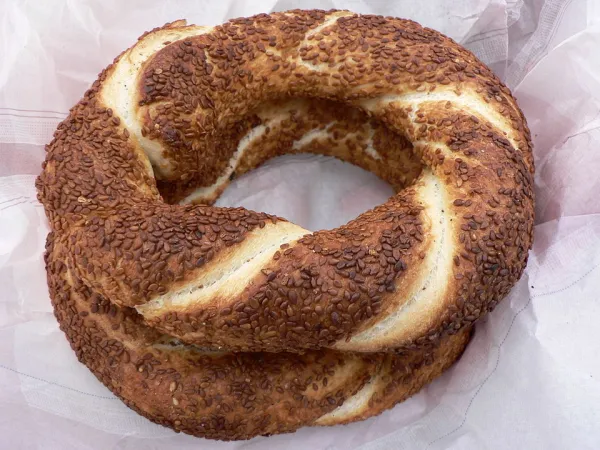
What makes a bagel a bagel — as opposed to a bread roll with a hole — is the boiling. Traditional bagel-making follows a specific sequence that has remained essentially unchanged for centuries:
- A stiff, high-gluten dough is mixed with flour, water, yeast, salt, and malt
- The dough is shaped into rings by hand
- The rings are allowed to retard (rest in the cold) overnight
- Before baking, the rings are boiled briefly — usually 30 to 90 seconds per side — in water often sweetened with malt syrup or honey
- The boiled rings are baked at high temperature on wooden boards or stone hearths
The boiling step is what creates the bagel’s signature characteristics: the shiny, chewy crust and the dense, slightly springy interior. The brief immersion in boiling water gelatinizes the starches on the surface, creating a seal that keeps the inside moist while the outside develops its distinctive sheen and snap.
Skip the boiling — as many mass-market bagel producers do, replacing it with steam injection — and you get a round bread with a hole. You do not get a bagel. This distinction is the source of intense debate and no small amount of snobbery in cities where bagel culture runs deep.
Immigration and the Bagel Bakers’ Union
When millions of Eastern European Jews immigrated to America between 1880 and 1924, they brought the bagel with them. In New York’s Lower East Side, Jewish bakeries produced bagels for an eager clientele, and the bagel quickly became associated with the Jewish immigrant experience.
In 1907, the International Beigel Bakers’ Union (Bagel Bakers Local 338) was established in New York. It was a small, tight-knit, exclusively Jewish union that controlled virtually all bagel production in the city. Membership was limited — often passed from father to son — and the work was done entirely by hand in basement bakeries, in teams of four or five men working through the night.
The union maintained strict standards and kept the craft small and artisanal. For decades, this meant that bagels remained a niche ethnic food, available mainly in Jewish neighborhoods and at Jewish-owned shops. The broader American public barely knew they existed.
That changed in the 1960s when Daniel Thompson invented the bagel-making machine, which could produce hundreds of bagels per hour. The unionized hand-rollers fought the machines bitterly, but automation eventually won. Once bagels could be produced at industrial scale, they began appearing in supermarkets, chain restaurants, and, inevitably, places far from any Jewish community.
New York vs. Montreal: The Great Bagel War
Two cities claim supremacy in the bagel world, and their rivalry is fierce.
New York bagels are large, puffy, and chewy, with a malty sweetness from the boiling liquid and a soft interior. They are traditionally plain, sesame, poppy, or everything (a late-twentieth-century innovation). New Yorkers credit their water — famously soft and mineral-light — for the bagel’s superior texture, though bakers debate whether water chemistry actually matters as much as technique.
Montreal bagels are smaller, denser, and sweeter. They are boiled in honey-sweetened water before being baked in a wood-fired oven, which gives them a slightly smoky, caramelized character. Montreal bagels have a larger hole and a crunchier exterior. The two legendary Montreal bagel shops — Fairmount (founded 1919) and St-Viateur (founded 1957) — run 24 hours a day and have achieved something close to sacred status.

The debate between the two styles is ultimately irresolvable, because they are optimizing for different qualities. The New York bagel is a vehicle for toppings — a platform for cream cheese, lox, tomato, and onion. The Montreal bagel is more self-contained — sweet and smoky enough to eat on its own, warm from the oven, needing nothing.
Both cities agree on one thing: what the rest of America calls a “bagel” is usually not one.
The Deli Connection
The bagel’s rise in America is inseparable from the Jewish deli. The classic deli breakfast or brunch — a bagel with cream cheese, smoked salmon (lox), tomato, red onion, and capers — is arguably the most iconic Jewish-American meal. It represents a fusion of Eastern European Jewish ingredients (the bagel, the cured fish) with American abundance and New York cosmopolitan style.
The deli also popularized the bagel and schmear — a bagel with a generous spread of cream cheese — as a grab-and-go breakfast. This pairing, simple and satisfying, is what carried the bagel from ethnic specialty to American staple.
Other classic bagel combinations from the deli tradition include:
- Bagel with butter — the minimalist’s choice
- Bagel with egg salad or tuna salad — lunch counter staples
- Bagel with whitefish salad — the connoisseur’s pick
- The “everything” bagel — coated in sesame, poppy, garlic, onion, and salt
How the Bagel Conquered America
By the 1980s and 1990s, the bagel had broken free of its Jewish and New York origins to become a national phenomenon. Chains like Einstein Bros., Bruegger’s, and Manhattan Bagel opened across the country. Frozen bagels from Lender’s appeared in supermarket freezer sections. By 2000, the bagel was the fastest-growing segment of the American bread market.
But the mass-market bagel was, and is, a very different creature from its artisanal ancestor. Industrial bagels are often steamed rather than boiled, made with softer dough, flavored with additions unthinkable to traditionalists (blueberry, cinnamon raisin, asiago cheese), and produced at a scale that the old Bagel Bakers’ Union would have found both impressive and horrifying.
The proliferation of bagel flavors and styles raises a question familiar in Jewish cultural life: what makes something authentic? Is a blueberry bagel a bagel? Is a steamed roll with a hole? Purists draw hard lines; pragmatists shrug and eat what tastes good. The debate itself — passionate, opinionated, and ultimately about identity — is perhaps the most Jewish thing about the whole bagel story.
The Jewish Bagel Today
For many American Jews, the bagel remains a powerful cultural marker — one of those everyday objects that carries meaning beyond its function. Bringing bagels to a Sunday morning gathering is a Jewish ritual as real as any in the prayer book, even if no one involved is particularly observant.
The bagel also illustrates a pattern in Jewish-American history: a food born of immigrant necessity becomes a marker of ethnic identity, then crosses over to mainstream popularity, then becomes so ubiquitous that its origins are forgotten. The challenge — and the opportunity — is to remember where it came from while welcoming its evolution.
Today, a new generation of Jewish bakers is pushing back against industrial bagel culture, returning to hand-rolling, overnight fermentation, malt-water boiling, and wood-fired or stone-hearth baking. In cities across America and beyond, small-batch bagel shops are proving that the old way still produces something that no machine can replicate.
Frequently Asked Questions
Why do bagels have holes? Several theories exist. The hole may have originally allowed bagels to be strung on dowels or strings for display and sale. It also helps the bagel cook more evenly by exposing more surface area to the boiling water and oven heat. Some historians connect the ring shape to other round breads in Central European baking traditions.
Are bagels kosher? Plain bagels made with standard ingredients (flour, water, yeast, malt, salt) are inherently kosher. However, kashrut issues can arise with toppings, spreads, and the bakery’s equipment. Bagels baked alongside non-kosher items or topped with non-kosher ingredients would not be kosher. Many traditional bagel bakeries maintain kosher certification.
What is the difference between a bagel and a bialy? Both are round Jewish breads from Eastern Europe, but they differ significantly. A bagel has a hole, is boiled before baking, and has a chewy crust. A bialy (from Bialystok, Poland) has a depression instead of a hole, is never boiled, has a softer texture, and is typically filled with diced onion and poppy seeds. Bialys are meant to be eaten fresh and do not keep well.
Frequently Asked Questions
Are bagels a Jewish food?
Yes. Bagels originated in the Jewish communities of 17th-century Poland and were brought to America by Eastern European Jewish immigrants. Jewish bakers dominated the bagel trade in New York for decades through the Bagel Bakers Union.
What makes a real bagel different from store-bought?
A traditional bagel is boiled in water before baking, which creates its distinctive chewy crust and dense interior. Mass-produced bagels are often steamed instead, resulting in a softer, bread-like texture that purists reject.
What is the difference between New York and Montreal bagels?
Montreal bagels are smaller, sweeter (made with honey and egg), boiled in honey water, and baked in a wood-fired oven. New York bagels are larger, chewier, boiled in plain water, and baked in a standard oven.
Sources & Further Reading
Related Articles
Jews in America: Four Centuries of History
From 23 refugees arriving in New Amsterdam in 1654 to a thriving community of nearly seven million, the story of Jews in America is a story of reinvention, contribution, and enduring identity.
Sephardi vs Ashkenazi: Two Streams of Jewish Life
Sephardi and Ashkenazi Jews share the same Torah but developed distinct languages, liturgies, foods, and customs across centuries of separation — two rivers from one source.
Life in the Shtetl: Eastern European Jewish Towns
For centuries, millions of Jews lived in small towns across Eastern Europe — communities rich in tradition, learning, and culture that shaped modern Jewish identity.