Jews in America: Four Centuries of History
From 23 refugees arriving in New Amsterdam in 1654 to a thriving community of nearly seven million, the story of Jews in America is a story of reinvention, contribution, and enduring identity.
Twenty-Three Refugees
In September 1654, a small French ship called the Sainte Catherine sailed into the harbor of New Amsterdam — the Dutch colony that would one day become New York City. On board were twenty-three Jews, most of them Sephardic, fleeing the Portuguese reconquest of Recife, Brazil. They arrived with almost nothing. The ship’s captain held their belongings as collateral for unpaid passage.
Governor Peter Stuyvesant wanted them gone. He petitioned the Dutch West India Company to expel the “deceitful race” and “hateful enemies of the name of Christ.” The Company, which had Jewish shareholders, overruled him. The refugees stayed.
From this unpromising beginning — unwanted, penniless, clinging to a toehold in a hostile colony — grew the largest and most influential Jewish community in the history of the diaspora.
Colonial and Early American Jews
The Jewish community in colonial America was tiny — perhaps 2,000 to 3,000 people by the time of the American Revolution. Most were Sephardic, descendants of Jews expelled from Spain and Portugal. They established synagogues in New York (Shearith Israel, 1654), Newport (Touro Synagogue, 1763), Philadelphia, Charleston, and Savannah.
These early Jews were merchants, traders, and craftsmen. They were a tiny minority, but they participated in American life from the beginning. Jews served in the Continental Army during the Revolution. Haym Salomon, a Polish-born Jew, helped finance the war effort. George Washington, in his famous 1790 letter to the Hebrew Congregation of Newport, declared that the new government “gives to bigotry no sanction, to persecution no assistance” — a foundational statement of American religious freedom.
The German Jewish Wave: 1840s-1880s
The first major wave of Jewish immigration came from German-speaking lands in the mid-nineteenth century. Approximately 150,000 German Jews arrived between the 1840s and 1880s, driven by economic hardship and political upheaval. Many became peddlers, fanning out across the American frontier with packs on their backs, eventually establishing small-town general stores. Some of those stores grew into department store empires: Macy’s (later owned by Isidor and Nathan Straus), Neiman Marcus, Saks Fifth Avenue.
German Jews also built the institutional infrastructure of American Judaism. They established Reform Judaism in America, founding Hebrew Union College (1875), the Union of American Hebrew Congregations, and the Central Conference of American Rabbis. Rabbi Isaac Mayer Wise, working from Cincinnati, was the architect of much of this institutional framework.
By the 1880s, the German Jewish community was largely prosperous, acculturated, and Reform. They had built hospitals, orphanages, mutual aid societies, and a network of synagogues stretching from New York to San Francisco. They considered themselves thoroughly American.
Then came the flood.
The Great Migration: 1880-1920
Between 1880 and 1920, approximately two million Jews arrived in the United States from Eastern Europe — from Russia, Poland, Lithuania, Romania, and the lands of the Austro-Hungarian Empire. They were fleeing pogroms, poverty, military conscription, and the suffocating restrictions of the Pale of Settlement.
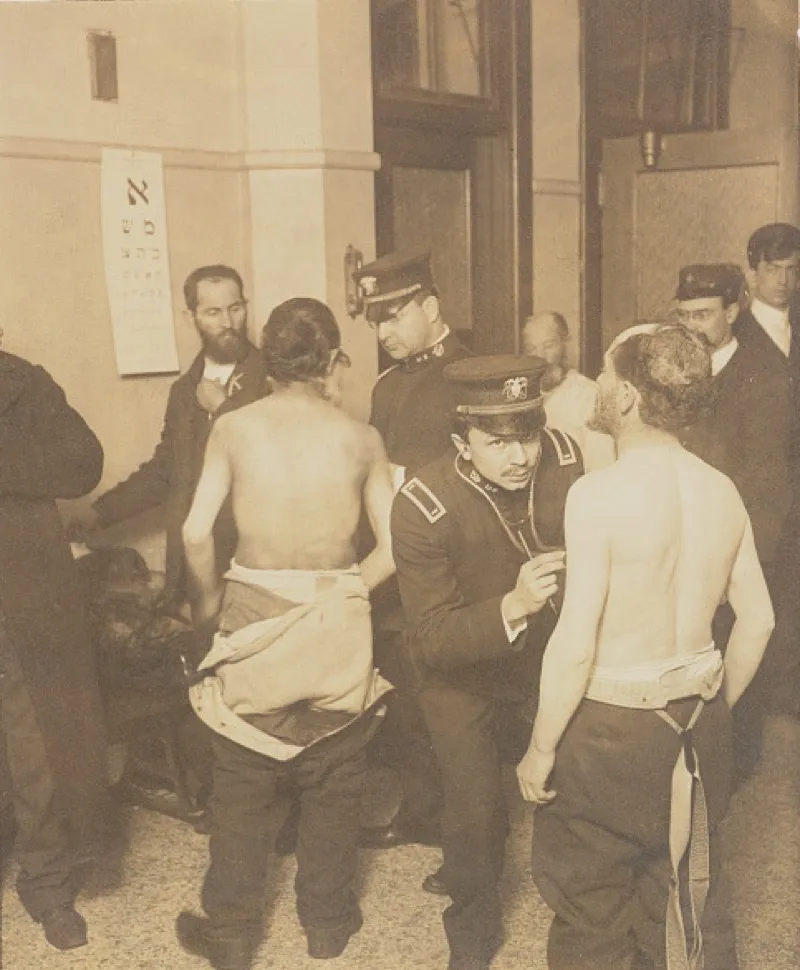
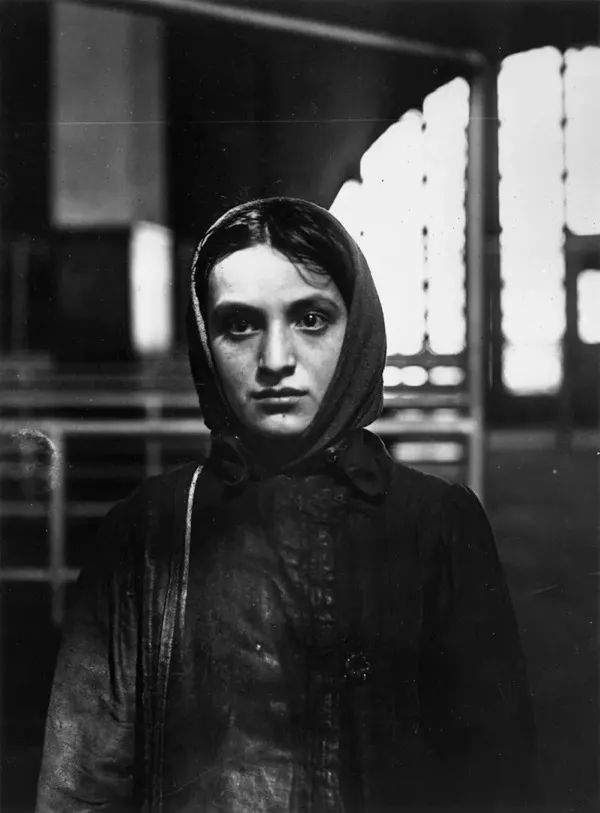
They arrived at Ellis Island by the thousands — exhausted, bewildered, carrying bundles and babies. Most spoke Yiddish, not English. Most were Orthodox. Most were poor. And most settled in the teeming tenements of New York’s Lower East Side, which became the densest neighborhood in the world.
The Lower East Side
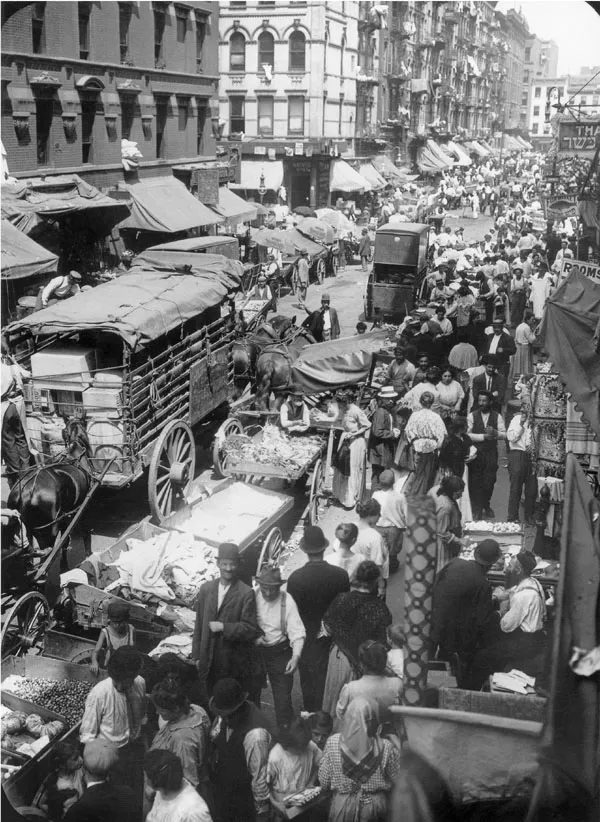
The Lower East Side in 1900 was a universe unto itself. Pushcart vendors lined the streets, selling herring, pickles, and fabric. Yiddish newspapers (the Forward, the Jewish Daily Bulletin) competed for readers. Sweatshops filled the tenement buildings, where men and women sewed garments for twelve or fourteen hours a day. The Triangle Shirtwaist Factory fire of 1911 — which killed 146 workers, many of them young Jewish and Italian women — became a turning point for the American labor movement.
But the Lower East Side was also a place of extraordinary cultural energy. Yiddish theater flourished on Second Avenue. Labor unions organized with passionate idealism. Young people devoured education — the City College of New York, free and open to all, became known as “the poor man’s Harvard.” Within a single generation, the children of sweatshop workers were becoming doctors, lawyers, teachers, and professors.
Hollywood, Broadway, and American Culture
The contribution of Jewish Americans to American culture is staggering in its scope. The major Hollywood studios — MGM, Paramount, Warner Bros., Universal, Columbia — were all founded by Jewish immigrants or their children. Irving Berlin (born Israel Beilin in Russia) wrote “God Bless America” and “White Christmas.” George Gershwin transformed American music. Arthur Miller and Neil Simon shaped American theater. Jerome Robbins choreographed West Side Story.
This cultural influence was not coincidental. Jews arrived in America at the precise moment when new forms of mass entertainment — film, popular music, radio, television — were being invented. Excluded from many established industries by antisemitic barriers, they built new ones.
Civil Rights and Social Justice
Jewish involvement in the American civil rights movement was profound and deeply rooted. Rabbi Abraham Joshua Heschel marched arm-in-arm with Martin Luther King Jr. from Selma to Montgomery in 1965, later saying: “I felt as though my legs were praying.” Jewish lawyers helped found the NAACP. Jewish students were among the Freedom Riders. Two of the three civil rights workers murdered in Mississippi in 1964 — Andrew Goodman and Michael Schwerner — were Jewish.
This involvement was motivated by both prophetic tradition and personal experience. Jews who had experienced persecution understood — viscerally — the meaning of discrimination. The Torah’s repeated command to “welcome the stranger, for you were strangers in the land of Egypt” resonated with a community that had so recently been strangers itself.
Suburbanization and Denominational Flourishing
After World War II, American Jews joined the great suburban migration. Synagogues followed — not the grand downtown temples of the German Jewish era, but suburban congregations that became the centers of Jewish social life. The Conservative movement thrived in the suburbs, offering a middle path between Orthodox observance and Reform liberalism.
All three major denominations — Orthodox, Conservative, and Reform — flourished in postwar America. The Reconstructionist movement, founded by Mordecai Kaplan, emerged as a fourth option. Jewish day schools multiplied. Federations, JCCs, and Hillel chapters on college campuses created a dense network of communal institutions.
The Modern Community
Today, the American Jewish community numbers approximately 6 to 7.5 million people — the largest or second-largest Jewish community in the world. It is extraordinarily diverse: Ashkenazi and Sephardic, Orthodox and secular, politically liberal and conservative, urban and suburban.
The 2020 Pew Research survey revealed a community in transition. Intermarriage rates exceed 60 percent among non-Orthodox Jews. Denominational affiliation is declining, with growing numbers identifying as “just Jewish.” At the same time, Orthodox communities — particularly Hasidic — are growing rapidly due to high birth rates.
American Jews remain disproportionately represented in academia, law, medicine, finance, technology, media, and politics. They are among the most educated and affluent demographic groups in the country. They are also, by most surveys, among the most politically liberal — a fact that puzzles some observers, given that economic self-interest might suggest otherwise.
The relationship between American Jews and Israel is complex and evolving. Older generations tend to feel a deep, often uncritical attachment to the Jewish state. Younger generations are more likely to express criticism of Israeli policies, particularly regarding the Palestinians, while still maintaining a connection to Israeli society and culture.
Four centuries after twenty-three refugees stepped off a French ship in New Amsterdam, the story of Jews in America continues — shaped by the same forces that have always defined it: the tension between assimilation and identity, the drive toward justice, and the stubborn refusal to disappear.
Frequently Asked Questions
When did Jews first arrive in America?
The first documented Jewish settlers arrived in New Amsterdam (later New York) in September 1654 — a group of 23 Sephardic Jews fleeing the Portuguese reconquest of Brazil. They faced resistance from Governor Peter Stuyvesant, who wanted to expel them, but the Dutch West India Company overruled him, and the community took root.
How many Jews live in America today?
Estimates range from 6 to 7.5 million, depending on how Jewish identity is defined. The 2020 Pew Research survey estimated 7.5 million Jewish adults and children in the United States, making it the largest or second-largest Jewish community in the world (roughly equal to Israel's Jewish population).
What role did Jews play in the American civil rights movement?
Jewish Americans were deeply involved in the civil rights movement of the 1950s and 1960s. Rabbi Abraham Joshua Heschel marched alongside Martin Luther King Jr. in Selma. Jewish lawyers helped found the NAACP. Jewish students made up a significant portion of the Freedom Riders. This involvement was rooted in both the prophetic tradition of pursuing justice and the Jewish experience of persecution.
Sources & Further Reading
Related Articles
Orthodox, Conservative, and Reform: Understanding Jewish Denominations
Judaism is not monolithic — it encompasses diverse movements from Ultra-Orthodox to Reform, each with its own approach to tradition, law, and modern life.
The Jewish Diaspora: 2,000 Years Across the Globe
How the destruction of the Second Temple scattered the Jewish people across continents, creating diverse communities united by faith.
Life in the Shtetl: Eastern European Jewish Towns
For centuries, millions of Jews lived in small towns across Eastern Europe — communities rich in tradition, learning, and culture that shaped modern Jewish identity.