Why Do Jews Wear Yarmulkes? The Meaning Behind the Kippah
The kippah (yarmulke) is worn as a sign of reverence before God — a reminder that something is always above you. Not biblical, but deeply meaningful.
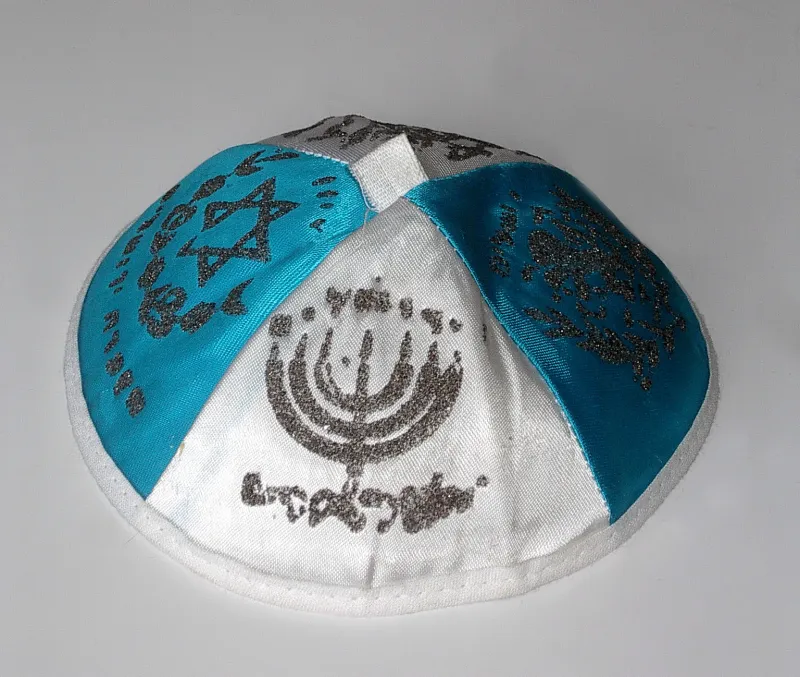
The Short Answer
Jews wear the kippah (yarmulke) as a sign of reverence before God — a constant, physical reminder that something is above you. It is a gesture of humility, an acknowledgment that you stand in the presence of the divine. The Talmud records that covering the head was a practice of the particularly pious, and over the centuries it became standard practice for Jewish men and, increasingly, for women in egalitarian communities.
Here is the surprise: the kippah is not mentioned in the Torah. It is not one of the 613 commandments. It is a custom — a minhag — that evolved over time from a mark of special piety into a universal Jewish identifier. And yet, this tiny piece of fabric has become arguably the most visible symbol of Jewish identity in the world.
The Talmudic Origins
The practice of covering the head appears in the Talmud, where it is associated with yirat shamayim — awe or reverence for heaven.
The most famous passage comes from Tractate Shabbat (156b), where a mother is told by astrologers that her son would become a thief. She insisted he always cover his head so that “the fear of heaven would be upon him.” One day his head covering fell off, and he immediately felt the urge to steal — reinforcing the idea that the covering served as a spiritual safeguard.
In Tractate Kiddushin (31a), the Talmud records that Rav Huna, son of Rav Yehoshua, would not walk four cubits with his head uncovered, saying: “The Divine Presence is above my head.” This became the foundational statement for the practice — covering the head as a recognition that God is always present.

The important point: none of these sources frame head covering as a biblical commandment. It is a practice that grew organically from a culture of reverence, was adopted by the pious, spread through the community, and eventually became normative. By the medieval period, most rabbinic authorities treated head covering for men as obligatory — not because the Torah requires it, but because custom (minhag) has the force of law when universally adopted.
Kippah vs. Yarmulke: A Glossary
The small round skullcap goes by several names:
- Kippah (Hebrew, plural: kippot) — the standard Israeli and Modern Hebrew term
- Yarmulke (Yiddish) — the standard Ashkenazi diaspora term. The etymology is debated: it may come from the Aramaic yira malka (“awe of the King,” i.e., God) or from a Turkic or Polish word for “skullcap”
- Capel — used in some Sephardic communities
All refer to the same item. Your choice of term often reflects your background: Israeli and Sephardic Jews tend to say “kippah”; American Ashkenazi Jews often say “yarmulke.”
Styles by Community
One of the most fascinating aspects of the kippah is how its style functions as a social identifier within the Jewish world. An observant Jew can often tell a great deal about another person’s community, denomination, and even political orientation from their kippah:
Black velvet kippah (large): Ultra-Orthodox (Haredi) communities. Worn under a hat (black fedora or shtreimel).
Black velvet kippah (small): Yeshivish (Lithuanian Orthodox) community. Often perched toward the back of the head.
Knitted/crocheted kippah (srugah): Modern Orthodox and Religious Zionist communities. Often colorful, sometimes with patterns.
White knitted kippah: Associated with the Breslov Hasidic movement and some Religious Zionist groups.
Suede kippah: Common among Conservative Jews and at lifecycle events. Often provided by synagogues as guest kippot.
Decorative/themed kippah: Sports teams, cartoon characters, wedding designs. Common at bar mitzvahs, weddings, and in liberal communities.
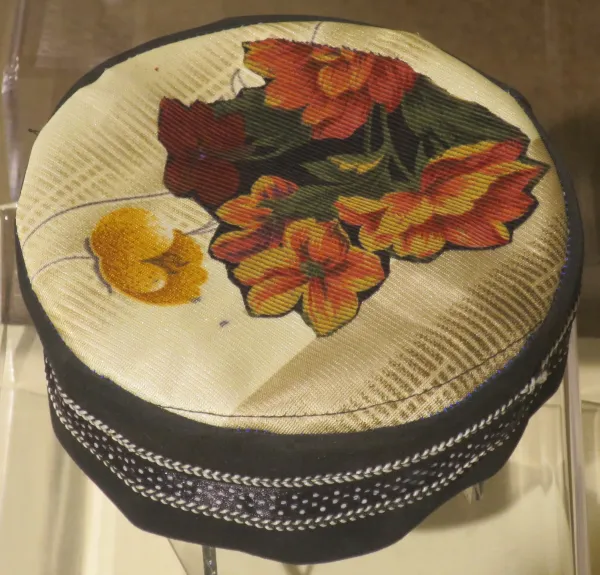
Bucharian kippah: Large, elaborately embroidered, flat-topped. Traditional in Bukharan Jewish communities from Central Asia.
None of these differences have legal significance — any head covering fulfills the custom. But in practice, the kippah is a remarkably nuanced social signal.
When to Wear It
Practice varies enormously across the denominations:
Orthodox men wear a kippah all the time — at home, at work, on the street, while sleeping (some). It is a constant marker of identity and a continuous acknowledgment of God’s presence. Removing it in public would be considered inappropriate.
Conservative men typically wear a kippah during prayer, meals, Jewish study, and in the synagogue. Some wear it all day; others wear it only for religious activities.
Reform men may wear a kippah during services (if their synagogue provides or encourages them) or not at all. The Reform movement leaves the practice to individual choice.
Non-Jews visiting a synagogue are typically offered a kippah at the door. It is a sign of respect for the sacred space, not a declaration of faith. Taking one and wearing it is the right thing to do as a guest.
Women’s Head Coverings
The kippah tradition has historically applied to men. Women’s head coverings in Judaism have a completely separate origin and meaning.
Married Orthodox women cover their hair as a sign of tzniut (modesty). The hair of a married woman is considered to have an intimate quality (erva), and covering it is a halachic obligation in Orthodox practice. Women use various coverings:
- Sheitel (wig) — common in many Hasidic and Haredi communities
- Tichel (scarf or headwrap) — common in Israeli Orthodox and some Hasidic communities
- Hat — common in Modern Orthodox circles
- Snood or beret — casual options for everyday wear
This practice is not about the kippah at all — it is a separate tradition rooted in different sources and applying only to married women.
In egalitarian Conservative, Reform, and Reconstructionist communities, some women have adopted the kippah as a statement of equality — wearing the same head covering as men during prayer and study. This modern development, beginning in the 1970s, has become increasingly common, though it remains a personal choice.
The Kippah as Identity
In the modern world, the kippah has taken on significance beyond its original religious meaning. Wearing a visible kippah in public is a statement of Jewish identity — and in some times and places, an act of courage.
In countries where antisemitism is present, wearing a kippah makes you visibly Jewish and potentially vulnerable. The decision to wear it publicly — or to tuck it under a baseball cap — is a personal calculus that many Jewish men face daily.
At the same time, the kippah has become a symbol of Jewish pride. Wearing it says: I am here. I am Jewish. I am not hiding. For a people with a long history of being forced to hide their identity, this small act of visibility carries enormous weight.
A Small Thing, A Big Meaning
The kippah is, physically, almost nothing — a few inches of fabric, weighing next to nothing, covering a small patch of scalp. But symbolically, it is one of Judaism’s most powerful objects. It says: I acknowledge something above me. I am not the center of the universe. I stand in the presence of God.
For something the Torah never commanded, that is a remarkable achievement. The kippah is proof that sometimes the deepest practices are not the ones that are legislated from above, but the ones that grow organically from below — from a community that found meaning in a simple, humble gesture and made it their own.
Frequently Asked Questions
Is wearing a kippah required by the Torah?
No. The Torah does not command men to cover their heads. The practice developed during the Talmudic period as a sign of reverence for God and has become customary rather than biblical law. Despite this, it has become so deeply ingrained in Jewish practice that most Orthodox authorities treat it as obligatory.
What is the difference between a kippah and a yarmulke?
They are the same thing — a small round skullcap worn on the head. 'Kippah' is Hebrew and 'yarmulke' is Yiddish (possibly from the Aramaic 'yira malka,' meaning 'awe of the King'). Israeli and Sephardic Jews tend to say 'kippah'; Ashkenazi Jews in the diaspora often say 'yarmulke.'
Do Jewish women wear head coverings?
Married Orthodox women cover their hair — with a wig (sheitel), scarf (tichel), or hat — as a sign of modesty. This is a different practice from the kippah and has different origins. In egalitarian Conservative and Reform communities, some women choose to wear kippot as well, though this is a modern development.
Test Your Knowledge
Think you know this topic? Try our quiz!
Take the Jewish Clothing & Symbols Quiz →Sources & Further Reading
Related Articles
Orthodox, Conservative, and Reform: Understanding Jewish Denominations
Judaism is not monolithic — it encompasses diverse movements from Ultra-Orthodox to Reform, each with its own approach to tradition, law, and modern life.
The Kippah: Covering the Head Before God
The small cap worn by Jewish men is one of the most recognizable symbols of Judaism — but its meaning runs deeper than you might think.
The Synagogue: House of Prayer, Study, and Assembly
More than just a place of worship — the synagogue is the heart of Jewish community life, combining prayer, learning, and social gathering under one roof.