Tefillin: The Sacred Boxes of Jewish Prayer
Two small black leather boxes containing Torah verses, bound to the arm and head each morning — tefillin are among the most ancient and powerful symbols of Jewish devotion.
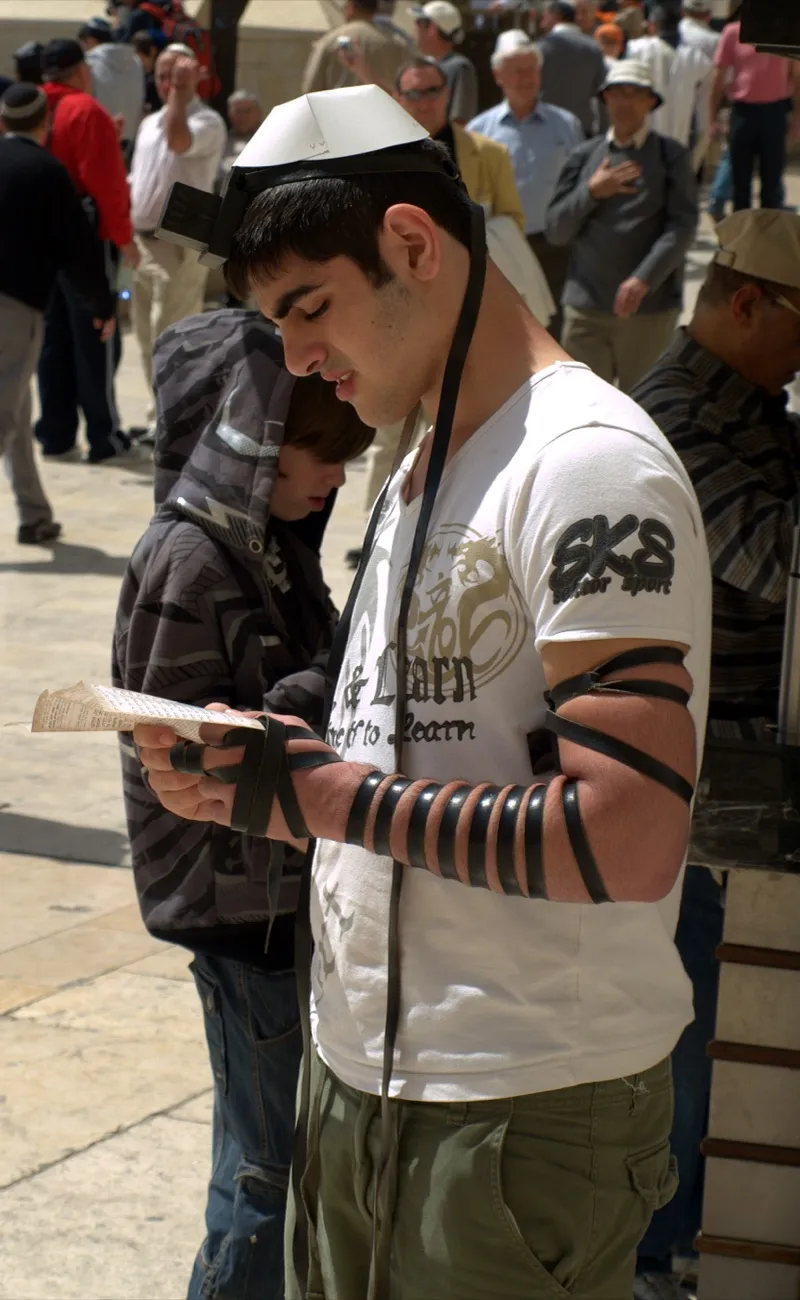
The Morning Ritual
The velvet bag is soft and familiar in your hands. You unzip it — or untie the drawstring, depending on your family — and the smell rises to meet you: leather, old and clean, faintly sweet. Inside, two small black boxes sit nestled with their long straps coiled around them. You have done this hundreds of times, maybe thousands, and yet there is something about the weight of them in your palm, the deliberate unwinding of the straps, the way the morning light catches the smooth leather, that makes each time feel like the first. You place the first box against your arm, pull the strap snug, and begin to wind. Seven times around the forearm. The leather tightens against your skin. Then the second box, settled on your forehead, adjusted until it sits just right. You are bound — literally, physically bound — to something ancient. The words of the Torah are now pressed against your body. The day can begin.
This is tefillin — one of the oldest, most distinctive, and most physically intimate rituals in Jewish life.
What Are Tefillin?
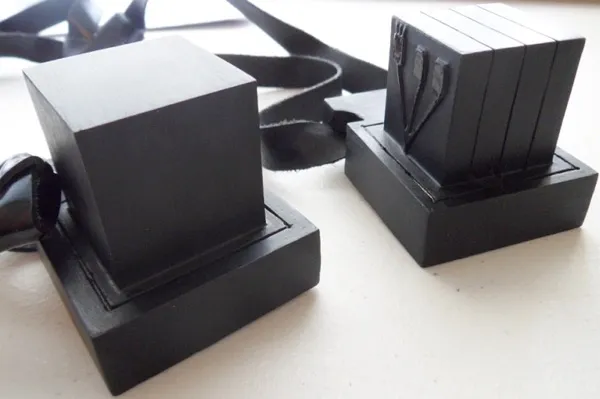
Tefillin (sometimes called phylacteries in English, from the Greek phylakterion, meaning “safeguard”) are a pair of small black leather boxes containing parchment scrolls inscribed with verses from the Torah. Each box — called a bayit (house), plural batim — is attached to long black leather straps called retzuot.
One box is worn on the arm, the other on the head. Together, they fulfill one of the most frequently referenced commandments in the Torah: to bind God’s words “as a sign upon your hand and as frontlets between your eyes” (Deuteronomy 6:8).
The boxes are perfectly black and perfectly square — requirements that are taken with absolute seriousness. Even a slight deviation in shape or color can render a pair of tefillin non-kosher. The straps, too, must be black on the outside and made from the hide of a kosher animal.
What’s Inside
Each tefillin box contains four passages from the Torah, handwritten in Hebrew on parchment by a sofer (scribe):
- Exodus 13:1-10 (Kadesh) — the sanctification of the firstborn and the remembrance of the Exodus
- Exodus 13:11-16 (V’hayah ki y’vi’acha) — the obligation to teach children about the Exodus
- Deuteronomy 6:4-9 (Shema) — the declaration of God’s oneness and the command to love God
- Deuteronomy 11:13-21 (V’hayah im shamoa) — the promise of reward for observing the commandments
All four passages share a common thread: they each mention the commandment to bind God’s words on the hand and between the eyes. In the arm tefillin (shel yad), all four passages are written on a single strip of parchment and placed in a single compartment. In the head tefillin (shel rosh), each passage occupies its own separate compartment — four tiny chambers within the box.
The parchments are written with the same exacting care as a Torah scroll. The sofer uses special ink, writes with a quill, and must form every letter with precise intention. If a single letter is malformed or a word misspelled, the entire parchment is invalid. Finished scrolls are checked twice — once by the sofer and once by an independent examiner, often using computer scanning in addition to the human eye.
How to Wear Tefillin
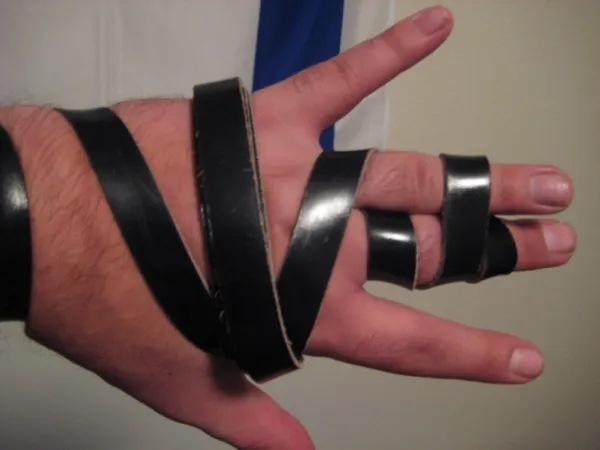
Putting on tefillin follows a specific sequence, and many Jewish men learn the process in the weeks leading up to their bar mitzvah:
Step 1: The Arm (Shel Yad)
The arm tefillin is placed first. The box is positioned on the inner bicep of the weaker arm — the left arm for right-handed people, the right for left-handed — so that when the arm is bent, the box faces the heart. A blessing is recited:
“Blessed are You, Lord our God, King of the Universe, who has sanctified us with His commandments and commanded us to put on tefillin.”
The strap is then wound seven times around the forearm, between the elbow and the wrist. The remaining strap is temporarily wrapped around the palm.
Step 2: The Head (Shel Rosh)
The head tefillin is placed at the hairline (or where the hairline once was), centered above the space between the eyes. It must not sit too low on the forehead or too far back on the head. A second blessing is recited:
“Blessed are You, Lord our God, King of the Universe, who has sanctified us with His commandments and commanded us concerning the mitzvah of tefillin.”
The straps of the head tefillin hang down over the chest, one on each side.
Step 3: The Finger Wrapping
Finally, the remaining strap of the arm tefillin is unwound from the palm and wrapped three times around the middle finger — once around the middle section, once around the lower section, and once more around the middle. As the strap is wound, many recite the verses from Hosea: “I will betroth you to Me forever; I will betroth you to Me in righteousness, justice, kindness, and mercy; I will betroth you to Me in faithfulness, and you shall know the Lord.” The strap forms the shape of the Hebrew letter shin on the back of the hand.
The worshipper then recites the Shema and continues with the morning prayer service.
When and Who
Tefillin are worn during weekday morning prayers (Shacharit) only. They are not worn on Shabbat or on most Jewish holidays (Yom Tov), because these days are themselves called an “ot” (sign) of the covenant between God and Israel — and wearing an additional sign would be redundant. The practice regarding Chol HaMoed (intermediate days of festivals) varies: Ashkenazi Jews in many communities do wear tefillin on Chol HaMoed, while Sephardi Jews and Hasidic Jews do not.
Traditionally, the obligation to wear tefillin begins at age 13 for boys — the age of bar mitzvah — when a young man takes on the full responsibilities of Jewish law. Many boys begin practicing a month or so before their bar mitzvah, learning the wrapping under the guidance of a father, rabbi, or tutor.
In Orthodox communities, tefillin are worn exclusively by men. In Conservative Judaism, women are increasingly encouraged to wear tefillin, and many do. Reform Judaism likewise welcomes women who choose to take on this practice, though it is not considered obligatory for anyone. The sight of women wearing tefillin, once rare, has become more common in egalitarian prayer spaces and has prompted meaningful conversations about access, obligation, and devotion.
The Making of Tefillin
Crafting a pair of tefillin is an extraordinarily painstaking process — one that can take several months from start to finish.
The batim (boxes) are made from a single piece of thick leather taken from the hide of a kosher animal, typically a cow. The leather is soaked, shaped over a mold, and pressed into a perfectly square form. The head tefillin requires the leather to be shaped into four distinct compartments from a single piece — a feat of craftsmanship that demands considerable skill. The boxes are then painted jet black with special ink.
The retzuot (straps) are also cut from kosher animal hide and must be dyed black on the outer side. They are long — the arm strap can be several feet in length to allow for all the wrappings.
The parchments are handwritten by a sofer who has trained for years in the laws of sacred writing. The scribe must immerse in a mikveh (ritual bath) before beginning, must write with conscious intention, and must not write from memory but copy from a verified text. A complete set of tefillin parchments can take weeks to write.
Every element is then assembled, stitched closed with sinew from a kosher animal (not thread), and inspected. The finished product is a sacred object whose every detail — from the squareness of the boxes to the blackness of the straps to the perfection of every letter — is governed by Jewish law.
Spiritual Meaning
The placement of tefillin is rich with symbolism. The arm tefillin is positioned near the heart, representing emotional devotion and the commitment of one’s desires and feelings to God’s service. The head tefillin sits near the brain, representing intellectual devotion — the dedication of one’s thoughts, reason, and understanding.
Together, tefillin bind the Jew to God’s word through both heart and mind. The act of wrapping is itself a kind of meditation — a daily, physical reminder that one’s thoughts and passions should be directed toward holiness. The straps encircle the arm and fingers like a ring, evoking the imagery of betrothal: the worshipper is, in a sense, renewing their bond with God each morning.
The Talmud speaks of tefillin in exalted terms. It teaches that God, too, “wears tefillin” — and that while Israel’s tefillin contain verses declaring God’s oneness, God’s tefillin contain verses declaring Israel’s uniqueness among the nations. This poetic image captures the mutual devotion at the heart of the relationship.
Across Communities
While the basic practice of tefillin is universal across Jewish communities, there are notable differences between traditions:
Ashkenazi Practice
Most Ashkenazi Jews follow the opinion of Rashi (Rabbi Shlomo Yitzchaki, 11th century) regarding the order of the parchments inside the head tefillin. The kippah is worn beneath the head tefillin. Some especially pious individuals also put on a second pair of tefillin according to the opinion of Rabbeinu Tam (Rashi’s grandson), who held that the parchments should be arranged in a different order.
Sephardi Practice
Sephardi Jews also follow Rashi’s order as the primary practice, but customs around the wrapping of the arm strap differ. Sephardi Jews typically wind the strap clockwise (when looking down at the arm), while many Ashkenazi Jews wind counterclockwise. The knot on the back of the head tefillin may also be shaped differently — a dalet in Ashkenazi practice versus a different formation in some Sephardi communities.
Hasidic Practice
Hasidic Jews follow the custom of wearing Rabbeinu Tam tefillin in addition to Rashi tefillin during the morning service. The Chabad-Lubavitch movement, in particular, has made tefillin outreach a signature practice — setting up “tefillin stands” in public places and inviting Jewish men who might not otherwise have the opportunity to put on tefillin.
Yemenite Practice
Yemenite Jews have distinctive customs regarding tefillin, including unique wrapping patterns and the use of specific types of leather. Their tallit and tefillin practices are among the oldest continuously maintained traditions in the Jewish world, reflecting customs that may predate the Ashkenazi-Sephardi split.
Bound to Something Eternal
Tefillin are not easy. They require time, knowledge, and discipline. They leave marks on the skin — faint red lines on the arm from the strap, an impression on the forehead from the box. But for those who wear them, these marks are not a burden. They are a reminder, carried on the body, that the day has been consecrated — that before the rush of the world began, you stood quietly, wrapped yourself in leather and parchment, and turned your heart and mind toward something beyond yourself.
Frequently Asked Questions
What is inside tefillin?
Each tefillin box contains four passages from the Torah, handwritten on parchment by a trained scribe (sofer). The passages are from Exodus 13:1-10, Exodus 13:11-16, Deuteronomy 6:4-9 (the Shema), and Deuteronomy 11:13-21.
Who wears tefillin?
Traditionally, Jewish males aged 13 and older wear tefillin during weekday morning prayers. In Conservative and Reform communities, women may also wear tefillin. They are not worn on Shabbat or most Jewish holidays.
How do you put on tefillin?
The arm tefillin (shel yad) is placed on the weaker arm (left for right-handed people), with the box on the inner bicep facing the heart. The strap is wound seven times around the forearm. The head tefillin (shel rosh) is placed at the hairline, centered above the forehead.
Test Your Knowledge
Think you know this topic? Try our quiz!
Take the Jewish Clothing & Symbols Quiz →Sources & Further Reading
Related Articles
The Kippah: Covering the Head Before God
The small cap worn by Jewish men is one of the most recognizable symbols of Judaism — but its meaning runs deeper than you might think.
Jewish Prayer: Connecting with the Divine
From the three daily prayer services to personal meditation, discover how Jewish prayer works and what it means.
The Shema: Judaism's Most Essential Prayer
Six Hebrew words — 'Hear, O Israel, the Lord our God, the Lord is One' — form the bedrock of Jewish faith, recited morning and evening, in joy and on the deathbed.
The Tallit: The Jewish Prayer Shawl
Wrapped in fringes and meaning — the tallit is both a garment of prayer and a symbol of divine commandments.