Leviathan in Jewish Tradition: Sea Monster, Symbol, and Messianic Feast
A colossal sea creature from the depths of biblical poetry — Leviathan embodies primordial chaos, divine power, and the promise that at the end of days, the righteous will feast on its flesh.
The Monster in the Deep
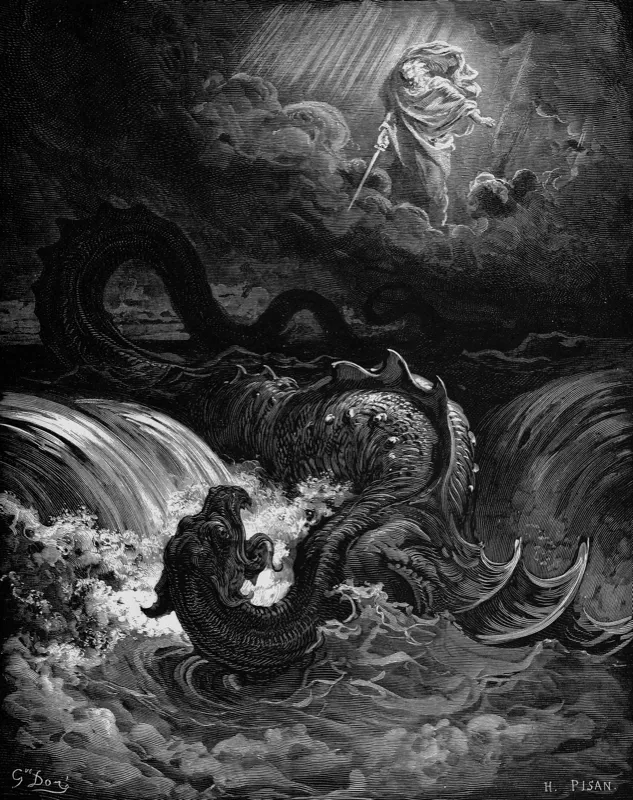
There is something in the water. The Hebrew Bible knows it. The Talmud describes it. The Midrash elaborates on it with evident fascination. It is Leviathan — Livyatan — a sea creature of incomprehensible size and power, fire-breathing, scale-armored, and utterly untameable by any force except God’s own hand.
Leviathan is not a minor figure in Jewish tradition. It appears in some of the most powerful poetry in the Tanakh, dominates one of the longest divine speeches in all of scripture (God’s answer to Job), and features prominently in the Talmud’s vision of the world to come. It is simultaneously a creature, a symbol, and a theological argument — and its story stretches from the first moment of creation to the last day of history.
The Biblical Leviathan
Leviathan appears in several biblical books, each revealing a different facet of this extraordinary creature.
Job: God’s Unanswerable Argument
The most extensive biblical description comes in Job 40–41, where God, speaking from the whirlwind, challenges Job to consider Leviathan as proof of divine power and human limitation:
“Can you draw out Leviathan with a fishhook, or press down its tongue with a cord? Can you put a rope in its nose, or pierce its jaw with a hook?… Who can open the doors of its face? Around its teeth is terror. Its sneezes flash forth light, and its eyes are like the eyelids of the dawn. From its mouth go flaming torches; sparks of fire leap forth. Out of its nostrils comes smoke, as from a boiling pot… On earth it has no equal — a creature without fear” (Job 41:1-33).
The point of God’s Leviathan speech is not zoological. It is theological. God is telling Job: you cannot even handle a sea creature — how dare you question the governance of the universe? Leviathan embodies everything that is beyond human control, beyond human understanding, beyond human scale. It is the ultimate argument from power.
Psalms: God’s Plaything
In Psalm 74, Leviathan appears in the context of creation mythology: “You crushed the heads of Leviathan; You gave him as food to the creatures of the wilderness” (Psalm 74:14). Here, Leviathan represents the primordial forces of chaos that God defeated to create the ordered world.

Psalm 104 offers a strikingly different mood: “There is the sea, great and wide… and Leviathan, which You formed to play with” (Psalm 104:25-26). Here, the fearsome monster is reduced to a divine toy — God’s playmate in the cosmic ocean. The image is almost whimsical: the creator of the universe, playing with a sea monster like a child with a rubber duck.
Isaiah: Eschatological Destruction
In Isaiah 27:1, Leviathan takes on eschatological significance: “On that day, the Lord will punish with His great, cruel, mighty sword Leviathan the fleeing serpent, Leviathan the twisting serpent; and He will slay the dragon that is in the sea.” This places Leviathan’s destruction at the end of days — connecting the primordial chaos monster to the messianic finale.
Talmudic Elaborations
The rabbis of the Talmud took the biblical Leviathan and elaborated with characteristic inventiveness and delight.
The Two Leviathans
Bava Batra 74b teaches that God originally created two Leviathans — one male and one female. But God realized that if they mated and reproduced, their offspring would destroy the world. So God killed the female Leviathan and preserved her flesh in salt — storing it for the great banquet of the righteous in the messianic era. The male Leviathan continues to live in the ocean, alone.
This detail is both practical (how else would there be enough Leviathan meat for the feast?) and poignant. The most powerful creature in creation is solitary — its mate destroyed for the sake of the world’s survival.
God Plays with Leviathan
The Talmud (Avodah Zarah 3b) divides God’s daily activities into four three-hour segments. During one of these segments, God plays with Leviathan. The image is extraordinary: the creator of the universe engaging in recreation with a sea monster. Some commentators understand this literally; others see it as a metaphor for God’s engagement with the hidden, chaotic dimensions of creation.
Size and Power
Rabbinic descriptions of Leviathan’s size are deliberately hyperbolic:
- Its eyes are so bright they illuminate the deep ocean
- When it is hungry, it exhales and makes all the waters of the deep boil
- Its fins radiate such intense light that the sun itself is dimmed
- The smell of its breath would kill any creature that inhaled it
- Only God can approach it
The Messianic Banquet
The most famous Leviathan tradition is the Se’udat Livyatan — the messianic banquet. In the world to come, God will slaughter Leviathan and prepare a feast for the righteous. The feast will also include Behemoth (the great land animal) and Ziz (the enormous bird) — a surf-and-turf-and-sky banquet of cosmic proportions.
The Talmud adds remarkable details:
- Leviathan’s skin will be used to construct a sukkah (booth) for the righteous to sit in during the feast
- The remaining skin will be spread over Jerusalem, and its brilliance will illuminate the entire world
- The meat of Leviathan is unlike any earthly food — it represents the ultimate spiritual nourishment, the taste of the World to Come
The messianic banquet tradition has been depicted in Jewish art for centuries. Medieval Haggadot (Passover prayer books) and manuscript illuminations frequently show Leviathan and Behemoth facing each other — or being served at a great table. The image appeared on synagogue decorations, amulets, and ceremonial objects.
Leviathan as Symbol
Beyond its literal role as a sea creature, Leviathan functions as a powerful symbol in Jewish thought.
Chaos conquered: Leviathan represents the primordial forces of disorder that God subdued during creation. The ordered world exists because God contained Leviathan — implying that chaos is always present beneath the surface, held in check by divine power. This is not a comfortable theology. It suggests that creation is not a finished product but an ongoing act of containment.
The limits of human power: God’s challenge to Job — “Can you draw out Leviathan with a fishhook?” — establishes a clear hierarchy. There are forces in the universe that no human technology, strength, or wisdom can control. Only God can handle Leviathan. Humility follows from this recognition.
The promise of redemption: Leviathan’s eschatological destruction (Isaiah 27:1) and its transformation into a feast (Talmud) represent the ultimate triumph of order over chaos, good over evil, meaning over absurdity. The messianic banquet is not just a meal — it is the final proof that chaos was never the last word.
Play and delight: God playing with Leviathan suggests that even the fearsome and chaotic have a place in God’s creation — not as enemies to be grimly opposed but as creatures to be engaged with, perhaps even enjoyed. The universe is not only serious. Even God plays.
A Monster Worth Knowing
Leviathan is one of Judaism’s most vivid and enduring images. It swims through the pages of Job and Psalms, coils through the Talmud’s eschatological visions, and surfaces in medieval art and modern imagination. It is terrifying and fascinating, ancient and ever-present.
For a tradition that so often emphasizes law, ethics, and rational argumentation, Leviathan is a reminder that Judaism also contains the wild, the mythic, and the untameable. There are sea monsters in the depths of Jewish thought — beautiful, frightening, and waiting for the feast at the end of days.
The hook is too small. The creature is too large. And somewhere in the deep, Leviathan waits.
Frequently Asked Questions
What is Leviathan in Jewish tradition?
Leviathan (Livyatan) is a massive sea creature described in several books of the Hebrew Bible — most extensively in Job 40-41, where God describes it as a fearsome, fire-breathing beast that no human can conquer. In Jewish tradition, Leviathan represents primordial chaos — the raw, untamed forces of the deep that God conquered during creation. The Talmud and Midrash elaborate extensively on Leviathan's size, power, and ultimate destiny: at the messianic banquet, the righteous will feast on Leviathan's flesh, and its skin will be fashioned into a sukkah (booth).
What is the messianic banquet of Leviathan?
The Talmud (Bava Batra 75a) teaches that in the messianic era, God will prepare a great feast for the righteous. The main course will be Leviathan (the sea creature), accompanied by Behemoth (a massive land animal) and Ziz (a giant bird). This banquet is understood both literally and allegorically — representing the ultimate reward for righteousness and the final triumph over chaos. The tradition adds that Leviathan's skin will be used to construct a sukkah (booth) for the righteous, and its remaining skin will illuminate all of Jerusalem.
Why did God create Leviathan?
The Talmud (Avodah Zarah 3b) offers a remarkable answer: God created Leviathan 'to play with' — 'There is Leviathan, whom You formed to play with' (Psalm 104:26). According to this tradition, God spends a quarter of each day playing with Leviathan. This playful image suggests that even the most fearsome forces of chaos exist within God's domain and serve God's purposes — including divine delight. Another midrash teaches that God originally created two Leviathans (male and female) but killed the female, preserving her meat for the messianic banquet, because their offspring would have destroyed the world.
Sources & Further Reading
Related Articles
The Book of Job: Suffering, Faith, and the Whirlwind
The Book of Job — the Bible's most searing exploration of suffering — tells of a righteous man who loses everything, rejects easy answers, and encounters God in the whirlwind.
The Messiah in Judaism: Anointed King, Not Divine Savior
The Jewish Messiah is a human king from the line of David who will bring peace, rebuild the Temple, and gather the exiles — not a divine being who saves souls. The concept has inspired hope, spawned false claimants, and evolved across denominations.
The Tanakh: A Complete Guide to the Hebrew Bible
The Tanakh — Torah, Nevi'im, and Ketuvim — is the foundational scripture of Judaism, containing 24 books of law, prophecy, and wisdom. Learn how it was formed and how it differs from the Christian Old Testament.