Key Kabbalistic Concepts: A Guide to Jewish Mystical Ideas
A clear guide to the core ideas of Kabbalah — Ein Sof, tzimtzum, the sefirot, shevirat hakelim, tikkun, the four worlds, and devekut — explained for the curious beginner.
Mapping the Invisible
Kabbalah is the mystical tradition of Judaism — a centuries-old attempt to understand the hidden structure of reality, the nature of God, and the purpose of the human soul. Unlike Jewish law, which tells you what to do, Kabbalah tries to explain why — why the world exists, why evil exists, why your actions matter on a cosmic level.
The concepts can feel abstract at first, even alien. But at their core, they address questions every human being has asked: How did something come from nothing? Why is the world broken? Can it be repaired? And what role do I play?
This guide walks through the key ideas, building from the most fundamental to the most practical.
Ein Sof: The Infinite
Everything in Kabbalah begins with Ein Sof — a Hebrew phrase meaning “without end” or “the Infinite.” Ein Sof is God as God truly is: infinite, formless, beyond all categories, beyond all language, beyond even the concept of “being.”
The Kabbalists insisted that Ein Sof is utterly unknowable. You cannot describe it, because any description would limit it. You cannot say “God is good” about Ein Sof, because that would imply God could also be “not good.” Ein Sof is beyond good and evil, beyond existence and non-existence. It is the ultimate mystery.
This raises an obvious problem: if God is infinite and unknowable, how does anything else exist? How do finite, limited beings like us emerge from a reality that has no edges, no boundaries, no “other”? The Kabbalists’ answer is one of the most extraordinary ideas in the history of religious thought.
Tzimtzum: The Divine Contraction
Rabbi Isaac Luria (1534–1572), known as the Ari, proposed a radical idea: before creation, Ein Sof filled everything. There was no “space” for a world. So God performed an act of tzimtzum — contraction or withdrawal. God pulled back, creating a void — a “vacated space” (chalal hapanui) — within which the finite world could emerge.
Think about what this means. The first act of creation was not an act of expansion but an act of restraint. God made room. God stepped back so that something other than God could exist. Some thinkers have compared this to a parent who restrains their own power so a child can grow and learn independently.
Into the vacated space, God sent a ray of divine light — a thin beam called the kav. This light was the raw material of creation. But it was too powerful for the vessels that were meant to contain it.
Shevirat HaKelim: The Shattering of the Vessels
The divine light was channeled into ten vessels (kelim), corresponding to the ten sefirot. The upper three vessels — Keter, Chokhmah, and Binah — received the light without incident. But the lower seven vessels could not contain the intensity of the light. They shattered.
This catastrophe is called shevirat hakelim — the shattering of the vessels. The broken shards fell downward, and sparks of divine light became trapped within them. These fallen shards became the raw material of the physical world, and the trapped sparks became hidden points of holiness scattered throughout all of creation.
The shattering explains, for the Kabbalists, why the world is broken. Evil, suffering, and imperfection are not God’s intention but the result of a cosmic accident — or perhaps a necessary stage in a larger process. The sparks of divinity are everywhere, but they are concealed, waiting to be found and released.
The Sefirot: The Tree of Life
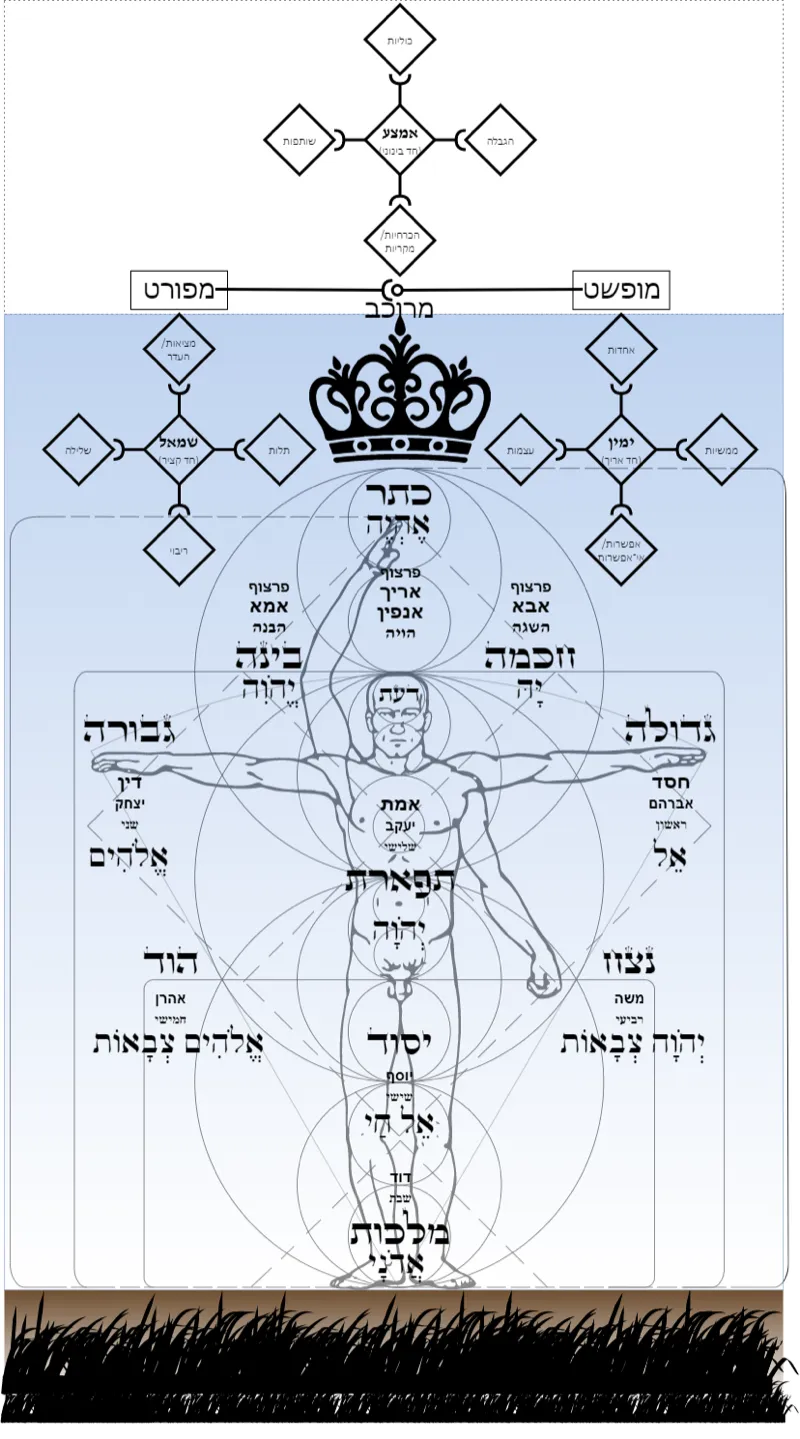
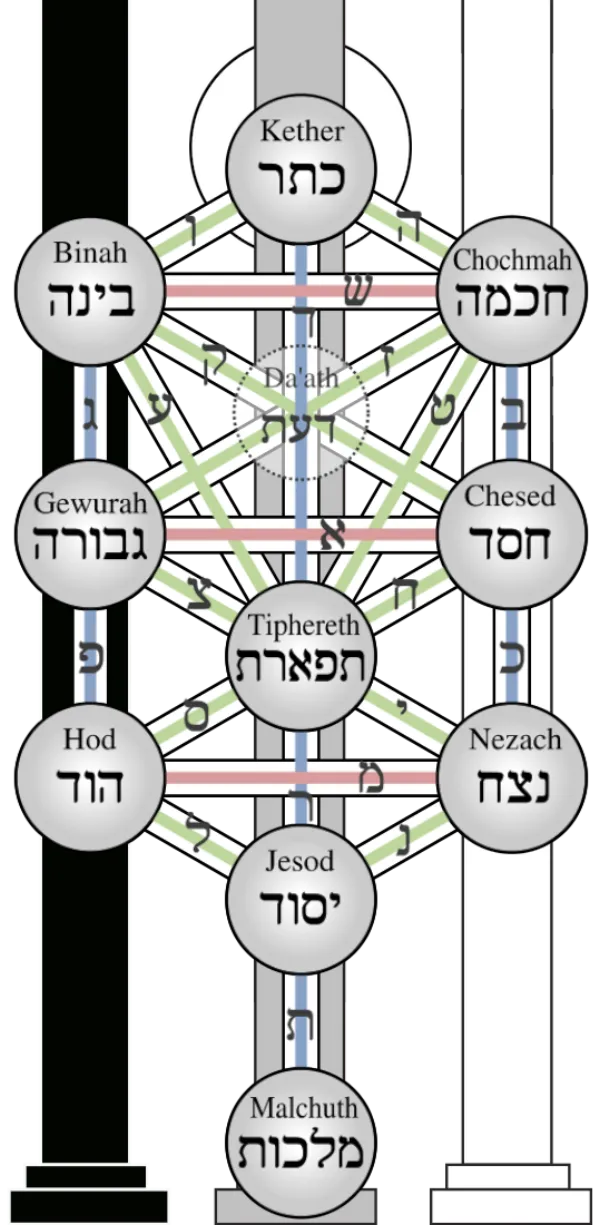
The ten sefirot are the primary framework of Kabbalistic thought. They are divine attributes — qualities through which Ein Sof expresses itself and interacts with the world. Arranged in a diagram called the Etz Chaim (Tree of Life), they form three columns:
Right Column (Mercy):
- Chokhmah (Wisdom) — the initial flash of insight, the seed of an idea
- Chesed (Loving-kindness) — unbounded generosity, love without limit
- Netzach (Victory/Eternity) — endurance, perseverance, ambition
Left Column (Judgment):
- Binah (Understanding) — the capacity to develop and analyze an idea
- Gevurah (Strength/Judgment) — discipline, boundaries, the ability to say no
- Hod (Splendor) — humility, gratitude, acknowledgment
Central Column (Balance):
- Keter (Crown) — the highest, most hidden sefirah, the divine will
- Tiferet (Beauty) — the harmonious balance of mercy and judgment
- Yesod (Foundation) — the channel through which all divine energy flows into the world
- Malkhut (Sovereignty) — the sefirah closest to our experience, the divine presence (Shekhinah) in the world
The sefirot are not separate gods — that would be heresy. They are aspects of the one God, like colors refracted through a prism. And they exist not only in God but in the human soul. When you practice kindness, you activate Chesed within yourself. When you set boundaries, you activate Gevurah. The spiritual life, in Kabbalah, is the process of bringing all ten sefirot into balance.
The Four Worlds
Kabbalah describes reality as consisting of four nested worlds, each progressively more dense and material:
- Atzilut (Emanation) — the world of pure divinity, where the sefirot exist in their most pristine form. No separation from God exists here.
- Beriah (Creation) — the world of the divine throne, of archangels and cosmic structures. The first hint of “otherness” appears.
- Yetzirah (Formation) — the world of angels and spiritual forces. Most of what we call “the spiritual realm” exists here.
- Asiyah (Action) — the physical world, the world of matter and daily experience. This is where we live.
Each world contains its own version of the ten sefirot, creating a fractal-like structure of nested reality. When you pray, the Kabbalists say, your words ascend through all four worlds, gathering power as they rise.
Tikkun: Repairing the World
If the shattering of the vessels scattered divine sparks throughout creation, then the purpose of human life is tikkun — repair. Every time you perform a mitzvah, every time you act with kindness, every time you study Torah or pray with intention (kavanah), you release a trapped spark and return it to its source.
This idea transformed Jewish practice. Suddenly, every action — even the most mundane — had cosmic significance. Eating a piece of bread with a blessing didn’t just fulfill a commandment; it liberated a spark of holiness trapped within the wheat. Helping a stranger wasn’t just ethical; it was an act of cosmic repair.
The concept of tikkun olam — repairing the world — which has become central to modern Jewish social justice movements, has its roots in this Kabbalistic vision. The phrase originally referred not to political activism but to the mystical work of gathering sparks and healing the shattered vessels.
Devekut: Cleaving to God
The ultimate goal of Kabbalistic practice is devekut — “cleaving” or “attachment” to God. This is not merely intellectual knowledge of God but an experiential union — a state of consciousness in which the boundary between self and divine dissolves.
Devekut is achieved through intense prayer, meditation, ethical living, and the performance of mitzvot with full spiritual intention. The Hasidic movement, founded in the 18th century, made devekut central to Jewish life, teaching that every Jew — not just scholars — could achieve intimate connection with God through joy, prayer, and mindful attention to the present moment.
Why These Ideas Matter
Kabbalistic concepts can seem impossibly abstract — infinite light, shattered vessels, nested worlds. But beneath the metaphysics lies a profoundly human message: the world is broken, and you can help fix it. Every act of goodness matters. Every moment of awareness counts. You are not a passive observer of creation — you are an active participant in its redemption.
Whether you take these ideas literally as descriptions of cosmic reality, or metaphorically as a poetic framework for understanding the human condition, the Kabbalistic vision offers something rare: a theology in which imperfection is not a scandal but a call to action, and in which every human being — regardless of learning or status — plays an essential role in the healing of the world.
Frequently Asked Questions
What is Ein Sof in Kabbalah?
Ein Sof (literally 'without end') is the Kabbalistic term for God's infinite, unknowable essence — God as God truly is, before any act of creation or self-revelation. Ein Sof is beyond all description, beyond all attributes, beyond even the word 'God.' It is the ultimate mystery from which everything emerges.
What are the sefirot?
The sefirot are ten divine attributes or emanations through which Ein Sof interacts with the world. Arranged in the Tree of Life, they range from Keter (Crown) at the top to Malkhut (Sovereignty) at the bottom. They represent qualities like wisdom, understanding, loving-kindness, strength, beauty, and foundation — and they exist both in God and in the human soul.
What does tikkun mean in Kabbalah?
Tikkun means 'repair' or 'rectification.' In Lurianic Kabbalah, it refers to the cosmic process of gathering the divine sparks scattered during the shattering of the vessels (shevirat hakelim) and restoring them to their proper place. Every mitzvah and ethical act contributes to this repair, making human beings active partners in healing creation.
Key Terms
Sources & Further Reading
Related Articles
Isaac Luria (The Ari): The Mystic Who Reimagined Creation
He lived only 38 years and wrote almost nothing. Yet Isaac Luria transformed Jewish mysticism so completely that his ideas — divine contraction, shattered vessels, cosmic repair — became the spiritual vocabulary of an entire people.
Kabbalah: An Introduction to Jewish Mysticism
Beyond the law and the stories lies a hidden dimension of Judaism — Kabbalah, the mystical tradition that seeks to understand the nature of God, creation, and the human soul.
The Zohar: Mystical Heart of Kabbalah
The Zohar — the 'Book of Radiance' — is the foundational text of Jewish mysticism. Attributed to an ancient sage but likely composed in medieval Spain, it reveals a hidden dimension of Torah that has captivated seekers for seven centuries.