Niggun: The Wordless Melodies of Hasidic Judaism
A niggun is a wordless melody — hummed, chanted, or sung — that lies at the heart of Hasidic spiritual practice. No lyrics, no instruments, just voices reaching for something words cannot touch.
Beyond Words
There is a moment in Hasidic gatherings — at a tish (rebbe’s table), at a farbrengen (informal gathering), at a Shabbat meal — when the talking stops and the singing begins. Not songs with words. Not prayers with texts. Just melody. Voices rising and falling together, repeating a simple phrase of notes again and again, building in intensity, in emotion, in something that the Hasidic masters would call devekut — clinging to God.
This is a niggun (plural: niggunim). It is one of the most distinctive and powerful expressions of Jewish spirituality — a wordless melody that bypasses the intellect and speaks directly to the soul.
What Is a Niggun?
A niggun is a melody without words. Some niggunim use syllables — “bim bam,” “dai dai dai,” “ya ba bai” — but these are sounds, not language. They have no semantic meaning. They exist only to carry the melody.
Niggunim range from simple (a four-note phrase repeated endlessly) to complex (multi-section compositions that unfold over ten or fifteen minutes). They can be joyful, mournful, contemplative, or ecstatic — sometimes all of these in a single piece, as the melody moves through different emotional registers.
The key features:
- No words. The melody is the message.
- Repetition. Niggunim are typically repeated many times, building intensity with each cycle.
- Communal singing. While a niggun can be hummed alone, its power is unleashed in a group — voices layering, harmonizing, pushing each other higher.
- Spiritual purpose. A niggun is not entertainment. It is a form of prayer, meditation, and spiritual ascent.
The Baal Shem Tov and the Birth of the Niggun
The niggun tradition is rooted in the Hasidic movement founded by Rabbi Israel ben Eliezer — the Baal Shem Tov (Master of the Good Name) — in 18th-century Ukraine. The Baal Shem Tov revolutionized Jewish spiritual life by teaching that God could be reached not only through Talmudic study but through joy, prayer, nature, and — crucially — music.
He taught that melody has the power to open gates that study alone cannot. A story is told: a simple, uneducated man came to the Baal Shem Tov, distraught that he could not pray or study like the scholars. The Baal Shem Tov told him to sing. The man’s wordless melody, offered with sincerity, was worth more in heaven than the most learned discourse.
This was radical. In a world where Jewish achievement was measured primarily by scholarship, the Baal Shem Tov declared that a heartfelt tune from an illiterate farmer could pierce the heavens. The niggun became the great equalizer — anyone could sing, anyone could connect.
Each Court, Its Own Song
As the Hasidic movement grew and split into various courts (dynasties), each developed its own musical identity:
Chabad (Lubavitch)
Chabad has one of the largest and most documented collections of niggunim — over 300 melodies associated with the seven Chabad rebbes. Chabad niggunim are often contemplative and complex, reflecting the movement’s intellectual-mystical orientation. The “Niggun of Four Stanzas” (attributed to the Alter Rebbe, the founder of Chabad) moves through four emotional stages: yearning, struggle, joy, and transcendence. It is considered one of the most important niggunim in the tradition.
Breslov
The followers of Rabbi Nachman of Breslov are known for their passionate, joyful singing. The melody associated with “Azamra” (I will sing) reflects Nachman’s teaching that one should always find the good point and sing. Breslov niggunim tend to be uplifting and accessible.
Modzitz
The Modzitz dynasty is legendary for its musical sophistication. Its rebbes were genuine composers who created multi-movement works of remarkable complexity. The “Ezkerah” (I will remember) niggun composed by the first Modzitzer Rebbe is an extended, emotionally devastating melody that he reportedly composed while undergoing leg surgery without anesthesia. It is one of the longest and most complex niggunim in existence.
Karlin-Stolin
Known for intense, forceful singing — almost shouting. Karlin niggunim are loud, passionate, and physically overwhelming. The energy in a Karlin synagogue during prayer has been described as volcanic.
Vizhnitz
Melodious, warm, and accessible. Vizhnitz niggunim are among the most widely known outside Hasidic communities and have influenced mainstream Jewish music.
How Niggunim Work
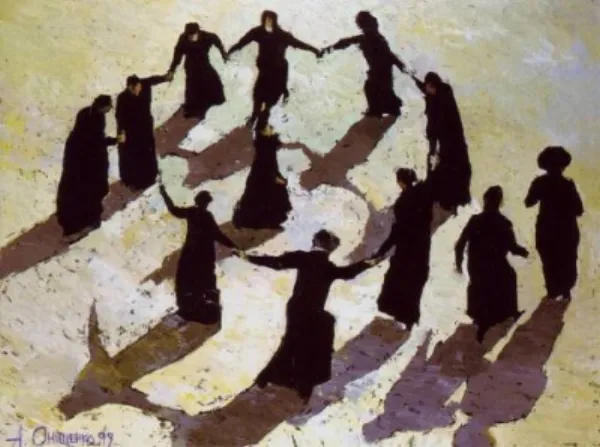
A niggun typically unfolds in stages:
- A single voice begins. Quiet, tentative. The melody is introduced.
- Others join. The melody grows as more voices enter. Harmonies emerge — sometimes planned, sometimes spontaneous.
- Repetition builds intensity. The same phrase is sung again and again. With each repetition, the energy increases — louder, faster, more fervent.
- The peak. At some point, the niggun breaks through into something transcendent. People are clapping, swaying, sometimes dancing, sometimes weeping. The room vibrates.
- The descent. Gradually, the melody softens, slows, and fades. There is silence — a different kind of silence than before, charged and full.
This structure mirrors the Hasidic understanding of spiritual ascent: you begin in the ordinary, you climb through effort and repetition, you touch something beyond yourself, and you return — changed.
The Healing Power of Niggun
Hasidic tradition attributes healing properties to niggunim:
- Emotional healing: Singing a niggun can access and release emotions that are too deep or too painful for words. The wordless melody gives permission to feel without having to articulate.
- Community bonding: Singing together creates a physical synchrony — breathing together, vibrating together — that strengthens social bonds and reduces isolation.
- Meditative focus: The repetitive structure of a niggun functions similarly to a mantra, calming the mind and focusing attention.
- Joy as therapy: Rabbi Nachman of Breslov taught that depression is the greatest spiritual obstacle, and joy — achieved through song and dance — is its antidote.
Modern music therapy research supports some of these claims: group singing reduces cortisol levels, increases oxytocin, and activates brain regions associated with reward and social bonding.
The Modern Niggun Revival
In recent decades, niggunim have traveled far beyond Hasidic communities:
- Jewish Renewal movement: Rabbis like Shlomo Carlebach (who composed hundreds of beloved melodies, many niggun-like) brought Hasidic musical energy into mainstream Jewish life.
- Jewish summer camps: Many popular camp songs are niggunim or niggun-inspired melodies.
- Meditation retreats: Jewish meditation teachers use niggunim as a contemplative practice, bridging Hasidic and Buddhist-influenced approaches.
- Recordings: Albums of Hasidic niggunim are widely available, from archival field recordings to contemporary arrangements.
- Non-Jewish audiences: The sheer beauty and emotional power of niggunim have attracted listeners and musicians from many traditions.
Summing Up
A niggun is the sound of a soul reaching beyond itself. It requires no literacy, no learning, no special status — just a voice and a willingness to be open. In a tradition that values words enormously — the Torah is words, the Talmud is words, prayer is words — the niggun stands as a reminder that some truths live beyond language. You do not need to be Hasidic to feel it. You just need to listen, and then to sing.
Frequently Asked Questions
Why are niggunim wordless?
The Hasidic masters taught that words are vessels — useful but limited. The deepest emotions and the highest spiritual states cannot be captured in language. A niggun bypasses the intellect entirely and speaks directly from soul to soul. The Baal Shem Tov said: 'When words fail, the melody continues.' A niggun can express joy that no word contains, sorrow that no language can hold, and yearning that exists beyond articulation.
Does every Hasidic group have its own niggunim?
Yes. Each Hasidic court (dynasty) has signature niggunim associated with its founding rebbe or spiritual tradition. Chabad has an extensive collection of niggunim composed by or associated with its rebbes. Breslov is known for 'Azamra' and melodies tied to Rabbi Nachman's teachings. Modzitz Hasidism is famous for its musical sophistication, with rebbes who composed complex, multi-part compositions. The niggun is a form of spiritual identity — hearing one can immediately tell you which community is singing.
Can non-Hasidic Jews sing niggunim?
Absolutely. Niggunim have spread far beyond Hasidic communities. They are sung at Jewish summer camps, at Reform and Conservative Shabbat services, at Jewish retreats and meditation gatherings, and in living rooms around the world. Some of the most popular niggunim — like 'Bim Bam' or the Chabad 'Nigun Simcha' — have become part of mainstream Jewish musical culture. No special knowledge is required. You hear the melody, you join in.
Sources & Further Reading
Related Articles
Hasidic Dress: Tradition in Every Thread
The distinctive black and white attire of Hasidic Jews carries centuries of meaning — each garment tells a story of piety, community, and identity.
Jewish Music Through the Ages: From Temple Songs to Modern Melodies
Journey through 3,000 years of Jewish music — from ancient Temple melodies to klezmer, Ladino songs, and contemporary fusion genres.
Klezmer: The Soul Music of Eastern European Jews
From shtetl weddings to world stages — klezmer is the joyful, weeping, irresistible music of the Jewish soul.
The Synagogue: House of Prayer, Study, and Assembly
More than just a place of worship — the synagogue is the heart of Jewish community life, combining prayer, learning, and social gathering under one roof.