10 Most Beautiful Synagogues in the World
From Budapest's massive Dohány Street to India's tiny Paradesi synagogue, these ten houses of worship showcase the astonishing diversity of Jewish architectural expression across the globe.

Sacred Spaces, Extraordinary Places
A synagogue can be anything from a rented storefront to an architectural masterpiece. Judaism does not require grandeur for worship — ten Jews and a Torah scroll are sufficient. But when Jewish communities have had the resources, the security, and the vision to build, they have created some of the most breathtaking sacred spaces on earth.
What makes synagogue architecture fascinating is its diversity. Unlike a cathedral or a mosque, there is no single architectural template for a synagogue. Jewish communities have built in whatever style surrounded them — Moorish, Gothic, Baroque, Romanesque, Art Nouveau, Brutalist — while incorporating the essential elements of Jewish worship: an ark for the Torah scrolls, a bimah (raised platform) for reading, and seating oriented toward Jerusalem.
Here are ten synagogues that demonstrate the extraordinary range of Jewish architectural expression.
1. Dohány Street Synagogue — Budapest, Hungary
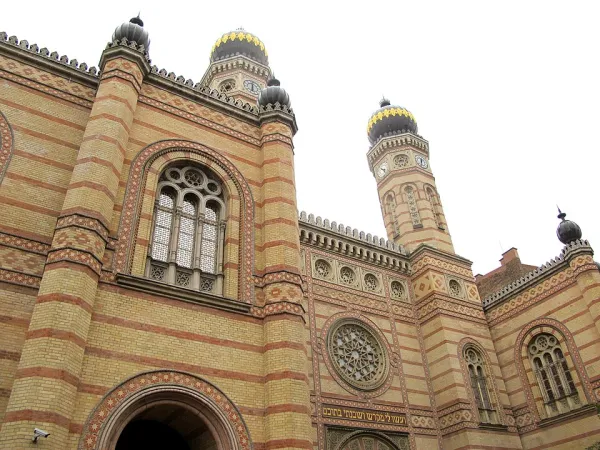
The Dohány Street Synagogue (also called the Great Synagogue) hits you like a revelation. Built between 1854 and 1859 by the Viennese architect Ludwig Förster, it is the largest synagogue in Europe — a massive Moorish Revival structure with twin onion-domed towers that rise above the Budapest streetscape like something transported from an Arabian Nights illustration.

The interior seats approximately 3,000 and features gilded columns, painted ceilings, and a rose window that filters light across the vast nave. The building is part of a larger complex that includes the Raoul Wallenberg Memorial Park, with a weeping willow sculpture by Imre Varga — each leaf inscribed with the name of a Hungarian Jewish Holocaust victim — and the Hungarian Jewish Museum.
The synagogue was severely damaged during World War II, when Budapest’s Jews were confined to the ghetto that surrounded it. Its restoration, completed in the 1990s with support from the Emanuel Foundation (funded partly by actor Tony Curtis, born Bernard Schwartz to Hungarian Jewish parents), is one of the great preservation success stories in Jewish heritage.
2. Touro Synagogue — Newport, Rhode Island, USA
The Touro Synagogue, dedicated in 1763, is the oldest surviving synagogue building in the United States and a National Historic Landmark. Designed by Peter Harrison, the leading architect of colonial America, it is a masterpiece of Georgian architecture — elegant, restrained, and deceptively simple.
From the outside, it looks like any well-built colonial meeting house. Inside, the surprise: twelve columns support the gallery (one for each tribe of Israel), the layout follows the Sephardic tradition of the congregation’s founders (Jews of Spanish and Portuguese descent), and a trapdoor in the floor may have been used to hide people — possibly enslaved individuals seeking freedom, possibly Jewish ritual objects, depending on which historian you ask.
The Touro Synagogue is perhaps best known for the letter George Washington wrote to its congregation in 1790, promising that the new American government would give “to bigotry no sanction, to persecution no assistance” — one of the earliest and most eloquent statements of religious freedom in American history.
3. Old-New Synagogue (Altneuschul) — Prague, Czech Republic
The Altneuschul has been in continuous use since approximately 1270, making it the oldest active synagogue in Europe. Built in the early Gothic style with its distinctive brick gables and steep roof, it sits in the heart of Prague’s former Jewish quarter like a stone sentinel guarding the community’s past.
The interior is austere and powerful — a double-nave layout with ribbed vaulting and a central bimah enclosed by a wrought-iron grille. The famous flag of Prague’s Jewish community, granted by the Habsburg Emperor Charles IV in the 14th century, hangs from the ceiling.
Legend has it that the attic of the Altneuschul houses the remains of the Golem — the clay creature supposedly brought to life by Rabbi Judah Loew (the Maharal of Prague) in the 16th century to protect the Jewish community from persecution. No one has checked recently.
4. Hurva Synagogue — Jerusalem, Israel
The Hurva (“ruin” in Hebrew) has one of the most dramatic histories of any synagogue. First built in 1700 by followers of Rabbi Judah HeHasid, it was destroyed by creditors in 1721 when the community couldn’t pay its debts. Rebuilt in 1864 as a grand Neo-Byzantine structure that dominated the Old City skyline, it was destroyed again by the Jordanian Arab Legion in 1948 during Israel’s War of Independence.
For decades, a single memorial arch marked the spot. Then, in 2010, the synagogue was rebuilt — a faithful recreation of the 19th-century building, with its soaring dome visible from across Jerusalem. Standing in its rebuilt interior, you feel the weight of its name: a place that was destroyed, and destroyed again, and still came back.
5. Central Synagogue — New York City, USA
Central Synagogue on Lexington Avenue is one of the oldest continuously used synagogues in New York City, built in 1870-1872 in a stunning Moorish Revival style by Henry Fernbach (himself the first known Jewish architect in America). Its twin octagonal towers, polychromatic stonework, and horseshoe arches make it one of the most recognizable buildings on the Manhattan skyline.
After a devastating fire in 1998, the synagogue was meticulously restored — its painted ceilings, elaborate stenciling, and gilded details brought back to their original splendor. The restoration won multiple preservation awards and demonstrated what a committed community can accomplish.
6. Paradesi Synagogue — Kochi, India
The Paradesi Synagogue in Kochi (Cochin), Kerala, was built in 1568 by the Paradesi (“foreign”) Jewish community — Sephardic Jews who arrived in India following the expulsion from Spain. It is the oldest active synagogue in the Commonwealth of Nations.
The synagogue is famous for its floor — covered with hundreds of hand-painted Chinese willow-pattern tiles, each one unique, imported from Canton in the 18th century. The clock tower above the entrance has dials showing the time in three scripts: Hebrew, Malayalam, and Roman. Inside, Belgian chandeliers hang above a congregation that has dwindled to a handful of members — but the synagogue remains, luminous and lovely, in the spice-trading quarter of old Kochi.
7. El Ghriba Synagogue — Djerba, Tunisia
El Ghriba on the island of Djerba is one of the oldest synagogues in the world, with traditions dating it back to the 6th century BCE — according to local legend, fleeing priests from the destroyed First Temple brought a door and a stone from the Temple itself.
The current building, reconstructed in the 19th century, features stunning blue-and-white tilework, arched colonnades, and a peaceful courtyard. El Ghriba hosts an annual pilgrimage that draws Jewish visitors from across the world — a living connection to one of Africa’s oldest Jewish communities.
8. Subotica Synagogue — Subotica, Serbia
The synagogue of Subotica (built 1901-1902) is a masterpiece of Hungarian Art Nouveau (Secessionist) architecture. Designed by Marcell Komor and Dezső Jakab, it features flowing organic forms, vibrant ceramics, and stained glass windows that transform the interior into a kaleidoscope of color.
After decades of neglect following the Holocaust’s devastation of Subotica’s Jewish community, the synagogue has been meticulously restored and now serves as both a house of worship and a cultural center — a testament to the community that built it and the broader effort to preserve European Jewish heritage.
9. Great Synagogue of Florence — Florence, Italy
The Tempio Maggiore (Great Synagogue) of Florence, completed in 1882, is visible across the city thanks to its enormous green copper dome — deliberately designed to stand alongside the great domes of Florence’s churches and assert the Jewish community’s presence in the Renaissance city.
The interior is a riot of Moorish Revival decoration: elaborate frescoes, gilded arabesques, and mosaics that reflect the Sephardic heritage of the community that built it. The synagogue survived World War II — the retreating German army mined it for destruction, but Italian partisans defused the charges just in time.
10. Eldridge Street Synagogue — New York City, USA
The Eldridge Street Synagogue on the Lower East Side, built in 1887, was the first great synagogue built by Eastern European Jews in America. Its Moorish-Gothic-Romanesque facade — an exuberant architectural cocktail — proclaimed the arrival of a community that intended to stay.
By the mid-20th century, the neighborhood had changed and the congregation had shrunk. The building deteriorated for decades until a massive 20-year restoration, completed in 2007, brought it back to glory. The crowning touch: a spectacular contemporary stained glass window by artist Kiki Smith and architect Deborah Gans, installed in a rose window opening that had been boarded up for decades. Old and new, memory and hope, glowing together in colored light.
What These Buildings Tell Us
These ten synagogues span six centuries, four continents, and a dozen architectural styles. They range from the austere Gothic of Prague to the exuberant Art Nouveau of Subotica, from the colonial restraint of Newport to the Moorish fantasy of Budapest. What unites them is not style but intention: each one is a community’s statement about who they are, where they belong, and what they believe is beautiful.
A synagogue is not just a building. It is an argument — in stone, glass, and light — for the endurance of the community that built it.
Frequently Asked Questions
What is the largest synagogue in the world?
The Dohány Street Synagogue in Budapest, Hungary, is the largest synagogue in Europe and the second-largest in the world (after the Belz Great Synagogue in Jerusalem). Built in 1854-1859 in Moorish Revival style, it can seat approximately 3,000 worshippers and is one of Budapest's most visited landmarks.
What is the oldest synagogue still in use?
The Old-New Synagogue (Altneuschul) in Prague, Czech Republic, has been in continuous use since approximately 1270, making it the oldest active synagogue in Europe. The Paradesi Synagogue in Kochi, India (1568), is the oldest active synagogue in the Commonwealth of Nations.
Can non-Jews visit synagogues?
Most historic synagogues welcome visitors of all faiths, particularly outside of service times. Many operate as museums or cultural centers with regular visiting hours. During services, visitors are usually welcome but should dress modestly, and men may be asked to wear a kippah (head covering). It's best to check visiting hours and any dress code requirements in advance.
Sources & Further Reading
Related Articles
Famous Synagogues Around the World: Architecture, History, and Spirit
From the soaring Dohány Street Synagogue in Budapest to the intimate Paradesi Synagogue in India, the world's great synagogues tell the story of Jewish diaspora, survival, and artistic expression in stone, wood, and stained glass.
Jewish Architecture: How Synagogues Reflect Faith Across the Ages
From ancient mosaics in the Galilee to the rebuilt Hurva in Jerusalem, Jewish architecture tells the story of a people who built sacred spaces in every land — adapting, innovating, and always facing Jerusalem.
The Synagogue: House of Prayer, Study, and Assembly
More than just a place of worship — the synagogue is the heart of Jewish community life, combining prayer, learning, and social gathering under one roof.