Russian and Soviet Jewish History: From the Pale to Freedom
The epic story of Russian and Soviet Jewry — from the Pale of Settlement and pogroms through Soviet suppression, the refusenik movement, and mass emigration to Israel and America.
Five Million Souls
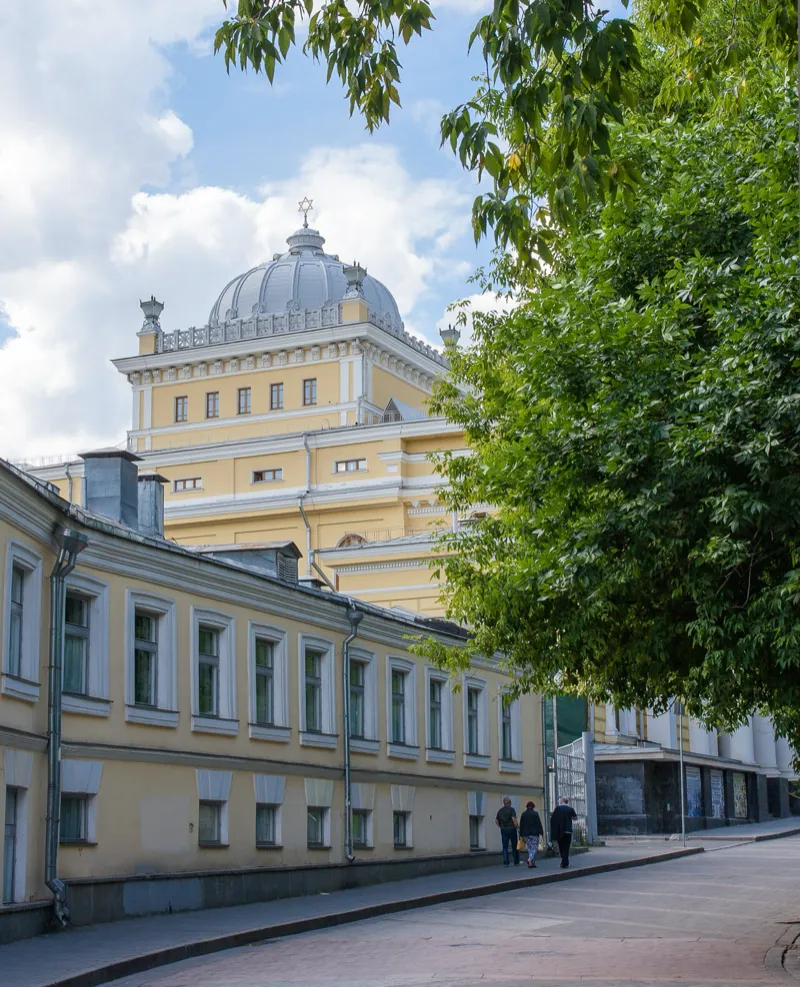
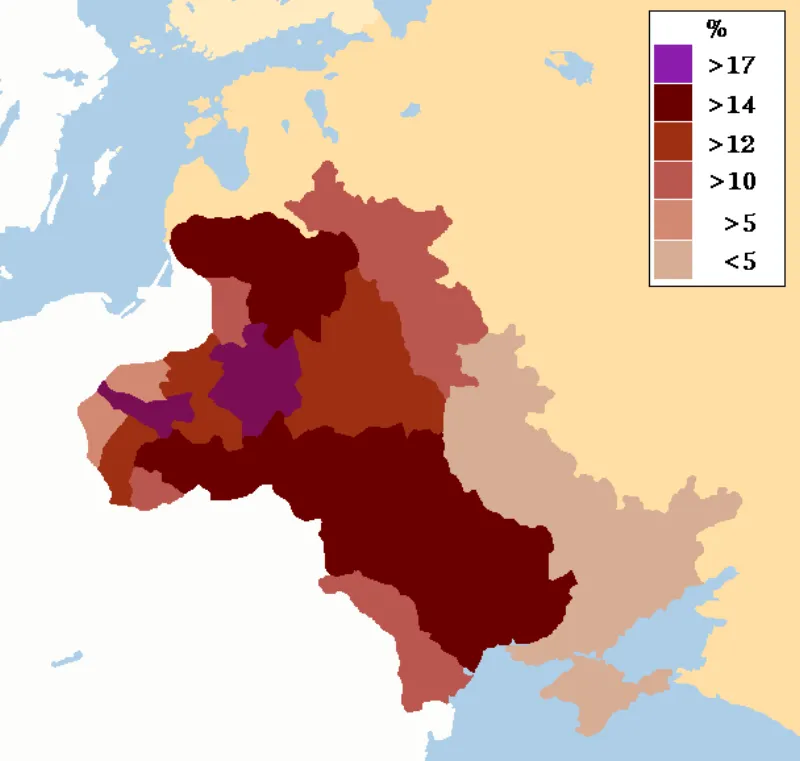
At the beginning of the 20th century, more than five million Jews lived in the Russian Empire — the largest Jewish community in the world by far. They were concentrated in a vast swath of territory stretching from the Baltic Sea to the Black Sea, a region the government had designated as the only place Jews were permitted to live. Within these borders, they built a civilization: shtetls and cities, yeshivot and theaters, synagogues and socialist cells, a literary culture in Yiddish and Hebrew that produced some of the greatest writers of the modern era.
Within a hundred years, this world would be almost entirely destroyed — first by pogroms, then by revolution, then by the Holocaust, then by Soviet suppression. The survivors and their descendants scattered across the globe, carrying with them the traditions, traumas, and talents of Russian Jewry. Their story is one of the most consequential chapters in all of Jewish diaspora history.
The Pale of Settlement
In 1791, Catherine the Great established the Pale of Settlement — a geographic boundary beyond which Jews could not reside without special permission. The Pale encompassed the territories Russia had acquired through the partitions of Poland, along with parts of Ukraine, Belarus, Lithuania, and Moldova.
The Pale was not a ghetto in the medieval sense — it was enormous, covering roughly 472,000 square miles. But it was a cage. Jews could not freely move to Moscow, St. Petersburg, or the Russian interior. Within the Pale, they faced further restrictions on where they could live (often barred from rural areas) and what professions they could practice.
Despite these constraints, Jewish life within the Pale was extraordinarily vibrant. Great yeshivot (Talmudic academies) in Volozhin, Mir, and Telz produced generations of scholars. The Hasidic movement, founded in Ukraine in the 18th century, transformed Jewish spirituality. Yiddish literature flourished — Sholem Aleichem’s stories of Tevye the Dairyman, set in a Pale shtetl, would later inspire Fiddler on the Roof.
But poverty was grinding. Most Jews in the Pale were poor — small traders, artisans, innkeepers. The May Laws of 1882, enacted after the pogroms, made conditions worse by expelling Jews from rural areas within the Pale, concentrating them in overcrowded towns and cities.
The Pogroms
The word pogrom comes from the Russian for “devastation,” and it became synonymous with anti-Jewish violence worldwide.
The Wave of 1881-1884
When Tsar Alexander II was assassinated in 1881, rumors spread — largely false — that Jews were responsible. Waves of violence erupted across southern Russia and Ukraine. Mobs attacked Jewish neighborhoods, looting, burning, beating, and killing. The government response was negligent at best and complicit at worst. The May Laws of 1882, rather than protecting Jews, imposed new restrictions — blaming the victims for the violence against them.
Kishinev, 1903
The Kishinev pogrom of April 1903 shocked the world. Over three days, mobs killed 49 Jews, injured hundreds, and destroyed over 1,500 homes. The local police stood by. International condemnation was intense — Theodore Roosevelt received a petition with over 12,000 signatures — but the Russian government barely responded.
The Hebrew poet Chaim Nachman Bialik traveled to Kishinev to document the aftermath. His poem “In the City of Slaughter” became one of the most powerful works in modern Hebrew literature — not only condemning the attackers but also, controversially, the Jewish men who hid while their families were assaulted.
The Consequences
The pogroms of 1881-1921 transformed Jewish history. They triggered the greatest mass migration in Jewish experience: between 1880 and 1924, roughly two million Jews left the Russian Empire. Most went to America, fundamentally transforming American Jewish life. Smaller numbers went to Palestine, South America, South Africa, and elsewhere.
The pogroms also radicalized Jewish political life. Some Jews embraced Zionism — if Europe would not accept them, they needed their own state. Others joined socialist and revolutionary movements — if the existing order produced pogroms, the order must be overthrown. The Jewish Bund, founded in Vilna in 1897, combined socialism with Jewish cultural autonomy, demanding “a better world for all, and Jewish rights within it.”
Revolution and Soviet Rule
The Russian Revolution of 1917 initially seemed like liberation. The Bolsheviks abolished the Pale of Settlement, ended official antisemitism, and granted Jews full legal equality for the first time in Russian history. Many Jews enthusiastically supported the revolution — not because of any “Jewish conspiracy” (an antisemitic canard) but because the old regime had oppressed them brutally.
The reality proved far more complicated. The Russian Civil War (1918-1921) brought the worst anti-Jewish violence since the medieval period. White Army forces, Ukrainian nationalists, and various warlords massacred Jews across Ukraine and Belarus. An estimated 50,000-200,000 Jews were killed in these pogroms — a catastrophe overshadowed by the later Holocaust.
Under Soviet rule, Jewish life was systematically dismantled — not through pogroms but through ideological suppression:
- Religion was attacked as “opium of the people.” Synagogues were closed, rabbis arrested, Hebrew study banned.
- Jewish institutions — schools, publishers, theaters — were shut down or forced to operate within strictly controlled Communist frameworks.
- The Yevsektsiya (Jewish Section of the Communist Party) — staffed ironically by Jews — enforced anti-religious policies against their own community.
- Yiddish was tolerated as a “proletarian” language, but Hebrew was banned as “Zionist” and “bourgeois.”
Stalin and the Dark Years
Under Stalin, Soviet antisemitism reached terrifying levels. During the Great Purge (1936-1938), Jewish communists were disproportionately targeted. In 1948, Stalin launched a campaign against “rootless cosmopolitans” — a transparent code for Jews. The Jewish Anti-Fascist Committee, which had rallied international support for the Soviet war effort, was dissolved and its members murdered.
The Doctors’ Plot of 1953 — a fabricated accusation that Jewish doctors were planning to poison Soviet leaders — seemed to herald a mass deportation of Soviet Jews to Siberia. Only Stalin’s death in March 1953 prevented what might have been a Soviet-style Final Solution.
The Refusenik Movement
By the 1960s, Soviet Jews existed in a paradox: they were denied the right to practice Judaism but were still identified as Jews on their internal passports, subjecting them to discrimination. They could neither be fully Soviet nor fully Jewish.
The Six-Day War of 1967 awakened something dormant. Soviet Jews — many of them thoroughly secularized — felt a sudden, unexpected pride in Israel’s victory. Underground Hebrew classes multiplied. Applications to emigrate surged. And the Soviet government responded by creating a new category of citizen: the refusenik.
Refuseniks were Soviet Jews who applied for exit visas and were refused. The act of applying typically meant losing one’s job, being expelled from university, and coming under KGB surveillance. Prominent refuseniks like Natan (Anatoly) Sharansky, Ida Nudel, and Yosef Begun became international symbols of the struggle for human rights.
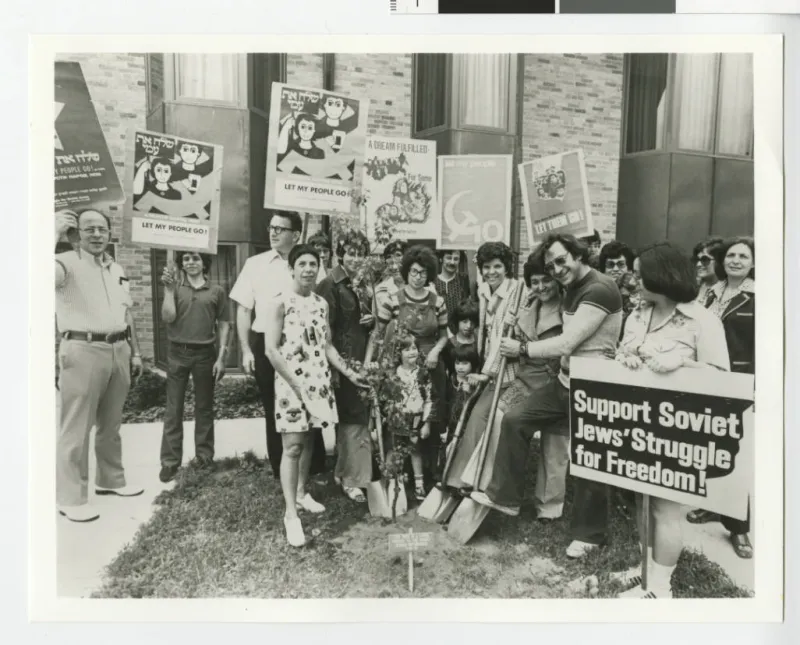
The Western Jewish community rallied to their cause. The rallying cry “Let my people go” — echoing Moses’s demand to Pharaoh — became the slogan of the Soviet Jewry movement. American Jews organized demonstrations, letter-writing campaigns, and political lobbying on a massive scale.
In 1974, the United States passed the Jackson-Vanik Amendment, linking Soviet trade benefits to freedom of emigration. It was one of the most effective uses of economic pressure for human rights in Cold War history.
The Great Exodus
When the Soviet Union began to crumble in the late 1980s, the gates finally opened. Between 1989 and 2000, approximately one million Jews left the former Soviet Union. The largest number — roughly 800,000 — went to Israel, transforming the country’s demographics, economy, and culture almost overnight.
Soviet immigrants brought exceptional levels of education — engineers, scientists, doctors, musicians, chess masters. They also brought challenges: many had minimal Jewish knowledge after decades of suppression, and their integration into Israeli society was not always smooth. The Russian-speaking community in Israel remains culturally distinct, with its own media, political parties, and social networks.
Others went to America, Germany, and elsewhere, adding new chapters to the ongoing story of the Jewish diaspora.
Legacy
Russian and Soviet Jewry’s story encompasses the extremes of Jewish experience: extraordinary cultural creativity, devastating persecution, ideological upheaval, heroic resistance, and mass migration. The Yiddish civilization of the Pale produced literature, music, humor, and religious thought that continue to shape Jewish life worldwide. The Soviet suppression created a generation of Jews who had to rediscover their own identity. The refusenik movement demonstrated that even the most powerful state cannot permanently extinguish a people’s desire for freedom.
“I am a Jew because the faith of Israel demands of me no abdication of the mind.” — Natan Sharansky
Today, the communities that Russian and Soviet Jews built — in Israel, America, Germany, and beyond — are among the most dynamic in the Jewish world. The shtetl is gone. The Pale is a historical memory. But the creativity, resilience, and stubborn refusal to disappear that characterized Russian Jewry lives on in their descendants.
Frequently Asked Questions
What was the Pale of Settlement?
The Pale of Settlement was the designated region in the western Russian Empire where Jews were permitted to live, established by Catherine the Great in 1791. It encompassed parts of modern-day Lithuania, Belarus, Ukraine, Moldova, Poland, and western Russia. At its peak, roughly five million Jews lived within the Pale, making up the largest Jewish community in the world. Jews needed special permission to live outside the Pale.
What were the Russian pogroms?
Pogroms (from the Russian word for 'devastation') were organized waves of anti-Jewish violence in the Russian Empire. Major waves occurred in 1881-1884 (following the assassination of Tsar Alexander II), 1903-1906 (including the notorious Kishinev pogrom), and 1918-1921 (during the Russian Civil War, when an estimated 50,000-200,000 Jews were killed). The pogroms triggered massive Jewish emigration.
Who were the refuseniks?
Refuseniks were Soviet Jews who were denied permission to emigrate, primarily to Israel, from the 1960s through the 1980s. After applying to leave, they were typically fired from their jobs, expelled from universities, and subjected to surveillance and harassment. Prominent refuseniks like Natan Sharansky became international symbols of the struggle for human rights. The movement helped end Soviet restrictions on emigration.
Sources & Further Reading
- YIVO Encyclopedia — Russian Empire ↗
- Jewish Virtual Library — Russian Jewry ↗
- My Jewish Learning — Soviet Jews ↗
- Benjamin Nathans, Beyond the Pale
Related Articles
The Jewish Diaspora: 2,000 Years Across the Globe
How the destruction of the Second Temple scattered the Jewish people across continents, creating diverse communities united by faith.
Life in the Shtetl: Eastern European Jewish Towns
For centuries, millions of Jews lived in small towns across Eastern Europe — communities rich in tradition, learning, and culture that shaped modern Jewish identity.
Zionism: The Movement That Built a Nation
Zionism — the movement for Jewish self-determination in the ancestral homeland — transformed from a radical 19th-century idea into the founding ideology of the State of Israel.