Mountain Jews of the Caucasus: Warriors, Survivors, Storytellers
In the mountains of Azerbaijan and Dagestan, a Jewish warrior community has preserved its identity for over a millennium — speaking Judeo-Tat, defending its villages, and defying every stereotype of diaspora vulnerability.
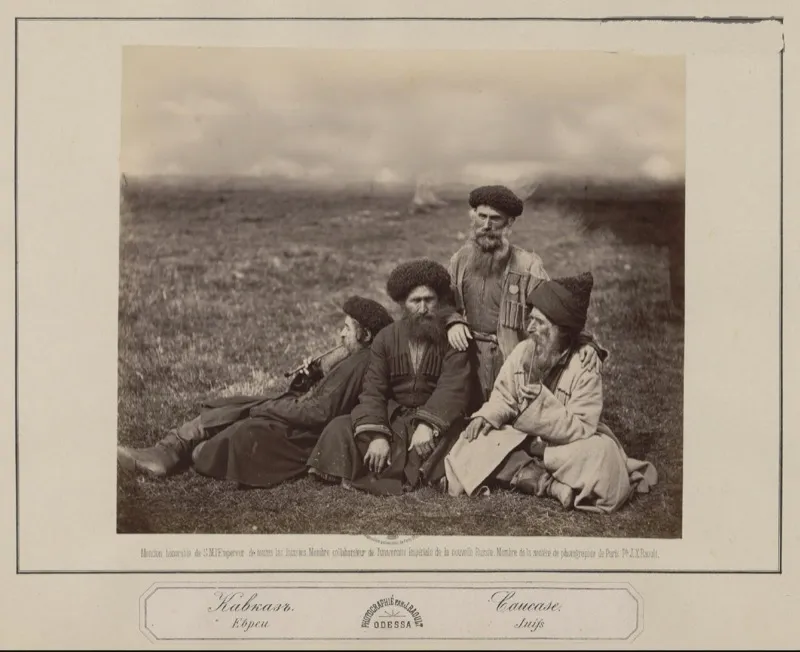
Jews with Daggers
In the popular imagination, diaspora Jews are scholars and merchants — people of the book, not the sword. The Mountain Jews of the Caucasus shatter that image completely. For over a millennium, in the rugged mountains of what is now Azerbaijan and Dagestan, a Jewish community lived that was as fierce as the terrain itself. Mountain Jewish men carried daggers. They rode horses. They maintained blood feuds. They defended their villages against bandits and invaders with the same tenacity their Caucasian neighbors did.
And they were unmistakably, devoutly, stubbornly Jewish.
The Mountain Jews — known as Juhuro in their own language — represent one of the most unusual chapters in the long story of the Jewish diaspora. Their existence challenges assumptions, complicates narratives, and reminds us that Jewish identity has taken as many forms as there are places where Jews have lived.
Origins in Persia
The Mountain Jews trace their ancestry to the Jewish communities of Persia (Iran). The exact timing and circumstances of their migration to the Caucasus are debated, but most scholars believe the move occurred during the Sasanian Persian Empire (224–651 CE), possibly earlier. Persian Jews had been living in the region since the Babylonian exile, and as the Persian Empire expanded into the Caucasus, Jewish communities followed — or were relocated as part of imperial population policies.
The earliest clear evidence of Jewish settlement in the eastern Caucasus dates to the 5th or 6th century CE, though the community claims much greater antiquity. What is certain is that by the time Arab armies arrived in the 7th century, Jewish communities were well established in the mountainous regions of present-day Azerbaijan and Dagestan.
Judeo-Tat: A Language Apart
The Mountain Jews speak Judeo-Tat (also called Juhuri), a Jewish dialect of the Tat language — which is itself an Iranian language related to Persian. Like other Jewish languages, Judeo-Tat incorporates Hebrew and Aramaic vocabulary, uses Hebrew script in its traditional written form, and serves as a marker of communal identity distinct from the surrounding population.
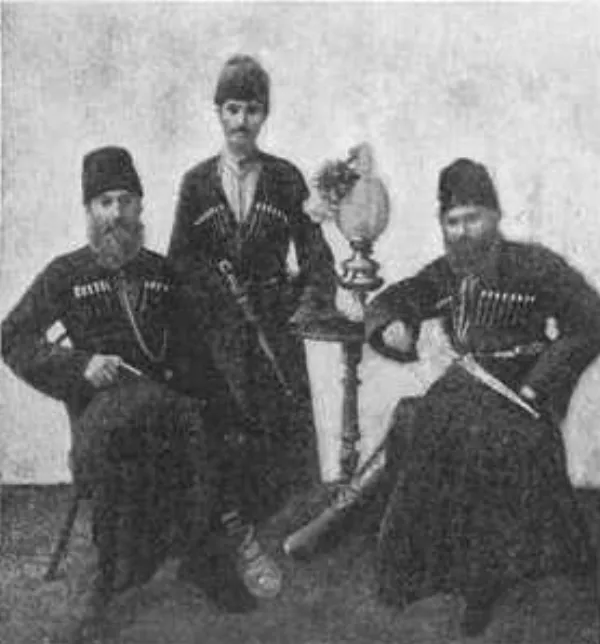
Judeo-Tat is part of the same linguistic family that produced Bukhori (Judeo-Tajik) and Judeo-Persian, reflecting the shared Persian roots of these communities. But centuries of isolation in the Caucasus gave Judeo-Tat its own character, incorporating loanwords from Azerbaijani, Arabic, Turkish, and Russian.
Today, Judeo-Tat is classified as an endangered language. Most younger Mountain Jews in Israel speak Hebrew, and those in Russia or Azerbaijan increasingly use Russian or Azerbaijani. Efforts to preserve the language through literature, music recordings, and educational programs are ongoing, but the clock is ticking.
The Warrior Tradition
What set the Mountain Jews apart from nearly every other diaspora community was their warrior culture. The Caucasus has always been a region where survival depends on the ability to fight. Surrounded by warlike tribal societies — Lezgins, Avars, Chechens, and others — the Mountain Jews adapted or perished.
Mountain Jewish men carried the kinzhal (Caucasian dagger) and were trained in its use. They practiced horsemanship. They participated in the adat — the Caucasian code of honor that governed relations between clans and communities. Blood feuds existed among Mountain Jews just as they did among their Muslim neighbors. Young men proved their worth through physical courage, and the community’s survival often depended on its ability to mount an armed defense of its villages.
This martial culture was not a departure from Jewish identity but an adaptation of it. Mountain Jews maintained their religious practices — Shabbat observance, kashrut, circumcision, synagogue worship — while simultaneously living as Caucasian mountain people. They saw no contradiction: being Jewish and being a warrior were both part of who they were.
Red Town: The Jewish Village
The most remarkable Mountain Jewish settlement is Qirmizi Qasaba — Red Town — located across the Gudial River from the city of Quba in northern Azerbaijan. Red Town is considered the only all-Jewish town outside of Israel and the United States.
The town’s name derives from the reddish rooftops of its buildings. At its peak, Red Town had a population of several thousand, all Jewish, with multiple synagogues, a mikveh, Jewish schools, and a vibrant communal life. The community was largely self-governing, with its own religious leaders and a social structure based on extended family clans (tukhum).
Red Town’s synagogues were distinctive — built in a style that blended Caucasian architectural traditions with Jewish liturgical requirements. The community’s religious practice was primarily Sephardic in orientation (reflecting their Persian origins), but with unique customs that reflected centuries of independent development.
Soviet Repression and Survival
The Soviet conquest of the Caucasus in the 1920s brought dramatic changes. Like Jewish communities throughout the Soviet Union, the Mountain Jews faced systematic suppression of religious life. Synagogues were closed. Religious leaders were arrested or killed. Hebrew education was banned. The community’s Judeo-Tat literary tradition was forcibly converted from Hebrew to Latin (later Cyrillic) script.
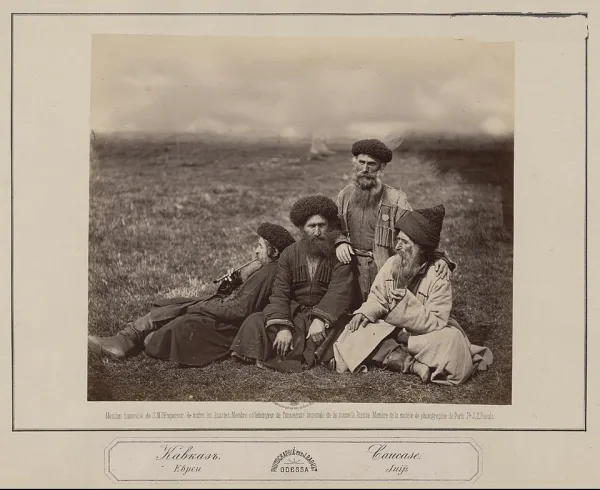
The Soviet regime also attempted to reclassify the Mountain Jews as “Tats” — stripping them of their Jewish identity by categorizing them as members of a non-Jewish ethnic group. Some Mountain Jews strategically accepted this classification to avoid antisemitic persecution, while others insisted on maintaining their Jewish identification on Soviet documents.
During World War II, the German advance into the Caucasus threatened the Mountain Jews with annihilation. German forces occupied parts of the region in 1942, and some Mountain Jews were indeed murdered. However, the rapid Soviet counteroffensive and the community’s location in remote mountain areas prevented the systematic genocide that destroyed European Jewry.
Throughout the Soviet era, Mountain Jews maintained their identity with remarkable tenacity. Circumcisions continued. Passover seders were held. Marriages followed traditional patterns. The warrior spirit that had sustained them for centuries proved equally effective against ideological persecution.
Emigration and Identity Today
The collapse of the Soviet Union in 1991 triggered massive emigration. Most Mountain Jews moved to Israel, where a community estimated at 100,000-150,000 now lives — concentrated in cities like Or Akiva, Hadera, and Be’er Sheva. A significant community also settled in Moscow, and smaller groups went to the United States (particularly New York) and Germany.
In Israel, Mountain Jews have navigated the complex terrain of Israeli identity politics. They are distinct from both Ashkenazi and Sephardi/Mizrachi Jews, and their Caucasian cultural background — with its emphasis on honor, clan loyalty, and martial values — sets them apart. Some have risen to prominence in Israeli society, particularly in business and sports (wrestling and martial arts, unsurprisingly, have produced notable Mountain Jewish athletes).
Red Town, meanwhile, persists. About 3,000 Mountain Jews still live there, though the community is aging and shrinking. The Azerbaijani government has invested in preserving the town’s heritage, recognizing it as a unique cultural asset. A Mountain Jewish museum was established, and several synagogues have been renovated.
Breaking the Mold
The Mountain Jews matter because they break the mold. They demonstrate that there is no single way to be Jewish — that Jewish identity can encompass scholars and warriors, merchants and horsemen, Talmudists and dagger-carriers. They lived in one of the most remote and dangerous regions on earth and maintained their identity not despite their environment but through creative engagement with it.
Their story is a rebuke to anyone who tries to reduce Jewish identity to a single template. The Judaism of the Mountain Jews is the same Torah, the same Shabbat, the same covenant — expressed through a cultural vocabulary that includes kinzhals and horsemanship alongside prayer shawls and Torah scrolls. It is Judaism wearing a different set of clothes — and carrying a very sharp knife.
Frequently Asked Questions
Who are the Mountain Jews?
The Mountain Jews (Juhuro) are a Jewish community from the eastern Caucasus region — primarily Azerbaijan and the Republic of Dagestan in southern Russia. They have lived in the region for at least 1,500 years, possibly longer, and are believed to descend from Persian Jewish communities that migrated to the Caucasus. They speak Judeo-Tat (Juhuri), a Jewish dialect of the Tat language (an Iranian language), and are known for their warrior tradition, clan-based social structure, and fierce independence.
What is Red Town (Quba) and why is it significant?
Red Town (Qirmizi Qasaba, also called 'the Jewish village') is a settlement across the river from the city of Quba in northern Azerbaijan. It is considered the only all-Jewish town outside of Israel and the United States, with a population that was historically entirely Jewish. Red Town has served as the spiritual and cultural center of Mountain Jewish life for centuries, with multiple synagogues, Jewish schools, and community institutions. Today it has about 3,000 residents and remains an active Mountain Jewish community.
What makes the Mountain Jews' warrior tradition unique?
Unlike many diaspora Jewish communities, Mountain Jews maintained a martial culture for centuries. Living in the remote, tribal Caucasus — where survival depended on the ability to defend one's village and family — Mountain Jewish men carried weapons, practiced horsemanship, and participated in the honor-based culture of their region. They fought alongside their Muslim neighbors against external invaders and maintained blood feuds. This warrior identity challenges the stereotype of Jews as a purely scholarly, non-martial people and reflects the profound impact of geography on Jewish cultural expression.
Sources & Further Reading
Related Articles
The Jewish Diaspora: 2,000 Years Across the Globe
How the destruction of the Second Temple scattered the Jewish people across continents, creating diverse communities united by faith.
Jewish Diversity: Race, Ethnicity, and the Many Faces of the Jewish People
From Ethiopian Beta Israel to Indian Bene Israel to Chinese Kaifeng Jews, the Jewish people span every continent and complexion — challenging assumptions about what a Jew looks like.
Russian and Soviet Jewish History: From the Pale to Freedom
The epic story of Russian and Soviet Jewry — from the Pale of Settlement and pogroms through Soviet suppression, the refusenik movement, and mass emigration to Israel and America.