Shabbat and Technology: Ancient Rest in a Digital World
Smartphones, smart homes, and the ancient commandment to rest — how Jewish law navigates the intersection of technology and Shabbat, from Shabbat-mode ovens to the KosherSwitch controversy to the unexpected gift of digital detox.
The Oldest Digital Detox
Every Friday evening, millions of observant Jews around the world do something that most people in the developed world find almost unimaginable: they turn off their phones. Not silence them. Not put them on “Do Not Disturb.” They power them down — or simply leave them untouched — for twenty-five hours. No texting, no scrolling, no emails, no social media, no streaming, no news alerts.
And increasingly, non-Orthodox Jews and even non-Jews are looking at this practice with something approaching envy.
Shabbat — the weekly day of rest commanded in the Torah — predates electricity by roughly three thousand years. The categories of prohibited work (melakhot) were defined when the most advanced technology was a weaving loom. And yet the principles behind those ancient categories have proven remarkably adaptable to the digital age, generating a fascinating intersection of religious law, engineering innovation, philosophical debate, and — unexpectedly — a compelling model for mental health in a hyperconnected world.
The Problem of Electricity
The Torah prohibits thirty-nine categories of creative work (melakhot) on Shabbat, derived from the labors used to construct the Tabernacle in the wilderness. These include kindling fire, building, writing, weaving, and others. When electricity arrived in the late 19th century, rabbinical authorities faced a new question: does using electricity violate any of these categories?
The debate has produced multiple opinions:
Fire (mav’ir): Early authorities compared incandescent bulbs — which heat a filament to glowing — to kindling a fire. This analogy works well for incandescent bulbs but less well for LEDs, which produce light without significant heat.
Building (boneh): Completing an electrical circuit creates something that did not exist before — a functioning system. Some authorities view this as a form of “building.”
Creating (molid): Some rabbis invoked the concept of molid — generating something new (in this case, a new electrical current or state).
Customary prohibition (minhag): Some authorities acknowledge that the exact halakhic basis is debated but argue that the universal Jewish acceptance of the prohibition gives it the force of law.
The practical result: mainstream Orthodox authorities prohibit operating electrical devices on Shabbat. Conservative Judaism permits electricity in general but maintains some restrictions. Reform Judaism leaves the decision to individual conscience.
Shabbat Mode: Engineering Meets Halakha
The tension between modern living and Shabbat observance has produced an entire field of halakhic engineering — designing technology that observant Jews can use without violating Shabbat.
Ovens and Stoves
The most common Shabbat-mode appliance is the oven. In standard operation, an oven’s thermostat turns the heating element on and off to maintain temperature. Opening the oven door lets heat escape, causing the thermostat to trigger the element — meaning the person who opened the door indirectly caused the fire to ignite.
In Shabbat mode, the oven overrides the thermostat, maintaining a constant low flame or heating element regardless of temperature fluctuations. Opening the door does not trigger any electrical change. The display is dimmed or turned off. Audible signals are disabled. The oven simply stays on at a set temperature until Shabbat ends.
Major appliance manufacturers — including GE, Samsung, KitchenAid, and Bosch — now include Shabbat mode as a standard feature on many models, developed in consultation with organizations like Star-K (a kosher certification agency).
Refrigerators
Modern refrigerators present multiple Shabbat challenges: the interior light turns on when the door opens; the compressor may activate due to temperature change; some models have electronic sensors, fans, and displays triggered by door opening.
Shabbat-mode refrigerators disable the light, modify compressor behavior, and deactivate sensors so that opening the door has no direct electrical consequences. Some observant Jews apply a simpler solution: taping down the light switch and using a timer for the compressor.
Shabbat Elevators
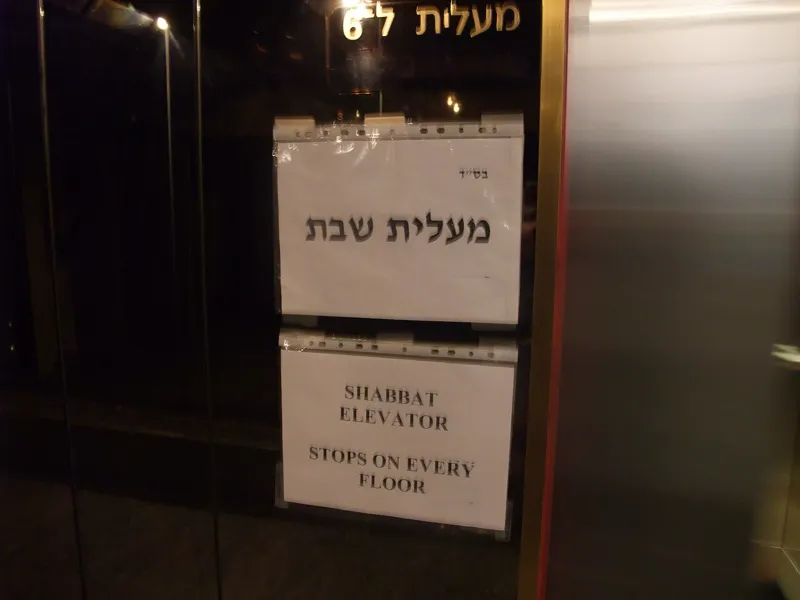
In buildings with many floors, Shabbat elevators run continuously on Shabbat, stopping at every floor automatically, with doors opening and closing on a timer. Passengers enter and exit without pressing any buttons. These are common in Israeli hospitals, hotels, and residential buildings with observant populations.
The halakhic permissibility of Shabbat elevators is debated — some authorities argue that the passenger’s weight affects the elevator’s motor, constituting indirect labor — but they are widely used in practice.
The Zomet Institute
The Zomet Institute in Alon Shvut, Israel, is the world’s leading center for developing Shabbat-compatible technology. Founded in 1977, Zomet employs engineers and rabbis who work together to create solutions for situations where technology use is necessary on Shabbat — particularly in security, medical, and military contexts.
Zomet’s innovations include:
- Shabbat phones for security personnel (modified to minimize halakhic violations)
- Medical devices adapted for Shabbat use in hospitals
- Military communication systems for the IDF
- Electrical wheelchairs for disabled individuals on Shabbat
- Automated systems for agricultural operations that cannot be paused
Zomet operates on the halakhic principle that pikuach nefesh (saving a life) overrides Shabbat — but even when Shabbat is overridden, the violation should be minimized to the extent possible. Their devices represent the minimum necessary deviation from Shabbat rest.
The KosherSwitch Controversy
In 2015, a product called the KosherSwitch ignited one of the most heated halakhic technology debates in recent memory. The device inserted a random time delay between a person flipping a switch and the electrical circuit being completed. The idea: since the person’s action did not directly and immediately cause the electrical change, the causal chain was broken, and the action was halakhically permissible.
The response from the rabbinical establishment was overwhelmingly negative. Major Orthodox authorities — including the Orthodox Union, the Rabbinical Council of America, and prominent individual poskim — rejected the KosherSwitch. Their objections were both technical (indirect causation is still rabbinically prohibited in most cases) and philosophical: the device undermined the entire spirit of Shabbat.
As one rabbi put it: “Shabbat is not a problem to be solved by engineering. It is a gift to be received.”
The controversy highlighted a fundamental question: when technology can technically circumvent halakhic restrictions, should it? Or does the circumvention itself violate something deeper than any specific prohibition — the quality of rest, disconnection, and presence that Shabbat is meant to create?
The Digital Detox Gift
Here is the irony that nobody anticipated: in the 21st century, the ancient Shabbat prohibition on technology has become one of Judaism’s most attractive features.
In an era of smartphone addiction, social media anxiety, information overload, and the documented mental health effects of constant connectivity, Shabbat offers what Silicon Valley wellness gurus charge thousands for: a structured, regular, complete digital detox.
Books like “24/6” by Tiffany Shlain and the “National Day of Unplugging” movement (founded by the Jewish organization Reboot) have brought the concept of technology Shabbat to mainstream audiences. The idea is simple: one day a week, put the screens away. Be present. Talk to people face-to-face. Read a physical book. Take a walk without documenting it. Eat a meal without photographing it.
What observant Jews have practiced for millennia — and what was often dismissed as archaic or restrictive — is now being rediscovered as profoundly healthy. The enforced disconnection of Shabbat creates space for conversation, reflection, prayer, rest, and the simple experience of being present without the constant pull of notification.
Not a Bug, a Feature
The most important thing to understand about Shabbat and technology is that the restriction is not a limitation imposed by an ancient text that didn’t anticipate iPhones. It is a principle — rest from creative manipulation of the world — that applies regardless of the specific technology.
The Torah did not prohibit smartphones. It prohibited melakha — purposeful, creative, world-changing work. In the 3rd century, that meant refraining from weaving and plowing. In the 21st century, it means refraining from sending emails and scrolling through feeds. The technology changes; the principle endures.
And the principle’s wisdom has never been more apparent. In a world that never stops pinging, buzzing, and demanding attention, Shabbat says: you can stop. For one day a week, you do not need to be available, productive, or connected. You are permitted — commanded, even — to simply be.
That is not an ancient restriction struggling to keep up with modernity. That is an ancient gift that modernity desperately needs.
Frequently Asked Questions
Why can't you use electricity on Shabbat?
The prohibition on electricity during Shabbat is not explicitly mentioned in the Torah (which predates electricity by millennia). Rabbinical authorities have offered various explanations for why it is prohibited: some compare completing an electrical circuit to 'building' (boneh); some compare it to 'kindling a fire' (mav'ir), especially with incandescent bulbs; others focus on the concept of 'creating' (molid) a new current. There is no single consensus on the exact reason, but the practical prohibition is nearly universally accepted in Orthodox practice. Conservative and Reform movements generally permit electricity use on Shabbat.
What is Shabbat mode on appliances?
Shabbat mode is a feature built into many modern appliances — particularly ovens, refrigerators, and dishwashers — that allows observant Jews to use them on Shabbat without violating Jewish law. In Shabbat mode, an oven maintains a constant temperature without the thermostat cycling on and off (which would involve the user indirectly causing ignition). Refrigerators disable the interior light and modify compressor behavior so that opening the door does not trigger electrical changes. These features are developed in consultation with rabbinical authorities and have become standard on many major appliance brands.
What is the KosherSwitch and why is it controversial?
The KosherSwitch is a device that introduces a random delay between flipping a switch and an electrical circuit being completed, so that the person's action does not directly cause the electrical change. Its inventors argued that this breaks the causal chain between the person and the prohibited action, making it permissible on Shabbat. Most major Orthodox rabbinical authorities rejected it, arguing that it undermines the spirit of Shabbat rest and that the indirect causation still constitutes a rabbinical prohibition. The controversy highlighted the tension between technological ingenuity and the fundamental purpose of Shabbat.
Sources & Further Reading
Related Articles
Responsa: How Jewish Law Evolves
When a rabbi faces a question the Talmud never imagined — electricity on Shabbat, organ donation, in vitro fertilization — the answer comes through responsa, Judaism's ancient and living system for applying eternal law to an ever-changing world.
Electricity on Shabbat: Why and How It's Prohibited
Why do observant Jews avoid electricity on Shabbat? The answer is more complex than you might think. Explore the halakhic debates — fire, building, completing a circuit — and the practical solutions like timers, Shabbat elevators, and Shabbat mode ovens.
Shabbat Laws: Understanding the 39 Melakhot
The 39 categories of work forbidden on Shabbat — the melakhot — are derived from the construction of the Tabernacle. Learn what they are, how they apply to modern life, and why different Jewish communities approach them differently.