Hedy Lamarr: The Most Beautiful Woman Who Invented Your WiFi
Hedy Lamarr was Hollywood's most glamorous star — and a self-taught inventor whose frequency-hopping technology became the basis for WiFi, Bluetooth, and GPS.
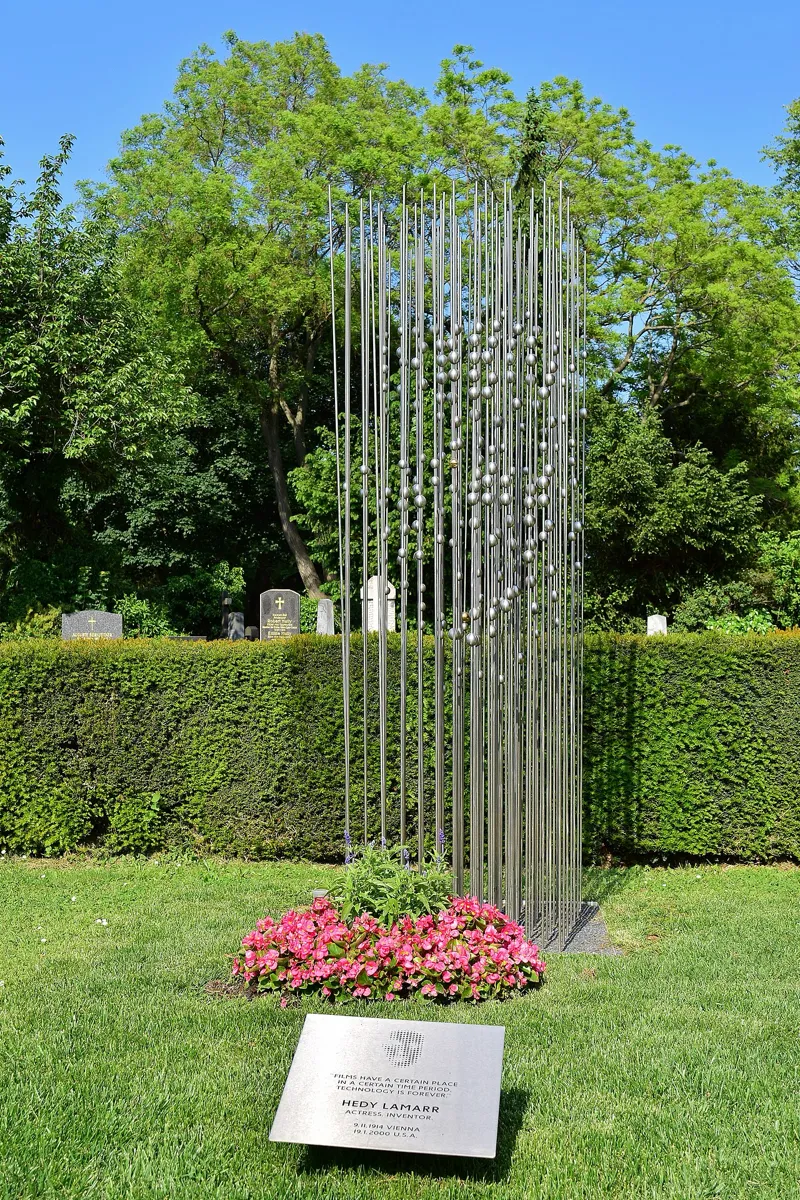
The Escapee
In 1937, a twenty-three-year-old Jewish woman fled her home in Vienna disguised as a maid. She left behind a controlling husband, a mansion full of Nazi guests, and a Europe sliding toward catastrophe. She carried almost nothing. Within a year, she would be the most famous movie star in the world.
Her name was Hedwig Eva Maria Kiesler. Hollywood would know her as Hedy Lamarr. And decades after her death, the world would discover that the woman once called “the most beautiful woman in the world” was also one of its most important inventors.
Vienna’s Jewish Daughter
Lamarr was born on November 9, 1914, in Vienna, to a prosperous assimilated Jewish family. Her father, Emil Kiesler, was a successful bank director. Her mother, Gertrud, had converted from Judaism to Catholicism, but under the racial laws that would soon engulf Europe, the family was Jewish. Young Hedwig grew up surrounded by Viennese culture — music, theater, art, and the intellectual ferment that made Vienna one of the great cities of the early twentieth century.
She was precociously intelligent and strikingly beautiful. By sixteen, she was acting in films. At eighteen, she appeared in the Czech film Ecstasy (1933), which caused a scandal for its brief nudity and became one of the most talked-about films in Europe.
In 1933, at nineteen, she married Fritz Mandl, one of Austria’s wealthiest arms manufacturers. Mandl was controlling and jealous. He tried to buy up every copy of Ecstasy and kept his young wife isolated. But he also entertained lavishly, hosting Mussolini and Hitler at their home, and Lamarr — brilliant and bored — listened carefully to the conversations about military technology.
Hollywood Star
After her escape, Lamarr met Louis B. Mayer, head of MGM, on a transatlantic crossing. He signed her to a contract and renamed her. In Hollywood, she became an immediate sensation, starring in Algiers (1938), Boom Town (1940), and Samson and Delilah (1949). She was the face that launched a thousand magazine covers.
But Lamarr was restless. Acting bored her. “Any girl can be glamorous,” she reportedly said. “All she has to do is stand still and look stupid.” In her spare time, she set up an inventor’s workshop in her home. She worked on improving traffic signals, developing a tablet that could turn water into a flavored drink (a precursor to instant soda), and redesigning airplane wings.
The Invention That Changed the World
After the sinking of a British ship carrying child refugees by a German U-boat in 1940, Lamarr became obsessed with the problem of torpedo guidance. Radio-guided torpedoes could be jammed by the enemy — they would send a signal on the same frequency, confusing the torpedo. Lamarr realized that if the radio signal rapidly hopped between different frequencies, it would be nearly impossible to jam.
She partnered with George Antheil, a avant-garde composer who had experience synchronizing player pianos. Together, they designed a system using a piano-roll mechanism to synchronize frequency hopping between a torpedo and its control ship. They received U.S. Patent 2,292,387 on August 11, 1942.
The Navy rejected the invention. A civilian actress and a composer — it seemed absurd. The patent was classified and filed away. Lamarr was told she could better serve the war effort by selling war bonds (which she did, raising millions).
It was not until the 1960s that the military began using frequency-hopping technology, and not until the digital revolution of the 1990s that Lamarr’s concept became the foundation for wireless communication. Spread spectrum technology — the direct descendant of her patent — underlies WiFi, Bluetooth, GPS, and modern cellular networks. Every time you connect to a wireless network, you are using Hedy Lamarr’s invention.
Later Years and Recognition
Lamarr’s later years were difficult. Her film career faded in the 1950s. She married and divorced six times. She became reclusive, eventually living as a near-hermit in Florida. She had multiple plastic surgeries, as though trying to recapture the beauty that had both defined and trapped her.
Recognition for her invention came late — too late. In 1997, at eighty-three, she received the Electronic Frontier Foundation Pioneer Award. When told of the honor, she reportedly said: “It’s about time.” She died on January 19, 2000, at eighty-five.
Her story embodies a particularly Jewish irony: the refugee who fled fascism to become America’s most glamorous star, whose greatest achievement was dismissed because she was a woman and an actress, whose invention now touches every life on earth. She was, in every sense, a woman ahead of her time.
Frequently Asked Questions
What did Hedy Lamarr invent?
Lamarr co-invented (with composer George Antheil) a frequency-hopping spread spectrum communication system, patented in 1942. Originally designed to prevent radio-guided torpedoes from being jammed, the technology was not used during WWII but later became foundational to WiFi, Bluetooth, GPS, and modern cellular networks.
How did Hedy Lamarr escape Austria?
In 1937, Lamarr fled her first husband, Fritz Mandl, an Austrian arms manufacturer with ties to Mussolini and Hitler. According to her autobiography, she disguised herself as a maid and slipped away during a dinner party. She made her way to London, then to Hollywood, where she was signed by MGM's Louis B. Mayer.
Was Hedy Lamarr recognized for her invention during her lifetime?
Not until very late. Her patent expired in 1959 without ever being used or generating royalties. In 1997, at age 83, she finally received the Electronic Frontier Foundation Pioneer Award and was inducted into the National Inventors Hall of Fame in 2014, after her death in 2000.
Key Terms
Sources & Further Reading
Related Articles
Gal Gadot: From IDF Soldier to Wonder Woman
Gal Gadot went from IDF combat instructor to Miss Israel to Hollywood's most iconic superhero — becoming a symbol of Israeli pride and Jewish strength on the global stage.
Jewish Inventors Who Changed the World
From the polio vaccine to blue jeans, from nuclear science to Google — Jewish inventors and entrepreneurs have shaped the modern world. Meet the innovators whose work touches daily life in ways most people never realize.
Rosalind Franklin: DNA's Hidden Hero
Rosalind Franklin's X-ray crystallography produced Photo 51, the image that revealed DNA's double helix — but Watson and Crick got the credit and the Nobel Prize.