What Is a Synagogue Service Like? A First-Timer's Guide
Walking into a synagogue for the first time can be intimidating. Here is exactly what you will see, hear, and do — from Shabbat morning services to Torah reading — across different denominations.
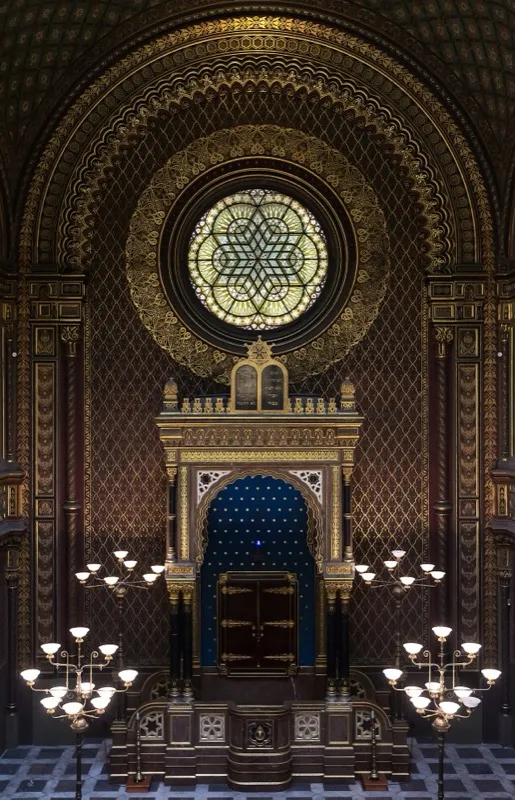
Walking Through the Door
You have been invited to a synagogue service — maybe for a friend’s bar mitzvah, maybe out of curiosity, maybe because your partner’s family expects you there on Saturday morning. You have never been to one before. You do not know Hebrew. You are not sure when to stand, when to sit, or what that scroll thing is.
Take a breath. You are going to be fine. Synagogues are used to visitors, and most congregants are genuinely happy to see a new face. Here is what to expect.
Before You Arrive
Timing: Shabbat morning services typically start between 8:30 and 10:00 AM, depending on the synagogue. Orthodox services start earlier (often 8:30 or 9:00). Reform services tend to start later (10:00 or 10:30). Arriving a few minutes late is normal — many regulars drift in throughout the first section.
Head covering: Men are expected to wear a kippah (yarmulke/skullcap) in virtually all synagogues. There will be a basket of them at the entrance. In egalitarian (Conservative and Reform) synagogues, women may also wear kippot. In Orthodox synagogues, women generally do not, but married women cover their hair with a hat or scarf.
Phones: Turn it off. In Orthodox synagogues, using a phone on Shabbat is prohibited. Even in non-Orthodox synagogues, it is considered disrespectful.
Driving: In Orthodox communities, you should not drive to synagogue on Shabbat (it is prohibited). If you do drive, park a block or two away. In Conservative and Reform communities, driving is accepted.
The Structure of a Shabbat Morning Service
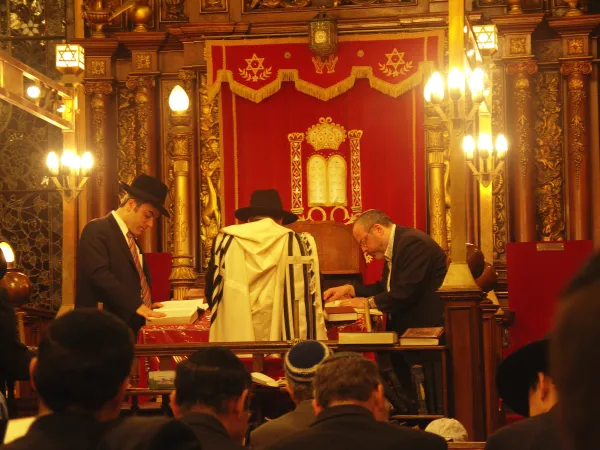
A Shabbat morning service has several major sections. Not every synagogue includes every section, and the length of each varies:
1. Preliminary Prayers (Pesukei d’Zimrah) — 20-40 minutes
The service opens with psalms, blessings, and songs of praise. This section warms up the congregation — building from quiet individual meditation toward communal prayer. In many synagogues, this section is led by a prayer leader or cantor. You will notice people arriving during this section; it is considered the least formal part.
2. Shema and Its Blessings — 10-15 minutes
The Shema — “Hear, O Israel, the Lord our God, the Lord is One” — is the central declaration of Jewish faith. It is recited with great focus. Many people cover their eyes with their hand during the first line. The surrounding blessings discuss creation, God’s love for Israel, and redemption.
3. Amidah (Standing Prayer) — 10-20 minutes
The Amidah is the core prayer of every Jewish service. The congregation stands (the word “amidah” means “standing”) and prays silently. In an Orthodox service, you will see everyone standing, swaying gently, whispering. It is a strikingly intimate moment in the middle of a communal gathering. After the silent Amidah, the prayer leader may repeat it aloud (in Orthodox and some Conservative services).
4. Torah Reading — 30-60 minutes
This is the centerpiece of the Shabbat morning service. The Torah scroll — handwritten on parchment, dressed in a decorative cover — is removed from the ark (the ornate cabinet at the front of the synagogue) in a ceremonial procession. Congregants may touch the scroll with the corner of a prayer shawl or prayer book and then kiss it.
The weekly Torah portion is chanted in Hebrew from the scroll by a designated reader. The reading is divided into seven sections (called aliyot), and different congregants are called up to recite blessings before and after each section. If there is a bar or bat mitzvah, the young person typically reads one of these sections (or the accompanying Haftarah — a reading from the Prophets).
5. The Rabbi’s Sermon (D’var Torah) — 10-20 minutes
The rabbi offers a talk connecting the weekly Torah portion to contemporary life. This is in the local language and is often the most accessible part of the service for newcomers.
6. Musaf (Additional Service) — 15-25 minutes
An additional Amidah prayer specific to Shabbat and holidays. Not all denominations include this — most Reform synagogues skip it.
7. Concluding Prayers and Announcements — 5-10 minutes
Final songs, community announcements, and the closing Adon Olam or Ein Keloheinu hymn. Then: kiddush.
When to Stand, When to Sit
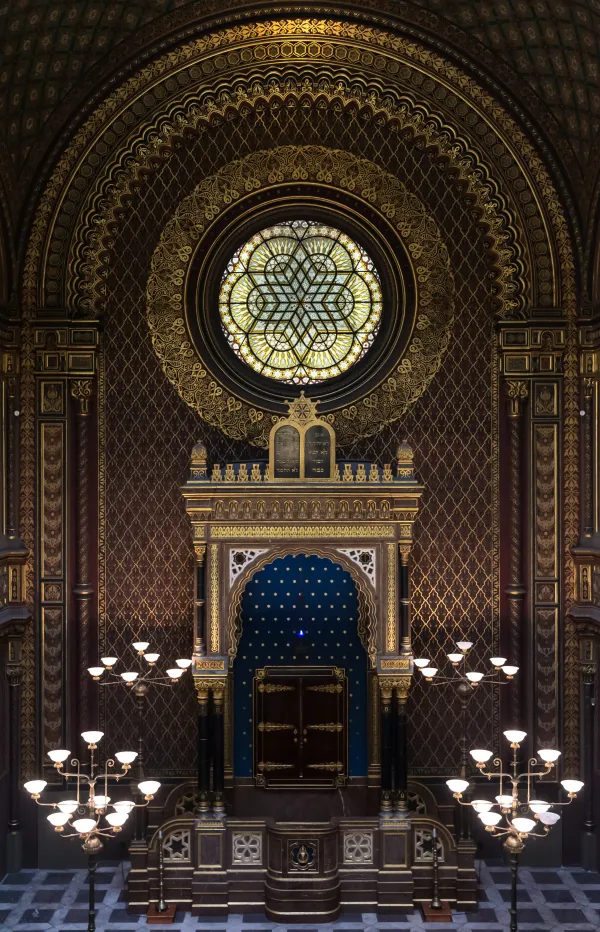
This is the question every first-timer asks. Here are the key moments:
Stand for:
- The Amidah (the long silent prayer — you will know because everyone stands)
- The Barchu (call to prayer — the leader says “Bar’chu et Adonai ham’vorach” and everyone rises)
- Opening and closing the ark
- The Torah procession (when the scroll is carried around the room)
- Aleinu (a concluding prayer, near the end)
Sit for:
- Most of the Torah reading
- The sermon
- Most psalms and songs
The golden rule: Watch the people around you. If they stand, you stand. If they sit, you sit. Nobody will judge you for being half a second behind.
Orthodox vs. Conservative vs. Reform
The differences are significant:
| Feature | Orthodox | Conservative | Reform |
|---|---|---|---|
| Seating | Men and women separate (mechitzah) | Together | Together |
| Language | Mostly Hebrew | Mix of Hebrew and English | Significant English |
| Length | 2.5-3+ hours | 2-2.5 hours | 75-90 minutes |
| Music | No instruments on Shabbat | Sometimes organ/guitar | Often instruments and choir |
| Torah reading | Full weekly portion in Hebrew | Full or abbreviated | Abbreviated, sometimes English |
| Women’s participation | Women do not lead, read Torah, or have aliyot | Full participation | Full participation |
| Prayer book | Traditional siddur (all Hebrew) | Bilingual (Lev Shalem or Sim Shalom) | Bilingual (Mishkan T’filah) |
After the Service: Kiddush
Almost every synagogue hosts a kiddush (light reception) after services — grape juice or wine, challah, and snacks. In some communities, the kiddush is an elaborate spread; in others, it is crackers and herring. This is the social part. It is where you meet people, chat with the rabbi, and eat. Do not skip it — it is often the best part for a visitor.
What Not to Worry About
- Making mistakes. Everyone does. Even regulars occasionally stand when they should sit.
- Not knowing Hebrew. Follow in English. The experience is valid even if you do not understand every word.
- Being noticed. You will be — but in a welcoming way. People may approach you to say hello or offer to help you follow along. Accept graciously.
- Photography. Do not take photos during the service, especially in Orthodox synagogues where photography on Shabbat is prohibited.
Summing Up
A synagogue service is part worship, part community gathering, part ancient ritual preserved in living practice. It can feel long, unfamiliar, and deeply beautiful — sometimes all at once. The best approach is to show up, be respectful, follow the crowd, and let the experience wash over you. You do not need to understand everything to feel something.
Frequently Asked Questions
How long is a typical Shabbat morning service?
It varies significantly by denomination. An Orthodox Shabbat morning service typically runs 2.5 to 3 hours. Conservative services are usually about 2 to 2.5 hours. Reform services are generally shorter — about 75 to 90 minutes. The length depends on the congregation, whether there is a bar/bat mitzvah that week, and how much the rabbi and cantor elaborate.
Do I need to know Hebrew to attend?
No. Most non-Orthodox synagogues use prayer books with English translations alongside the Hebrew. Even in Orthodox synagogues, the rabbi's sermon is in the local language. You can follow along in English, and no one will expect you to read Hebrew on your first visit. Focus on the overall experience rather than understanding every word.
What should I wear to synagogue?
Dress modestly and respectfully. For men in an Orthodox synagogue: long pants, a collared shirt, and a kippah (head covering — they are usually available at the door). For women in an Orthodox synagogue: skirts below the knee, sleeves past the elbow, no low necklines. In Reform and Conservative synagogues, the dress code is more relaxed — business casual is a safe bet. When in doubt, err on the side of more formal.
Sources & Further Reading
Related Articles
Orthodox, Conservative, and Reform: Understanding Jewish Denominations
Judaism is not monolithic — it encompasses diverse movements from Ultra-Orthodox to Reform, each with its own approach to tradition, law, and modern life.
Shabbat: The Weekly Day of Rest
Every week, Jewish life pauses for 25 hours of rest, reflection, and togetherness — discover the beauty of Shabbat.
The Synagogue: House of Prayer, Study, and Assembly
More than just a place of worship — the synagogue is the heart of Jewish community life, combining prayer, learning, and social gathering under one roof.