The Jewish Prophets: Voices of Justice and Vision
From Isaiah's visions of peace to Amos's thundering demand for justice, the Jewish prophets shaped not only Judaism but the moral imagination of the world. Meet the major and minor prophets and their enduring message.
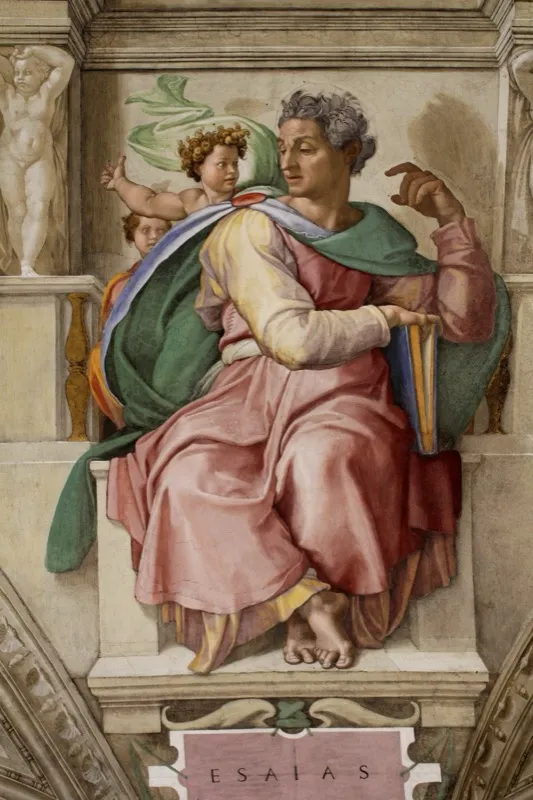
The Voice in the Wilderness
Imagine a man walking into the royal court of ancient Israel — uninvited, unwashed, wearing rough garments — and pointing his finger at the king. “You have sinned,” he says. Not whispering. Not suggesting. Declaring, with the full weight of heaven behind him.
This is the prophet. And in no other ancient civilization did such a figure exist quite like this: a person who spoke for God not to comfort the powerful but to challenge them, not to confirm the status quo but to shatter it.
The Hebrew word for prophet, navi, likely derives from a root meaning “to call” or “to announce.” The prophet is one who has been called by God and announces God’s word — often against the prophet’s own wishes. Moses protested. Jeremiah wept. Jonah ran away. Prophecy, in the Jewish tradition, is not a career choice. It is an interruption.
The Major Prophets
Isaiah: The Vision of Peace
Isaiah son of Amoz prophesied in Jerusalem during the 8th century BCE, a turbulent period when the Assyrian Empire threatened to swallow Israel whole. His book — the longest of the prophetic books at 66 chapters — contains some of the most soaring language in all of scripture.
Isaiah gave the world the vision of universal peace: “They shall beat their swords into plowshares and their spears into pruning hooks; nation shall not lift up sword against nation, neither shall they learn war anymore” (Isaiah 2:4). These words are inscribed on the wall across from the United Nations building in New York.
Many scholars divide the Book of Isaiah into at least two sections: First Isaiah (chapters 1-39), set during the Assyrian crisis, and Second Isaiah (chapters 40-66), written during or after the Babylonian exile. Second Isaiah opens with words of breathtaking comfort: “Comfort, comfort my people, says your God. Speak tenderly to Jerusalem” (Isaiah 40:1-2).
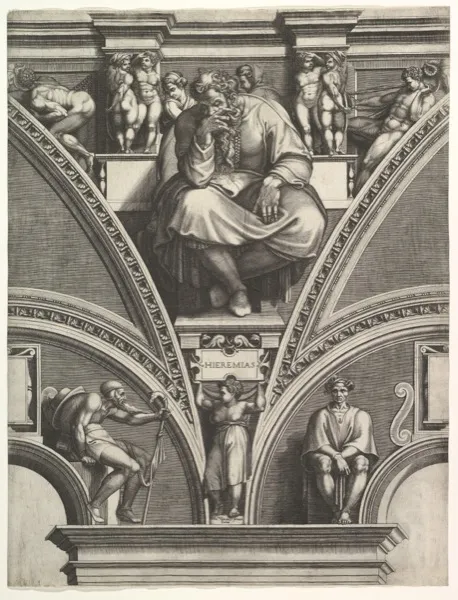
Jeremiah: The Weeping Prophet
Jeremiah prophesied in Jerusalem in the decades leading up to the destruction of the First Temple in 586 BCE. He is often called the “weeping prophet” because of his anguished tone and the personal suffering he endured. He was thrown into a pit, imprisoned, mocked, and threatened with death — all for delivering a message nobody wanted to hear: Jerusalem would fall.
But Jeremiah’s message was not only destruction. Even as the Babylonian army besieged Jerusalem, he purchased a field in his hometown of Anathot — an act of radical hope. “Houses and fields and vineyards shall again be bought in this land” (Jeremiah 32:15). In the very act of forecasting disaster, he planted a seed of return.
Jeremiah also articulated one of Judaism’s most revolutionary ideas — the “new covenant” written on the heart: “I will put My Torah within them, and write it on their hearts” (Jeremiah 31:33). For Jews, this is not about replacing the Torah but about internalizing it — making it second nature.
Ezekiel: The Visionary of Exile
Ezekiel prophesied among the Babylonian exiles, and his book is the strangest of the three. It opens with a vision of God’s chariot (merkavah) — four living creatures with four faces, wheels within wheels, flashing fire — that became the foundation of Jewish mysticism. The rabbis considered this vision so dangerous that they restricted its study.
Ezekiel’s most famous passage is the Valley of Dry Bones (chapter 37): God leads the prophet to a valley filled with skeletal remains and asks, “Can these bones live?” At God’s command, the bones reassemble, flesh covers them, breath enters them, and they stand — “a vast army.” The vision is about national resurrection, the return of Israel from exile, but it has resonated through centuries as a symbol of hope after catastrophe, including after the Holocaust.
The Twelve Minor Prophets
The twelve “minor” prophets — Trei Asar in Aramaic — are grouped as a single book in the Tanakh. Their brevity should not be mistaken for insignificance. Some of the most quoted lines in all of Jewish tradition come from these small books:
- Hosea: Uses the metaphor of a troubled marriage to describe God’s relationship with Israel. “I desire mercy, not sacrifice” (6:6).
- Joel: The Day of the Lord and the outpouring of the spirit. “Your old shall dream dreams, your young shall see visions” (3:1).
- Amos: A shepherd from Tekoa who delivers the most searing social critique in the Bible. “Let justice roll down like waters, and righteousness like an ever-flowing stream” (5:24).
- Obadiah: The shortest book in the Tanakh — a single chapter about the judgment of Edom.
- Jonah: Not a typical prophetic book but a narrative about a reluctant prophet, a great fish, and God’s mercy extending even to Israel’s enemies.
- Micah: Distills the prophetic message to its essence: “What does the Lord require of you? Only to do justice, love mercy, and walk humbly with your God” (6:8).
- Nahum: The fall of the Assyrian Empire.
- Habakkuk: A philosophical prophet who questions God’s justice directly. “The righteous shall live by their faith” (2:4).
- Zephaniah: Judgment and restoration. A fierce warning followed by a tender promise.
- Haggai: Urges the returning exiles to rebuild the Temple.
- Zechariah: Messianic visions. “Not by might, nor by power, but by My spirit” (4:6).
- Malachi: The last of the prophets. His book closes with the promise of Elijah’s return before “the great and terrible day of the Lord.”
The Haftarah Connection
Every Shabbat, after the Torah reading in synagogue, a selection from the Prophets is chanted — this is called the Haftarah. The Haftarah is thematically linked to the Torah portion of the week, creating a conversation between the Torah and the Prophets across the centuries.
For example, when the Torah portion tells of the binding of Isaac, the Haftarah from Jeremiah speaks of God’s enduring love for Israel. When the Torah portion describes the building of the Tabernacle, the Haftarah from Kings describes Solomon building the Temple. These pairings are ancient — they may date to a period when Torah reading was restricted by foreign rulers and the Prophets served as substitutes.
Social Justice: The Prophetic Core
What sets the Jewish prophets apart from other ancient religious figures is their relentless focus on social justice. They are not primarily interested in theology or mystical experience (though both appear). Their central concern is how people treat each other — especially how the powerful treat the vulnerable.
Isaiah rails against those who “join house to house and field to field” — ancient real estate moguls squeezing out the poor. Amos condemns those who “sell the righteous for silver and the needy for a pair of sandals.” Micah accuses rulers who “tear the skin off my people and the flesh off their bones.”
Rabbi Abraham Joshua Heschel, in his landmark 1962 study The Prophets, described the prophetic consciousness as “divine pathos” — God feeling the suffering of the oppressed. The prophet does not merely report God’s words; the prophet feels God’s feelings. When the poor are crushed, God is wounded. The prophet’s outrage is God’s outrage.
The End of Prophecy
According to the Talmud, prophecy departed from Israel with the deaths of Haggai, Zechariah, and Malachi in the early Second Temple period. After them, divine communication continued through the Bat Kol — a faint “echo” of a heavenly voice — and through the interpretive work of the rabbis.
Why did prophecy end? Some say the spiritual level of the generations declined. Others suggest that prophecy was no longer needed once the Torah and its interpretation were fully established. The Hasidic tradition proposes a more radical reading: prophecy did not end — it was democratized. Every sincere prayer, every genuine act of compassion, every moment of deep insight contains a spark of the prophetic spirit.
The prophets may have fallen silent centuries ago, but their words remain the loudest in the room. “Let justice roll down like waters.” We are still listening.
Frequently Asked Questions
How many prophets are there in Judaism?
The Talmud states that there were 48 male prophets and 7 female prophets (Sarah, Miriam, Deborah, Hannah, Abigail, Huldah, and Esther) whose prophecies were recorded for future generations. However, it adds that many more prophets existed whose messages were relevant only to their own time and were not preserved in scripture.
What is the difference between major and minor prophets?
The terms 'major' and 'minor' refer only to the length of their books, not their importance. The three major prophets — Isaiah, Jeremiah, and Ezekiel — each have long books. The twelve minor prophets (Hosea through Malachi) have shorter books and are grouped together as a single volume called the Trei Asar (Twelve) in the Tanakh.
When did prophecy end in Judaism?
According to the Talmud (Sanhedrin 11a), prophecy departed from Israel after the deaths of the last prophets — Haggai, Zechariah, and Malachi — around the early Second Temple period (5th century BCE). After that, guidance came through the Bat Kol (divine echo) and rabbinic interpretation rather than direct prophetic revelation.
Sources & Further Reading
Related Articles
The Synagogue: House of Prayer, Study, and Assembly
More than just a place of worship — the synagogue is the heart of Jewish community life, combining prayer, learning, and social gathering under one roof.
The Tanakh: A Complete Guide to the Hebrew Bible
The Tanakh — Torah, Nevi'im, and Ketuvim — is the foundational scripture of Judaism, containing 24 books of law, prophecy, and wisdom. Learn how it was formed and how it differs from the Christian Old Testament.
The Torah: The Heart of Judaism
The Torah is more than a book — it is the living constitution of Jewish life, studied and debated for over three millennia.