Mussar: Jewish Self-Improvement
Mussar is Judaism's discipline of ethical self-improvement — a centuries-old practice of cultivating character traits (middot) through study, meditation, and daily practice, revived for the modern age.

The Rabbi Who Noticed Something Wrong
In 19th-century Lithuania, Jewish learning was at an extraordinary peak. Yeshivot were producing brilliant Talmudic scholars. Halakhic expertise was more refined than ever. Jewish men spent years — sometimes decades — mastering the intricacies of Jewish law.
And yet, a young rabbi named Israel Lipkin Salanter (1810-1883) noticed a disturbing disconnect. Scholars who were meticulous about the laws of Shabbat could be cruel to their families. Businessmen who would never eat a morsel of non-kosher food cheated their employees. Jews who prayed three times daily slandered their neighbors without a second thought.
The problem, Salanter concluded, was not a lack of knowledge. It was a lack of character work. Knowing the right thing and doing the right thing were separated by an enormous gap — a gap that intellectual study alone could not bridge. Something more was needed: a systematic discipline of ethical self-improvement.
That discipline was Mussar.
Ancient Roots
The word mussar appears throughout the Hebrew Bible, meaning “instruction,” “discipline,” or “correction.” The book of Proverbs alone uses it dozens of times: “The beginning of wisdom is the fear of the Lord; fools despise wisdom and mussar” (Proverbs 1:7).
Ethical literature has been part of Judaism for millennia:
- Pirkei Avot (Ethics of the Fathers, ~200 CE): The Mishnah’s tractate on moral wisdom, containing maxims from generations of rabbis
- Chovot HaLevavot (“Duties of the Heart,” Bahya ibn Paquda, 11th century): A systematic treatment of inner spiritual life
- Orchot Tzaddikim (“Ways of the Righteous,” anonymous, 15th century): A guide to character traits organized around virtues and vices
- Mesillat Yesharim (“Path of the Just,” Rabbi Moshe Chaim Luzzatto, 1740): Perhaps the most influential Mussar text, laying out a ladder of spiritual development from watchfulness to holiness
What Salanter did was transform these scattered traditions into a movement — with institutions, methods, and a passionate urgency.
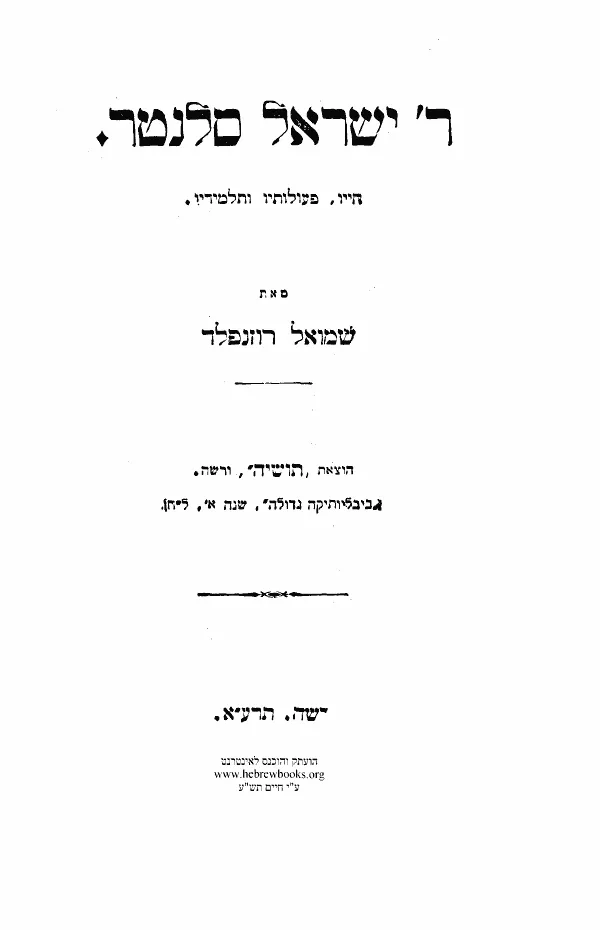
Salanter’s Revolution
Salanter’s central insight was psychological: intellectual understanding does not automatically produce behavioral change. You can know perfectly well that anger is destructive and still lose your temper. You can believe in the value of generosity and still be stingy. The distance between the head and the heart is vast.
To bridge this gap, Salanter developed a method:
1. Study with emotion (hitpa’alut): Don’t just read ethical texts — read them aloud, with feeling, repeatedly, until they penetrate not just the intellect but the emotions. Salanter would have students read passages from Mesillat Yesharim in a darkened room, chanting them with intensity, allowing the words to seep into the subconscious.
2. Self-examination (cheshbon hanefesh): Regular, honest inventory of your character — identifying your specific weaknesses and tracking your progress. This practice resembles what modern psychology calls “self-monitoring” and what mindfulness traditions call “self-awareness.”
3. Daily practice: Choose one middah (character trait) to focus on for a period — often a week or a month — and practice it in concrete situations throughout the day. If you are working on patience, deliberately place yourself in situations that test patience. If you are working on generosity, give something away every day.
4. Community accountability: Practice in groups (vaad or chaburah), where members support each other, share struggles, and hold one another accountable.
Salanter established Mussar houses (batei mussar) — rooms dedicated to ethical study and contemplation, separate from the yeshiva study hall. He trained disciples who carried the movement to yeshivot across Lithuania.
The Middot: Character Traits
At the heart of Mussar practice is work on specific middot — the character traits that define who we are. Key middot include:
- Anavah (humility): Not self-deprecation but accurate self-assessment — knowing your place without arrogance or false modesty. “Who is wise? One who learns from every person” (Pirkei Avot 4:1)
- Savlanut (patience): The ability to bear difficulty, delay, and frustration without reactivity. Patience is not passivity — it is the strength to respond thoughtfully rather than react impulsively
- Hakarat hatov (gratitude): Literally “recognizing the good” — cultivating awareness of the blessings in your life, from the magnificent to the mundane
- Nedivut (generosity): Giving freely — of resources, time, attention, and spirit. Generosity extends far beyond money
- Emet (truth): Living with integrity and honesty — not just avoiding lies but aligning your inner life with your outer behavior
- Seder (order): Bringing discipline and structure to daily life — not as rigidity but as the framework that makes meaningful action possible
- Bitachon (trust): A deep sense that life is ultimately meaningful and trustworthy, even when circumstances are difficult
- Chesed (lovingkindness): Active compassion — going beyond what is required to help others
Mussar teaches that every person has a unique constellation of strengths and weaknesses. Some people naturally excel at generosity but struggle with patience. Others are naturally orderly but lack spontaneous compassion. The goal is not to achieve perfection in all traits but to identify your specific areas of growth and work on them with dedication.
Salanter’s Famous Stories
Salanter was known for his pointed observations about the gap between ritual and ethics:
- He once said: “A person’s face is a public space” — meaning that your facial expression affects everyone around you. Walking around looking angry or miserable is a form of ethical failure
- When he discovered that a bakery was forcing workers to work all night before Passover to produce matzah, Salanter declared: “I cannot certify this matzah as kosher. It may be free of chametz, but it is baked with the sweat of exploited workers”
- He reportedly told his students: “I used to worry about my own soul and other people’s bodies. Now I worry about other people’s souls and my own body” — a shift from self-righteous judgment to compassionate responsibility

The Three Schools
After Salanter, the Mussar movement developed into three main approaches, each emphasizing different aspects:
The Kelm School (founded by Simcha Zissel Ziv): Emphasized careful, measured self-observation and mindful awareness. The Kelm approach was disciplined and analytical — students kept detailed journals of their character traits and progress.
The Slabodka School (founded by Nosson Tzvi Finkel, the “Alter of Slabodka”): Emphasized gadlut ha’adam — the greatness of the human being. Rather than focusing on human weakness, Slabodka Mussar stressed human potential and dignity. If you treat yourself as great, you will behave greatly.
The Novardok School (founded by Yosef Yozel Horwitz): The most radical approach — emphasizing bitul ha’yesh (negation of the self) through extreme exercises in humility. Novardok students deliberately put themselves in embarrassing situations to overcome their attachment to self-image.
Destruction and Revival
The Mussar movement was centered in Lithuanian Jewry, and Lithuanian Jewry was nearly annihilated in the Holocaust. The yeshivot were destroyed. The Mussar houses were burned. The students were murdered.
After the war, surviving Mussar teachers reestablished yeshivot in Israel and America. But the movement remained largely within the Orthodox world — and even there, it was often overshadowed by the emphasis on Talmud study.
The modern Mussar revival began in the early 2000s, driven largely by Alan Morinis, a Canadian filmmaker and writer who discovered Mussar during a personal crisis. His 2007 book Everyday Holiness introduced Mussar to a broad audience, and his Mussar Institute now offers programs to people of all backgrounds — Orthodox, Conservative, Reform, secular, and even non-Jewish.
Today, Mussar groups meet in synagogues, community centers, and living rooms across denominations. The practice has found resonance in an age of self-help culture, mindfulness movements, and the perennial human desire for personal growth. What distinguishes Mussar from secular self-improvement is its rootedness in Jewish wisdom — the conviction that character development is not just psychologically beneficial but spiritually essential.
Practice Over Perfection
Mussar is not about becoming perfect. It is about becoming conscious. The goal is to shrink the gap between the person you are and the person you want to be — one middah, one day, one interaction at a time.
As Salanter taught: “The loudest sound in the universe is the sound of a person changing.” The change may be invisible to others. But in the tradition of Jewish ethics, the inner life is where the real work happens — and every moment of genuine self-improvement reverberates through the world.
Frequently Asked Questions
What is Mussar?
Mussar (also spelled Musar) is a Jewish ethical and spiritual discipline focused on character development. The word comes from the Hebrew for 'instruction' or 'discipline.' Mussar involves identifying your specific character weaknesses, studying ethical texts related to those traits, and practicing concrete exercises to strengthen your character. It can be understood as Judaism's answer to the question: How do I become a better person?
What are middot?
Middot (singular: middah) are character traits or virtues in Jewish tradition. Key middot include anavah (humility), savlanut (patience), hakarat hatov (gratitude), nedivut (generosity), emet (truth/integrity), seder (order/discipline), bitachon (trust), and chesed (lovingkindness). Mussar practice involves working on specific middot through study, meditation, journaling, and practical exercises.
Do I need to be religious to practice Mussar?
No. While Mussar has deep roots in Jewish tradition and draws on religious texts, the modern Mussar revival has attracted practitioners from all backgrounds — secular Jews, non-Jews, and people of various faiths. Organizations like the Mussar Institute offer programs that are accessible to anyone interested in character development, regardless of religious background or belief.
Sources & Further Reading
Related Articles
Orthodox, Conservative, and Reform: Understanding Jewish Denominations
Judaism is not monolithic — it encompasses diverse movements from Ultra-Orthodox to Reform, each with its own approach to tradition, law, and modern life.
Jewish Ethics: A Guide to Moral Living
From Hillel's golden rule to the Mussar movement, Jewish ethics offers a comprehensive framework for moral living — covering speech, the environment, labor rights, medical decisions, and the obligation to repair the world.
The Talmud: A Beginner's Guide to Jewish Oral Law
The Talmud is the vast ocean of Jewish thought — centuries of rabbinic debate on law, ethics, storytelling, and the meaning of life, all compiled into one extraordinary work.